Who Says Childhood Is a Happy Period?
We are starting with the 19th sarga of the vairagya prakarana of Yooga Vasishta.
Everyone extolls childhood as a period of ananda, unlimited happiness.
Even Brihadaranyaka Upanishad says...
The Lord is telling Sage Vishwamitra —
This world is an ocean. There is no time when it is quiet. It is full of waves.
These waves are the various actions which keep on happening relentlessly in the world.
It is full of animals.
The four kinds of animals – those which take birth from the mother’s body, those which hatch out of eggs, those which sprout out of seed, and various other kinds of micro organisms which multiply by various means.
They say to be born as a human being is very rare.
Only after going through thousands of births you get to take birth as a human being.
But then, as soon as he takes birth, why is there so much suffering?
Physical debility, total lack of freedom of movement.
An infant is completely dependent on someone else even for basic movement.
Forget walking around, even for turning its side on the bed, it will not be able to do on its own. There is no strength in its limbs.
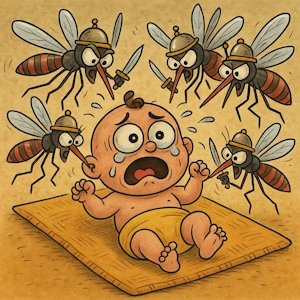
A bee or a wasp is attacking the child, a mosquito is biting — can the child do anything on its own?
It cannot defend itself. It cannot even move away to safety.
It feels hungry, thirsty — except crying, what can the child do?
It can't make food. It can't even drink a glass of water on its own.
It can cry miserably, that's all.
Its stomach aches — it's because of something that is wrong with the food that you gave.
Can the child even tell you where it is aching?
It doesn’t even have words.
It may not even realize that it is the food that you gave.
It can't even reprimand you.
There is no intelligence.
You are putting too much salt in the food.
Can the child realize this and tell you?
Or too little sugar?
No. It can only cry.
The child’s stomach is bloated.
The child wants to skip a meal. Can it realize this and tell you?
The child wants to play. Run around and play. It is bound. Bound to the bed.
Or bound to the pram, or your shoulder.
Absolutely no freedom to do anything at all.
If an elephant gets angry all of a sudden, cries loudly — what do we do?
We immediately tie the elephant to a pillar with strong chains, thinking that something is wrong.
Then after a few days, if you see what that place will look like — it's a pity to look at that place.
The child is also bound to the bed like this.
Maybe it cries without reason. That’s why it is not given freedom.
Infancy is a period of incarceration. Where is ananda in it for the child?
Crying, crying, crying — for anything and everything, crying.
Crying for nothing also. Where is ananda in childhood?
Even in old age, when you are bound to bed, you are not so much dependent on others. You can at least express yourself — what you want.
Even a prisoner has more freedom.
Infancy is worse than these.
Soiling the place where you live — only birds and animals do this.
Except in cattle shed, where do you see beings living in the middle of their own dung and urine?
Except in the bird nest, where do you see their own droppings?
A child — unless the mother or the attendant cleans up — it is forced to sleep in its own excreta.
Is this the ananda of childhood?
A child would cry a lot. Not only when the child is hungry.
Even after being fed, the child cries.
We are puzzled — for what?
Maybe the child has so many desires, unfulfilled.
It gets disappointed and angry when they are not fulfilled.
It gets frustrated and cries.
The child can't do anything else.
Except cry. Otherwise, why should the child cry every now and then?
Who says childhood is a happy period of life?
An adult has to be careful in life at every step.
You can slip and fall. You can burn yourself in the kitchen.
Or even when drinking coffee, you can end up burning your mouth.
You can catch diseases unless you take care of yourself — to heat, wind, rain, cold weather.
Even for an adult — every step he has to be cautious and careful.
The life is full of dangers.
Only the child’s situation is worse than that.
If an adult sees that the ceiling fan is shaking violently and can fall on his head any time, he can run away.
Will the child be able to do this?
Even if the child — suppose — realizes that it is going to fall, can the child do anything about it? Even call for help?
Lord is asking — what is so praiseworthy about infancy, childhood?
-
Childhood is often praised as a time of happiness, but it is actually filled with helplessness, dependence, and suffering.
-
A newborn has no strength or mobility and is entirely reliant on others for even the most basic actions.
-
The infant cannot defend itself from discomfort or threats like hunger, insects, or illness, and can only cry in response.
-
It lacks the ability to express needs clearly or understand what is causing pain, making communication impossible.
-
Even basic bodily needs like eating or toileting are unmanageable for the child without assistance.
-
The child lives in unclean conditions unless constantly attended to, sometimes forced to remain in its own waste.
-
Crying is often unrelated to hunger; it reflects deeper frustration, unfulfilled desires, or inner unrest.
-
Infancy resembles imprisonment — complete lack of freedom, bound physically and mentally without control.
-
Adults have dangers in life, but they also have awareness, speech, and the ability to act in self-defense.
-
Compared to adults, infants face greater vulnerability because they cannot avoid or even report danger.
-
While human birth is considered rare and precious, the initial stage of life is riddled with misery and powerlessness.
What does the helplessness of infancy show us about childhood?
It shows that childhood is not the joyful phase it's assumed to be. It begins with total dependence, lack of freedom, and constant discomfort, where even turning on the bed or escaping a mosquito bite is impossible without help.
Why do people still think childhood is a blissful time?
Because they remember it from the outside — through photos, stories, or their own adult perspective. But the child's inner experience, filled with helplessness and frustration, is rarely acknowledged.
Isn't childhood naturally joyful before stress sets in later?
Joy isn't automatic. A child may be free from responsibilities, but also lacks basic control, strength, and communication. Without these, happiness becomes inaccessible despite the absence of adult stress.
Why is crying the only option for a child?
Because the child has no language, no strength, and no decision-making ability. When it's hungry, hurt, or uncomfortable, the only signal it can send is crying — it's a biological fallback, not an emotional expression.
What if a child cries even after being fed and cleaned?
It likely reflects internal frustrations, unmet desires, or physical unease it can't identify. Just like adults feel unsettled when things go wrong without knowing why, infants too experience distress without clarity.
Isn't crying a normal part of development?
Yes, but the point is not that crying is abnormal — it's that it highlights the severe helplessness of infancy. If a stage of life revolves around crying as the main tool for survival, it's hardly a phase of joy.
What does 'bound like an elephant' mean in this context?
It compares the physical restriction of infants — tied to beds, cribs, or shoulders — to elephants restrained when deemed unstable. The child, like the elephant, is restricted not out of safety, but because it can't be trusted to act safely on its own.
Isn't that just care and protection?
Partly, yes. But it also reflects the child's utter lack of agency. Unlike an adult who is restrained only when harmful, the child is restrained by default because it simply cannot function freely.
Isn't this a bit extreme to compare a baby to a prisoner or an animal?
The comparison isn't meant to insult but to reveal truth. Just as animals are confined for safety, children too live without freedom or privacy. The similarity helps us question romanticized views of early life.
Why is childhood compared to living in filth?
Because without help, a child soils its surroundings and lies in it. Like birds in nests or cattle in sheds, children are unaware and unable to maintain hygiene, showing how far they are from the dignity adults enjoy.
Is that really such a problem if the caregiver is attentive?
Of course, with care the child is kept clean. But the key point is — the child cannot help itself. That dependence, not the dirt, is what makes it undignified and stressful from the child's point of view.
But don't animals also live this way?
Exactly — and that's the argument. Unlike humans, animals are not expected to rise above this. If the most celebrated stage of human life resembles animal existence, we need to rethink what we're celebrating.
What kind of danger is a child more exposed to than an adult?
An adult can see threats and act — like avoiding a falling ceiling fan or walking away from heat. A child can't move, can't warn, and can't escape even if it senses the danger.
Isn't that why adults are always nearby?
Ideally yes. But supervision isn't constant or perfect. The child's vulnerability remains — even a few seconds of delay can mean injury or distress that the child can't even report.
But isn't danger just a part of life? Why single out childhood?
Because danger combined with helplessness is different from danger with awareness. Adults can act and speak. A child faces the same threats with none of the tools, making its condition far worse.
Why is infancy called a 'rare but miserable' phase?
Because even though human birth is rare and valuable (after thousands of lives), its beginning is marked by suffering, not joy. The rarity doesn’t guarantee comfort — it only gives the chance for future growth.
Why suffer right after such a rare birth?
To highlight that privilege doesn't protect you from struggle. Even a long-earned human birth starts with tests — helplessness, pain, and dependence — so that growth becomes necessary, not optional.
Isn’t the value of life more important than how it begins?
Yes, but recognizing the harsh start helps us understand the full journey. If we ignore the pain of infancy, we build false narratives around life’s worth and skip the lessons of humility it offers.






English
Yoga Vasishta
Click on any topic to open
7
30
Astrology
Bhagavad Gita
Bhagavatam
Bharat Matha
Devi
Devi Mahatmyam
Ganapathy
Garuda Puranam
Glory of Venkatesha
Hanuman
Kathopanishad
Mahabharatam
Mantra Shastra
Mystique
Practical Wisdom
Purana Stories
Radhe Radhe
Ramayana
Rare Topics
Rigveda Explained
Rituals
Sages and Saints
Shiva
Spiritual books
Sri Suktam
Story of Sri Yantra
Temples
Vedas
Vishnu Sahasranama
Yoga Vasishta
26
17
10
0


