Pandu’s Tapas and the Limits of Human Effort
(Mahabharata – Aadi Parva 1.125)
1. The Character of Pandu
तत्रापि तपसि श्रेष्ठे वर्तमानः स वीर्यवान्।
सिद्धचारणसङ्घानां बभूव प्रियदर्शनः॥
सुश्रूषुरनहंवादी संयतात्मा जितेन्द्रियः।
स्वर्गं गन्तुं पराक्रान्तः स्वेन वीर्येण भारत॥
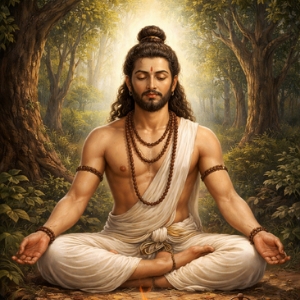
Pandu lived established in the highest austerity.
Powerful, yet gentle, he was pleasing even to Siddhas and Cāraṇas.
He was devoted to service, free from arrogance, restrained in speech, self-controlled, and victorious over his senses.
Reflection:
This is not the portrait of a king seeking heaven— it is the portrait of a man who has already made his life worthy of heaven.
2. Loved as Brother, Friend, and Son
केषांचिदभवद्भ्राता केषांचिदभवत्सखा।
ऋषयस्त्वपरे चैनं पुत्रवत्पर्यपालयन्॥
To some he was a brother, to some a friend, and to many sages he was cherished and protected like a son.
Insight:
Authority commands obedience, purity commands affection.
Pandu ruled not by fear, but by inner alignment with dharma.
3. A King Becomes Like a Brahmarshi
स तु कालेन महता प्राप्य निष्कल्मषं तपः।
ब्रह्मर्षिसदृशः पाण्डुर्बभूव भरतर्षभ॥
With the passage of time, through faultless tapas,
Pandu became like a Brahmarshi.
Question:
How can a king become a Brahmarshi without abandoning kingship?
Answer:
By abandoning ego, not responsibility.
4. The Sages’ Journey to Brahmaloka
अमावास्यां तु सहिता ऋषयः संशितव्रताः।
ब्रह्माणं द्रष्टुकामास्ते संप्रतस्थुर्महर्षयः॥
On the day of Amāvasyā, great sages firm in vows set out,
desiring to behold Brahmā.
Seeing them, Pandu asks:
भवन्तः क्व गमिष्यन्ति ब्रूत मे वदतां वराः॥
'Where are you all going, O best among speakers?'
The sages reply:
समावायो महानद्य ब्रह्मलोके महात्मनाम्।
देवानां च ऋषीणां च पितॄणां च महात्मनाम्॥
वयं तत्र गमिष्यामो द्रष्टुकामाः स्वयंभुवम्॥
'There is a great assembly in Brahmaloka—
of gods, sages, and forefathers.
We go there to see the Self-born Lord.'
Insight:
Brahmaloka is not a private reward—it is a cosmic gathering.
5. Pandu Attempts the Impossible Path
पाण्डुरुत्थाय सहसा गन्तुकामो महर्षिभिः।
स्वर्गपारं तितीर्षुः स शतशृङ्गादुदङ्मुखः॥
Pandu rose instantly, wishing to go with the sages,
attempting to cross into heaven from Mount Śataśṛṅga.
The path is described as terrifying and transcendent:
नातिक्रामेत पक्षी यान्कुत एवेतरे मृगाः।
वायुरेको हि यात्यत्र सिद्धाश्च परमर्षयः॥
Not even birds can cross these regions—
only wind, Siddhas, and supreme sages.
Seeing Pandu with his two wives, the sages say:
न सीदेतामदुःखार्हे मा गमो भरतर्षभ॥
'Do not grieve. Do not proceed further.'
Deep truth:
Even holiness has jurisdictions.
6. Pandu’s Inner Wound: Childlessness
Pandu replies:
अप्रजस्य महाभागा न द्वारं परिचक्षते।
स्वर्गे तेनाभितप्तोऽहमप्रजस्तु ब्रवीमि वः॥
'For one without progeny, no gate to heaven is spoken of.
This burns me—I am childless, I speak the truth.'
अनपत्योऽपि विन्देयं स्वर्गमुग्रेण कर्मणा॥
Even without children, I wish to attain heaven through fierce effort.
Question:
Is heaven denied due to lack of virtue?
Answer:
No. It is delayed due to incomplete cosmic obligation.
7. The Sages Reveal Destiny
अपत्यमनघं राजन्वयं दिव्येन चक्षुषा।
दैवोद्दिष्टं नरव्याघ्र कर्मणेहोपपादय॥
O king, through divine sight we know—
you shall have faultless progeny.
Perform the effort destiny has assigned to you.
अक्लिष्टं फलमव्यग्रो विन्दते बुद्धिमान्नरः॥
The wise attain results without anguish
when they act in harmony with ordained outcomes.
8. The Silent Realization
तच्छ्रुत्वा तापसवचः पाण्डुस्चिन्तापरोऽभवत्।
आत्मनो मृगशापेन जानन्नुपहतां क्रियाम्॥
Hearing this, Pandu became deeply thoughtful,
remembering the curse incurred by killing the sage in deer-form—
knowing his own action had obstructed his path.
Insight:
The greatest sorrow is not punishment—
it is understanding too late how actions echo.
1. If Pandu had such great tapas, why was heaven denied to him?
Because tapas purifies the present, but karma binds across time.
Tapas can burn impurities, but certain karmic knots require specific resolutions, not brute force.
2. Why is progeny so crucial in this context?
Because progeny is not mere biology.
It is continuity of dharma, the repayment of the three debts: to sages (knowledge), to gods (sacrifice), to ancestors (lineage).
Without progeny, one link in the cosmic chain remains incomplete.
3. Why do the sages stop Pandu instead of encouraging his renunciation?
Because renunciation that ignores karma is escapism, not liberation.
True renunciation: accepts destiny, acts within it, and transcends it through right means.
4. What is the real tragedy of Pandu?
Not childlessness. Not exile.
But the conflict between will and consequence.
He desires heaven through effort,
yet must first accept the path destiny has laid before him.
5. What is the central teaching of this passage?
Spiritual greatness does not cancel responsibility.
Enlightenment does not bypass order.
Even kings-turned-sages must walk the path their karma assigns.
Final Vedantic Reflection:
Tapas can elevate the soul, but karma determines the doorway.
Destiny is not broken by force — it is fulfilled by alignment.
Conclusion:
Pandu teaches us that spiritual life is not escape, but completion.





English
Mahabharatam
Click on any topic to open
7
30
Astrology
Bhagavad Gita
Bhagavatam
Bharat Matha
Devi
Devi Mahatmyam
Ganapathy
Garuda Puranam
Glory of Venkatesha
Hanuman
Kathopanishad
Mahabharatam
Mantra Shastra
Mystique
Practical Wisdom
Purana Stories
Radhe Radhe
Ramayana
Rare Topics
Rigveda Explained
Rituals
Sages and Saints
Shiva
Spiritual books
Sri Suktam
Story of Sri Yantra
Temples
Vedas
Vishnu Sahasranama
Yoga Vasishta
26
17
10
0


