Our Scriptures Should Not Be Called Mythology
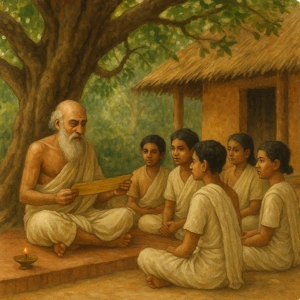
When we say Sri Hari is the ultimate protector, this is not just a stuti or a praise. This is based on facts — facts from our Itihasa, from our history.
Don’t think history is only what you learn in school and college. That is political history at best, and often manipulated and modified to suit the changing political and social equation.
For a believer of Sanatana Dharma, our history is the Puranas and Itihasas — all the Puranas and the two Itihasas, the Ramayana and the Mahabharata. The definition of Purana is पुरा भवमिति पुराणम् — whatever happened in the past is called Puranam. That means they are real incidents that occurred, not fiction, not story, not somebody’s imagination.
The usage of the word mythology is wrong as far as Sanatana Dharma is concerned because they are not myths. A myth means a traditional story — still they don’t consider it as true as a fact. A story is a story and a fact is a fact. Another definition of myth is a widely held but false belief or idea, more in line with an imagination or product of a creative mind, with emphasis on the word false.
The modern Indologists borrowed this term from Greek mythology and Roman mythology — Greek mythology, Roman mythology, and Indian mythology. There are even some Indian universities giving degrees in Indian mythology.
Be careful — if you are referring to whatever is told in Puranas and Itihasas, they are not myths, they are not fiction, they are not false beliefs, they are not false ideas. They are facts — facts from our glorious past, facts from our glorious history. We cannot comment on what mythology means in the context of Greek mythology or Roman mythology. We don’t know.
But in the context of Sanatana Dharma — be absolutely sure, be absolutely certain — don’t use the term Indian mythology. If you see anyone using that term, explain to them, discourage them from using that term. They are not myths, they are facts, they are our past, they are our history.
-
Is there a real difference between myth and sacred history?
Yes. A myth is treated as imaginative narrative; sacred history claims to report events that actually happened and shaped a civilization’s memory and practice. -
If texts were compiled long after the events, can they still be history?
Yes. Many cultures preserve history through oral transmission, lineage records, and ritual recounting before later compilation. Distance in time does not automatically erase factual content. -
What makes a Purana different from a generic storybook?
A Purana follows the pancha lakshana framework: creation, dissolution, genealogies, reigns of Manus, and the stories of lineages. This structure anchors narratives to a civilizational timeline. -
How should I understand miraculous events?
Two levels help: the event-level claim (what is said to have happened) and the meaning-level claim (what it reveals about dharma, devotion, and consciousness). Do not collapse one into the other. -
Can symbolism and history coexist in the same narrative?
Yes. A single account can be both descriptive of events and densely symbolic. Symbolism adds layers; it does not force the core event to be fiction. -
What counts as evidence here?
Internal consistency, cross-text corroboration, living ritual continuity, place-based memory, and material findings all count. Evidence is cumulative, not restricted to one modern method. -
How do place traditions strengthen claims?
When rituals, names, and festivals persist at specific sites across centuries, they form a continuous chain linking text to geography and community memory. -
Why insist on precise terms like Itihasa and Purana?
Words frame cognition. If you name something as fiction, you will read it shallowly; if you name it as history-with-meaning, you will read it responsibly. -
Is faith enough, or do I need reasons?
Have both. Faith opens the door; reasons stabilize the walk. Reasoned faith is resilient; blind doubt is as fragile as blind belief. -
How to engage with claims that everything is mythology?
Ask for clear criteria. Then present the narrative structure, continuity of practice, and cross-references. Shift the debate from labels to method. -
What about parts that look exaggerated?
Treat scale-language as a traditional way to signal power, not as a cheap trick. Extract the moral and metaphysical point before judging by modern literalism. -
How do Puranas relate to ethics today?
They present dharma in action: decisions under pressure, duties in relationships, and consequences. Ethics is learned by watching characters navigate life, not by slogans. -
Can modern science and these texts speak to each other?
They answer different questions. Science studies mechanisms; these texts disclose meaning, value, and purpose. Use both, without forcing one to do the other’s job. -
What is the practical payoff of reading them as history-with-meaning?
You gain roots, not just entertainment. Roots give identity, duty, courage, and a compass for complex choices. -
How do I start reading responsibly?
Use a good traditional commentary, note the pancha lakshana anchors, visit connected places when possible, and track how rituals keep the memory alive. -
How should I speak about these texts in public?
Be precise and calm. Say ‘Itihasa’ and ‘Purana’, explain what those mean, and show how living practices and lineages carry them forward. -
What stance should I take when uncertain about a passage?
Suspend quick judgment, gather context, compare commentaries, and ask what the passage contributes to dharma, devotion, and knowledge. Openness plus rigor beats instant dismissal.
Same is the case with Itihasa — Itihasa also means पूर्ववृत्तान्तः — vrithanta from the past. Vrithanta means news, vartha — narration of real incidents. News is not the same as fiction, even though these days we are not so sure. But Sanskrit as a language is so precise, there are words for everything. कथा means प्रबन्धकल्पना — which has kalpana in it, kalpana according to a situation.
So when Sanskrit calls something Puranam, it means it is Puranam — narration of incidents of the past, not kalpana, not somebody’s imagination. Puranam Pancha Lakshanam — to call a scripture as Puranam, there are criteria to be met — five criteria. So never confuse the narratives of the Puranas and Itihasas as mere stories.
People who talk that way, think that way, they don’t know anything about our past. Learn to use right words. That is how your intelligence grows, your understanding grows. Words are all that we have. They are our food for the mind. Words only nourish our minds. Good food — good physical health. Bad food — bad physical health. Right words — good mental health. Wrong words — bad mental health.





English
Vishnu Sahasranama
Click on any topic to open
7
30
Astrology
Bhagavad Gita
Bhagavatam
Bharat Matha
Devi
Devi Mahatmyam
Ganapathy
Garuda Puranam
Glory of Venkatesha
Hanuman
Kathopanishad
Mahabharatam
Mantra Shastra
Mystique
Practical Wisdom
Purana Stories
Radhe Radhe
Ramayana
Rare Topics
Rigveda Explained
Rituals
Sages and Saints
Shiva
Spiritual books
Sri Suktam
Story of Sri Yantra
Temples
Vedas
Vishnu Sahasranama
Yoga Vasishta
26
17
10
0


