Sri Hari Protected Raja Parikshit From Brahmastra
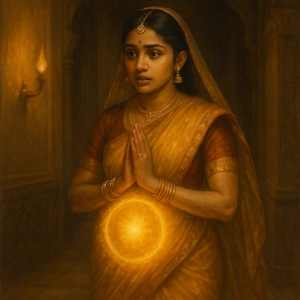
Coming back to Sri Hari as the ultimate protector.
During the battle of Kurukshetra, Ashwathama, son of Dronacharya, wanted to please Duryodhana. He killed all the sons of the Pandavas while they were asleep — a dastardly and cowardly act, condemned even by Duryodhana himself.
The Pandava camp was drowned in sorrow and grief. Arjuna promised to take revenge. Draupadi was inconsolable. He told Draupadi that after the death rites of her sons were performed, she could place her foot on top of Ashwathama’s severed head and then take a bath.
Arjuna mounted his chariot with the ferocious Gandiva in his hand and, of course, Sri Hari as his sarathi. They started chasing Ashwathama, who began running. He kept running to all the different corners of the world.
Finally, when he realized that there was no escape, he decided to use the Brahmastra. He had upadesha of the Brahmastra, the deadliest of all weapons.
Brahmastra is not just an arrow — it is an arrow energized by a mantra. The person who would use Brahmastra, or any other astra like the Vayavyastra, Pashupatastra, or Varunastra, must first receive upadesha of the mantra and, through intense practice, gain siddhi in that mantra. Only then would it work.
They are not physical weapons; they are basically mantras used as weapons. The physical arrow is only symbolic. Ashwathama had upadesha of the Brahmastra mantra and siddhi in it. He decided to use it against the Pandavas.
He sat down and started meditating. He activated the Brahmastra. The entire sky lit up and became the color of pralaya-agni. The Brahmastra started heading towards the Pandavas to annihilate them. These astras can be specifically targeted; you can decide exactly where they should hit — like the guided missiles of today.
Uttara, Abhimanyu’s wife (Abhimanyu was already dead), had Parikshit in her womb. Parikshit was the only one left in the Pandavas’ next generation, as all of their sons had been killed by Ashwathama. Uttara came running to Sri Hari, praying for help.
As per martial science, no weapon has the power to counter Brahmastra; it is the deadliest among the most deadly of weapons. If at all a Brahmastra is to be countered, it has to be with another Brahmastra.
Sri Hari protected the child in the womb of Uttara from the Brahmastra. Sri Hari protected all the Pandavas from the Brahmastra. He protected them with his Sudarshana Chakra. How does it matter to him whether it is Brahmastra or not? He simply protected all of them — nothing happened to them.
There is another version which says Parikshit was already hit by the Brahmastra by the time Uttara reached Sri Hari, and Sri Hari revived him. That is immaterial — whether he was protected beforehand or revived after being killed.
Sri Hari is capable of both. It does not matter. That is Sri Hari’s protection — the ultimate protection. Even Brahmastra is nothing if Sri Hari decides to protect someone. When someone is under Sri Hari’s protection…
-
What does divine protection actually mean?
It means preservation of dharma and of lives essential to it. Help arrives in a way that safeguards the moral order, not in a way that flatters comfort or ego. -
If a higher power can step in, why allow harm at all?
Freedom and accountability matter. Consequences teach. Intervention is precise: it prevents collapse of righteousness while allowing lessons to land. -
Are mantra-based weapons literal or symbolic?
In the tradition, mantra is disciplined consciousness that directs subtle forces. Whether read literally or as high-order symbolism, the teaching is about mastery of mind, ethics, and power. -
How can a mantra affect matter?
The model is layered causation: mind shapes intention, intention directs prana, prana influences outcomes. A refined mind can move big levers; an impure mind backfires. -
Why protect an unborn child?
Innocence merits protection, and the future of a righteous lineage carries social duty. Potentiality has moral weight; saving it serves the common good. -
Does grace cancel karma?
No. Grace can dilute, defer, or reroute karma, but not nullify moral law. It works through justice with mercy. -
Is prayer actually effective?
Sincere prayer purifies motive, focuses attention, and aligns one with help. Outcomes vary, but character and clarity always improve. -
What about free will if the divine overrides weapons?
Human choice still operates. Intervention sets boundaries so that the game remains fair; it does not play the game for you. -
Why not punish the wrongdoer instantly?
Timing educates. Sometimes exposure, remorse, or a delayed consequence teaches the person and warns society more effectively. -
Is there a hierarchy among powers?
Human skill < mantra-siddhi < divine will. Higher orders settle lower ones without strain. -
What makes using ultimate weapons ethical or unethical?
Purity, rightful cause, restraint, and authority are non-negotiable. Use without these is adharmic and rebounds on the user. -
How to handle multiple narrative versions of the same event?
Focus on the invariant teaching. Whether protection or revival is described, the core claim is preserved: ultimate guardianship can overrule destructive force. -
Does miraculous help make human effort pointless?
Not at all. Effort is the offering; grace is the multiplier. The bow must be drawn before the arrow can fly. -
Who qualifies for special protection?
Those aligned with dharma, clean in intent, surrendered without entitlement, and carrying responsibility for a larger good. -
What leadership lesson stands out?
Use power to preserve the future, not just to win the moment. Authority without conscience is self-destructive. -
How to apply this in daily life?
Do your duty well, keep the mind clean, pray honestly, protect the vulnerable, and avoid vindictiveness. That posture draws protection. -
How to evaluate extraordinary claims without being gullible?
Test for alignment with dharma, humility, non-exploitation, and consistency with the broader teaching. Keep an open yet sharp mind. -
Is suffering meaningless if help comes later?
Pain can purify and instruct; timely help prevents moral rupture. Both can be true at once. -
What does this reveal about Bhagavan?
Supreme freedom joined with compassion. Not bound by tools or tiers of power, yet always acting to uphold justice with mercy.





English
Vishnu Sahasranama
Click on any topic to open
7
30
Astrology
Bhagavad Gita
Bhagavatam
Bharat Matha
Devi
Devi Mahatmyam
Ganapathy
Garuda Puranam
Glory of Venkatesha
Hanuman
Kathopanishad
Mahabharatam
Mantra Shastra
Mystique
Practical Wisdom
Purana Stories
Radhe Radhe
Ramayana
Rare Topics
Rigveda Explained
Rituals
Sages and Saints
Shiva
Spiritual books
Sri Suktam
Story of Sri Yantra
Temples
Vedas
Vishnu Sahasranama
Yoga Vasishta
26
17
10
0


