Nachiketa’s Agni: The Bridge Beyond Death
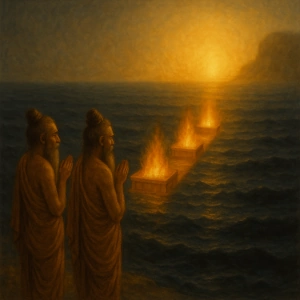
Kathopanishad 1.3.2 -
यः सेतुरीजानानामक्षरं ब्रह्म यत् परम् ।
अभयं तितीर्षतां पारं नाचिकेतँ शकेमहि ॥ २॥
yah setur ijaanaanaam aksharam brahma yat param
abhayam titirshataam paaram naachiketam shakemahi
This is where Yama himself, the knower of death, acknowledges a reality beyond even his domain — the supreme Brahman, the imperishable bridge, the fearless shore that lies across the ocean of mortality.
यः सेतुः ईजानानाम् — The bridge for yajna-performers
Not everyone can cross the ocean of samsara.
Most remain on this shore, caught in desires, rituals, and karmic bondage.
But there are some — ईजानाः — those who perform yajna, not mechanically, but with the burning desire to go beyond.
They offer, they renounce, they live with discipline and sincerity.
But still, effort alone cannot carry them across.
They need a setu — a bridge.
And the Upanishad boldly declares —
That bridge is Nachiketa Agni.
Nachiketa Agni is not just a fire ritual.
It is a revealed vidya, a sacred yajna taught by Yama himself to Nachiketa, involving:
- Three fire-altars, representing the three levels of the seeker’s journey
- A life of faith, inner discipline, and renunciation of fruit
- And an intention not for svarga (heaven), but for moksha — the other shore.
In traditional Shrauta terms, it is a qualified form of Agnichayana, refined and aimed not at reward, but at liberation.
This fire — when properly kindled — becomes the setu for those bound by action yet longing for freedom.
अक्षरं ब्रह्म यत् परम् — The imperishable, supreme Brahman
What lies across the bridge?
Not pleasure. Not rebirth. Not even heaven.
What lies across is Akshara Brahman — the imperishable, the unspeakable, the limitless silence behind all becoming.
This is the Parama Purusha, the unchanging Reality beyond all forms of change.
It is the goal of the yajna, the essence of the Vedas, the source and sink of all existence.
And reaching that is not by luck.
It is through the correct path, the revealed fire, the Nachiketa Vidya.
अभयं तितीर्षतां पारम् — The fearless shore longed for by true seekers
The goal is fearlessness — Abhayam.
Not just physical safety, but the complete absence of fear — even of death, loss, ego, and dissolution.
Only those who long to cross (तितीर्षतां)
Only those who want not repetition, but release,
Only those who are ready to walk the fire-path of Nachiketa,
…they become fit to cross into this Abhaya Sthāna — the fearless shore.
This is not theoretical moksha — this is existential freedom.
नाचिकेतं शकेमहि — May we be able to reach it, through Nachiketa Agni
This final line is not a statement — it is a prayer.
Even Yama, the one who teaches this Agni, includes himself in the longing:
“May we be able — Shakemahi — to reach that state through the fire revealed to Nachiketa.”
This is profound humility.
It shows that this fire is not merely external ritual.
It requires total alignment of body, mind, prana, and intention.
And when it is lit — not just on the vedi, but in the soul itself —
Then the bridge appears. Then the crossing begins.
Summary — What This Mantra Truly Says
- Nachiketa Agni is the Setu — the sacred bridge connecting ritual to realization.
- It is meant for those who perform yajna with the desire to transcend.
- The goal across that bridge is Akshara Brahman — the Supreme, imperishable Self.
- It is the fearless shore, the state beyond death, desire, and rebirth.
- And attaining it is possible only through this fire-path, walked with surrender and inner resolve.





English
Kathopanishad
Click on any topic to open
7
30
Astrology
Bhagavad Gita
Bhagavatam
Bharat Matha
Devi
Devi Mahatmyam
Ganapathy
Garuda Puranam
Glory of Venkatesha
Hanuman
Kathopanishad
Mahabharatam
Mantra Shastra
Mystique
Practical Wisdom
Purana Stories
Radhe Radhe
Ramayana
Rare Topics
Rigveda Explained
Rituals
Sages and Saints
Shiva
Spiritual books
Sri Suktam
Story of Sri Yantra
Temples
Vedas
Vishnu Sahasranama
Yoga Vasishta
26
17
10
0


