Liberation Even Through Hatred of the Lord
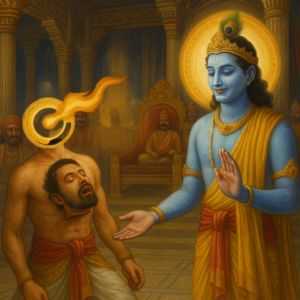
अनादिनिधनः –
आदिर्जन्म निधनं विनाशः तद्द्वयं यस्य न विद्यते सः
One without birth and death.
Because he is devoid of birth and death, he even doesn’t have states like infancy or old age. He is in a state of nitya yauvanam — ever youthful.
In the last episode, we spoke about how the Lord saves even the rationalists and atheists. The Lord asked Udayanacharya, 'Why should I save them? There should be a reason, a reason for me to interfere.'
Udayanacharya says, because they also constantly think about you only — how to negate you.
Narada Maharshi elaborates this in Bhagavata – seventh skandha – first chapter:
Conversation between Narada Maharshi and Yudhishthira –
यथा वैरानुबन्धेन मर्त्यः तन्मयतां इयात् ।
न तथा भक्तियोगेन इति मे निश्चिता मतिः
Narada Maharshi says, in my opinion, Parameswara cannot be achieved as much by having devotion towards him, bhakti towards him, than by having hatred towards him.
Having hatred towards God is an easier way to achieve him.
Sounds weird, isn’t it?
God-hater achieves God easier than God-lover.
But this is a very deep concept. This is not to promote hatred towards divinity. Narada is revealing a profound tatwa about upasana here.
And who is saying this? The very author of Bhakti Sutras, who formalized the concept of bhakti, who defined bhakti.
And where in Bhagavatam?
This is because of intense absorption:
कीटः पेशस्कृता रुद्धः कुड्यायां तं अनुस्मरन् ।
संरम्भभययोगेन विन्दते तत् स्वरूपताम्
An insect is caught by a wasp and confined in its hole. The insect, out of intense fear of what the wasp will do to it, keeps on thinking about the wasp, and after some time becomes like the wasp — cruel like the wasp.
This we see in human life also. Ordinary people living in terrorism-afflicted areas, war-afflicted areas — their initial reaction is absolute fear, but then after some time, you will see them themselves picking up weapons and start killing.
Intense absorption in thoughts brings about tadatmya — sakshatkara.
That thought may be one of fear — does not matter.
What Narada says is that this intensity is difficult to come in bhakti. It comes much more easily in fear.
It is not a recommendation. It is a statement of a fact.
एवं कृष्णे भगवति मायामनुज ईश्वरे ।
वैरेण पूतपाप्मानः तं आपुः नुचिन्तया ॥ २८ ॥
So even if someone under the influence of maya constantly remembers him out of hatred, he also attains him. He is also absolved of his sins and attains him.
कामाद् द्वेषाद् भयात् स्नेहाद् यथा भक्त्येश्वरे मनः ।
आवेश्य तद् अघं हित्वा बहवः तद्गतिं गताः
The absorption in him happens in five ways — out of kama, desire for bodily proximity to him, out of enmity, out of fear, out of love, and out of devotion — bhakti.
Any one of these can destroy sin and lead to his attainment.
गोप्यः कामाद् भयात् कंसो द्वेषात् चैद्यादयो नृपाः ।
सम्बन्धाद् वृष्णयः स्नेहाद् यूयं भक्त्या वयं विभो ॥ ३० ॥
Gopis attained him through kama. Their desire to be with him was so intense.
Their minds were always filled with his thoughts:
‘Oh, we shouldn’t allow him to put his lotus feet upon our bosom. His feet are so tender. Our bosoms are hard compared to his feet. His feet will get hurt.’
Such thoughts — throughout.
Nothing else in their minds. He made this happen through Rasa Leela.
Here, don’t confuse the kama of gopis with physical lust.
To understand what kind of emotion it was, you need to understand Rasa Leela in depth.
To call their emotion as lust is like calling a surgeon a butcher since both cut flesh with knives.
Gold and iron — both are metals, but you can’t say that they are the same, have the same quality.
Rasa Leela is very deep.
Kamsa was filled with fear for him — ‘He is going to kill me. Krishna is going to kill me.’
Every child started looking like Krishna to him, capable of ending his life.
It may be paranoia, but the absorption again was so intense.
Eventually, Kamsa also got enlightened.
Kings like Sisupala had intense dvesha towards him — intense enmity towards him — enmity that rose out of envy. They also eventually attained him.
The Yadavas had intense love for him because he was one of their own, their saviour. Pandavas had intense love for him.
Narada says: Snehad yooyam vayam bhaktya vibho — through intense love, you people; and through devotion, us — likes of me, likes of Narada.
कतमोऽपि न वेनः स्यात् पञ्चानां पुरुषं प्रति ।
तस्मात् केनापि उपायेन मनः कृष्णे निवेशयेत्
The point is to get absorbed in him.
The method doesn’t matter.
They have all attained through these five means — kama, fear, enmity, love, and devotion.
This is the most important point in upasana.
Intense absorption is the essence of upasana.
What you should avoid is distraction.
The mind should be filled 24x7 with the thoughts of your Ishta Devata.
Once again, this is not a recommendation for means such as hate or fear.
What you should try to develop are love and devotion.
To Kamsa and all, they were natural emotions.
The point is — intensity and absorption are most important in Ishwara Sakshatkara.
-
If the Lord is beyond birth and death, why does my small life matter?
-
Because an eternal source makes even brief moments powerful. One sincere turn of heart can outweigh years of drift.
-
-
Can obsession with denial really pull someone toward the Lord?
-
Intense focus reshapes the mind. Even oppositional focus can bend back toward truth, but love is the safer, cleaner path.
-
-
What should I do if a loved one mocks devotion yet thinks of God all day while arguing?
-
Guard affection, keep meals together, and pray for a gentle inner shift. Do not humiliate or trap them in debates.
-
-
Isn’t this teaching dangerous because it seems to excuse hatred?
-
It explains a mechanism; it does not recommend it. Choose love and humility. They heal you while you walk.
-
-
How do I make my own attention strong without turning harsh?
-
Short name rounds through the day, kind speech at home, and one hidden act of service. Strength with softness.
-
-
What is a clean test that my devotion is getting intense in a healthy way?
-
You calm down faster, apologize sooner, and sleep deeper. Family tension drops, not rises.
-
-
How do I channel fear into devotion when life shakes me?
-
Sit, breathe 4 in and 6 out for five minutes with his name on the exhale. Offer the next small duty and just do it.
-
-
If even enemies can be lifted, why keep regular practice?
-
Practice keeps the door unlocked. It readies the mind to recognize grace when it arrives.
-
-
How do I argue about faith without burning bridges?
-
Timebox, no sarcasm, end with thanks, and share a chore after. Relationship first, argument second.
-
-
What do I do when I feel unworthy of help?
-
Say: ‘I am here. Please turn me.’ Then act on one honest step. Worthiness grows after you begin, not before.
-
-
How do I guide children who swing between fascination and rebellion?
-
Keep a steady routine: one verse, one song, one kindness. Praise effort, not superiority.
-
-
Can health practices support devotion or is that worldly?
-
Body steadies mind. Morning light, simple food, regular sleep, and a 10–15 minute walk make remembrance easier.
-
-
How do I respond to sudden grace in someone I disliked?
-
Drop old labels at once. Celebrate quietly and ask for the same release wherever you are stuck.
-
-
What if my anger at injustice fuels attention better than gentle prayer?
-
Use it to act justly without spite. Do the needed boundary, then cool the heart with name and breath so it does not scar you.
-
-
Is constant remembrance possible in a busy job?
-
Yes. Anchor points work: doorways, first sip of water, start and end of tasks. One line: ‘This is offered.’
-
-
How does this help marriage or close family ties?
-
Replace winning with serving. Speak low, listen fully, and do one unasked help daily. Devotion becomes visible as care.
-
-
What about guilt over past hostility toward God or devotees?
-
Admit it, repair if needed, then serve quietly. Guilt is a signal; correction is the cure.
-
-
What is a compact daily set that builds intensity without strain?
-
Dawn light and one name-round, midday breath break, evening gratitude and a short walk. Keep it small and unbroken.
-
-
How do I measure progress without pride?
-
Track inner markers only: fewer spikes, steadier breath, kinder words. Offer any gain back to him and move on.
-





English
Vishnu Sahasranama
Click on any topic to open
7
30
Astrology
Bhagavad Gita
Bhagavatam
Bharat Matha
Devi
Devi Mahatmyam
Ganapathy
Garuda Puranam
Glory of Venkatesha
Hanuman
Kathopanishad
Mahabharatam
Mantra Shastra
Mystique
Practical Wisdom
Purana Stories
Radhe Radhe
Ramayana
Rare Topics
Rigveda Explained
Rituals
Sages and Saints
Shiva
Spiritual books
Sri Suktam
Story of Sri Yantra
Temples
Vedas
Vishnu Sahasranama
Yoga Vasishta
26
17
10
0


