Do you know who is Ananta or Adisesha?
धाता – अनन्तादिरूपेण विश्वं बिभर्तीति धाता
Again one among the 12 Adityas.
There is another similarity between Sri Hari and Surya.
Sun appears in the east in the morning and disappears in the west in the evening.
We don’t say that the sun is born or it dies.
Sun appears and disappears.
In Sri Hari’s avataras also this is so.
They appear and disappear.
They are in fact without beginning and end.
Even when we say Krishna was born as the son of Devaki and Vasudeva or Rama was born as the son of Kausalya and Dasharatha, we don’t take it in the literal sense.
अचित्समष्टिभूतायां प्रकृतौ चित्समष्टिभूतं विरिञ्चाख्यं गर्भं दधातीति धाता
Prakriti is the mother.
The whole universe comes out of Brahma.
Brahma is the foetus of the universe out of which the universe develops.
And Sri Hari places this foetus or pregnancy in the womb of Prakriti.
Hence he is called धाता.
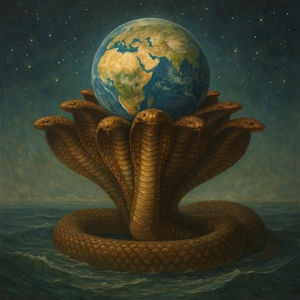
He bears the universe in the form of Ananta.
The universe rests on his hood.
Who is Ananta?
Ananta is the same as Adi Shesha — the bed of Maha Vishnu.
Sri Hari rests on his body and the universe on his hood.
Different ways of depiction.
And since we are talking about Adi Sesha —
And who are the Nagas?
Sage Kashyapa is the forefather of Devas, Asuras, Danavas, Nagas and humans.
Nagas are all children of Kashyapa born from his wife Kadru.
Originally they were thousand in number but down generations have multiplied into millions and millions.
There had always been rivalry between the co-wives of Kashyapa — Kadru and Vinata.
Kadru and Vinata both are wives of Kashyapa.
Vinata is mother of Garuda.
Kadru wished for a thousand children of great power and strength.
Vinata wanted to have only two sons who would outshine Kadru's thousand sons.
Once they spotted in the sky Uchchaisravas, the divine horse which came out when the Milky Ocean was being churned.
An argument broke out between them.
Vinata said the horse was white in color.
Kadru said its tail was black.
They reached an agreement that whoever loses would become the slave of the other.
Kadru knew that the horse was actually white.
But she was sure to come out with something to cheat Vinata.
She told her serpent sons to go and attach themselves to the tail of the horse — like hair — so that the tail looked black.
There were many honest and noble-minded among the serpents who did not want to do this.
Kadru cursed them that they would all perish in fire.
When Devas brought this curse to the notice of Brahma, he said — it was not totally inappropriate as the serpents are going to become cruel, evil-minded, and short-tempered, harming all other living beings.
He said that however the serpent clan will not be exterminated as steps have already been planned to prevent it.
Due to the fear of the curse of their mother, some of the serpents went ahead and turned the tail of the horse black by attaching themselves to it.
When the time for inspection came, Vinata was established incorrect and she was doomed to servitude.
Later on, her son Garuda won back her freedom.
In the process, Indra granted Garuda a boon that the serpents would become his food.
Ananta was one among the good Nagas and a very prominent one.
Disappointed with his mother's evil acts, he separated himself from the family and performed severe penances.
Pleased with his austerities, Brahma assigned him the task of carrying the worlds on his thousand-hooded head.
He is an upholder of dharma.
At the time of pralaya, a form Rudragni called Sankarshana Murthy would come out of his face, thus destroying the three worlds.
Sri Hari alone has assumed the form of Ananta and is carrying the universe.
Hence he is called धाता.
-
Why is the Lord called the bearer of the world?
-
Because the one source upholds everything without strain. For us, it means doing our duty steadily while remembering the support behind all effort.
-
-
Is the serpent that carries the earth literal or symbolic?
-
It is a teaching image for stability and infinity. Like a spine holds the body upright, the Lord’s power holds existence together.
-
-
If avatars ‘appear and disappear’ like the sun, what does that teach me about loss?
-
Forms come and go; presence remains. Remembering this softens grief and keeps love active without clinging.
-
-
If everything is supported already, do my choices matter?
-
Yes. Support is not control. You are responsible for clean action; the Lord supplies strength and results as he wills.
-
-
What does ‘one source, many forms’ mean for how I see people?
-
Stop competing with every face you meet. Respect different roles; the same light works through many bodies.
-
-
How do I build ‘ananta-like’ steadiness in everyday life?
-
Simple, repeatable rhythms: fixed wake time, short morning prayer, regular meals, and a 10–15 minute walk daily. Routines make devotion easier.
-
-
How can bhakti help my posture, breath, and energy?
-
Sit tall as if a gentle thread lifts your crown; breathe slow through the nose with the Lord’s name on the exhale; finish meals with a brief walk. Calm body, clear mind.
-
-
What is a family way to honor the sustaining power without drama?
-
Share chores, eat one meal together device-free, and end the day with one line of remembrance. Small, steady acts build a safe home.
-
-
How do I face rivalry or manipulation without becoming bitter?
-
Name the wrong, set boundaries, and refuse deceit. Choose truth over cleverness, and let the Lord handle scorekeeping.
-
-
How should I respond when someone’s anger feels ‘fated’?
-
Don’t spiritualize harm. Protect yourself and others, act justly, and keep the heart free of revenge. Justice can be firm and clean.
-
-
What proves that devotion is turning into real inner strength?
-
You bounce back faster from stress, speak less harshly, sleep deeper, and keep promises without show.
-
-
How does this vision change the way I work?
-
Offer tasks as service, keep accounts straight, and credit upward for any success. Being an instrument removes anxiety and pride.
-
-
What do I teach children about power and responsibility?
-
Power serves, it doesn’t scare. Praise honesty, effort, and kindness more than ‘winning’.
-
-
How do I handle fear of endings and uncertainty?
-
Remember cycles: day to night, season to season. Build an inner refuge with name, breath, and gratitude. Fear eases when belonging is felt.
-
-
Is worship about big cosmology or small character?
-
Both, but character shows the truth. Steady kindness is clearer proof of faith than grand talk.
-
-
How can I keep devotion from becoming superiority?
-
Do some service no one knows, and refuse to compare your path with others. Grace is not a medal.
-
-
What is a compact daily set to anchor me?
-
Dawn light and one round of name, mindful meals and a short walk, dusk pause with thanks. Keep it small and unbroken.
-
-
Where does hope come from when I feel weak?
-
From the one who carries all. Say a short prayer, take the next honest step, and let support do the heavy lifting.
-





English
Vishnu Sahasranama
Click on any topic to open
7
30
Astrology
Bhagavad Gita
Bhagavatam
Bharat Matha
Devi
Devi Mahatmyam
Ganapathy
Garuda Puranam
Glory of Venkatesha
Hanuman
Kathopanishad
Mahabharatam
Mantra Shastra
Mystique
Practical Wisdom
Purana Stories
Radhe Radhe
Ramayana
Rare Topics
Rigveda Explained
Rituals
Sages and Saints
Shiva
Spiritual books
Sri Suktam
Story of Sri Yantra
Temples
Vedas
Vishnu Sahasranama
Yoga Vasishta
26
17
10
0


