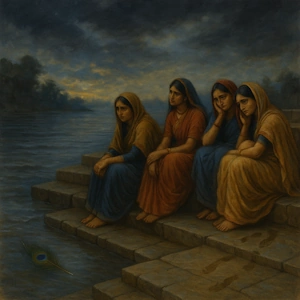
Gopikas Could Not Bear Their Grief When Sri Hari Left Mathura
प्रभवः – प्रकर्षेण महाभूतानि अस्माज्जायन्त इति प्रभवः
The pancha bhutas — earth, water, fire, air and ether.
Prakarsha indicates the vastness, greatness of creation of the pancha bhutas.
The pancha bhutas are born out of him.
There is a difference between mahabhutas and pancha bhutas as we see them.
The bhutas created originally are called mahabhutas, the five mahabhutas. They are pure.
Then there is another process called panchikarana through which the pancha bhutas as we see them now are created.
It is simple. This is how you should look at it.
Divide the five mahabhutas into two parts each.
Keep one part of each mahabhuta as it is.
The other part — again divide into four parts.
Each part mix with the pure half of each of the mahabhuta kept separately.
For example, take akash.
Divide into two. Keep one part aside.
Take the other part, divide it again into four parts.
Each of these mix with the pure halves of vayu, agni, jala and prithvi kept aside.
Similarly for other bhutas also.
At the end of it, you will find that
Akasha bhuta will consist of one half of akasha, and the other half a mix of vayu, agni, jala and prithvi — all mixed together.
This is panchikarana.
In most scriptures it has been described in a very complex manner.
This is how you can easily understand panchikarana.
देवादिजनवैजात्यात् प्रकृष्टोऽत्पत्तिमत्त्वतः।
अविद्या-दोष-वैधुर्यात् प्रभवः परिकीर्तितः
Whenever he apparently took birth as avataras, they were quite different from births of devas or humans.
This is important — he was not even like gods.
Because even devas suffer from avidya, at times.
He doesn’t.
You see any of the avataras, you will not see a hint of avidya anywhere, in any of them.
In these births, he was never associated with ignorance.
The prefix pra indicates greatness, magnificence. His birth (bhava) was always magnificent, not ordinary.
Hence he is called prabhavah.
The gopikas are simpletons.
They know only one thing — to love, to love the Lord.
They don’t know anything else.
They don’t want to know anything else.
After the Lord went away, they were all sad.
Uncontrollable viraha-dukkha overpowered each and every one of them.
At that time, Sri Hari sent a messenger — Uddhava.
Uddhava came to the gopikas and said:
The Lord has told to tell them that he has not gone anywhere.
He is Paramatma, omnipresent. He cannot go anywhere.
He cannot leave a place and go, because he is Paramatma — he has to be always present everywhere.
He is still among them. Only his body is not visible now.
They should utilize this time to meditate upon this tattva.
This is going to help them to understand, to spiritually evolve.
It is all in the mind.
Mind is the cause for this attachment.
Mind is the cause for this grief.
Mind only causes bondage.
Mind only will give moksha.
You all should learn to attain success over the mind.
Peace can be attained only if you release your mind from attachment with every object in this world, every person in this world.
This peace itself can eventually lead to moksha.
And the simpletons — the gopikas — this message was just unbearable for them.
This was the limit.
One — he went away. And now he is sending these kind of messages.
They said — so easy to say. Very good.
He used to be so good to us.
Now see, he is gone and sitting somewhere, sending these kind of messages.
One of them said — the lotus looks forward eagerly towards the rising sun. She waits eagerly for the sun to rise. And when she sees him, her face blossoms with happiness.
But the sun — does he ever have such a feeling towards the lotus?
We had the wrong idea about love.
We thought love is always reciprocated.
Even a hunter — when his game is hurt and is in terrible pain — even he will not be able to see that for long.
He will pull his arrow out and allow its life to end. Allow the last breath to go out.
Don’t we deserve even that much of mercy?
Another gopika said — only one who has a thorn stuck in his foot would know the pain. An onlooker will not know the pain.
Once he was our hero.
Now he has become the hero of that hunchback of Mathura.
The reference is to Kubja.
After he reached Mathura, he gave shapa-moksha to the hunchback Kubja and made her into a beautiful woman.
The story spread like wildfire.
Even gopikas at Vrindavana came to hear about this.
They are getting jealous.
Now she has become his favorite.
She is from the city.
We are all ignorant village folk.
She is modern.
She has got glamour.
That must be why he has left us and gone for her.
There was that other hunchback who sent Lord Rama to vanavasa — Manthara.
This Kubja of Mathura must be a rebirth of that Manthara only.
She must be a witch.
See the sentiments. So human. So simple. So straightforward.
See how they are lamenting. They are unable to bear the separation.
This God is like a child playing around with toys.
He keeps some together for some time. Then takes them apart.
Doesn’t he know the pain we are going through?
Another one said — now that Kubja’s time is good.
She got his blessing and has become an enchantress.
People used to laugh at her for her ugliness.
But mind you, no spring is permanent.
Every garden withers at some point in time.
Oh Uddhava, we can’t forget him — no matter what philosophy you want to speak, what sermon you want to give.
He used to play hide and seek from behind us.
You want us to forget him?
Another gopika said —
Now there is no point.
If it is an enemy, you can defeat him with intelligent moves.
If it is a friend, you can win over him with affection.
You can get the favor of a scholar by giving respect to him.
You can please your guru by offering namaskaras to him again and again.
But our Krishna has become a vairagi.
Nothing can be done anymore about him.
He is gone out of hand.
He has become a vairagi.
See what language he speaks — Paramatma, detachment, mind, moksha.
Nothing can be done about him anymore.
He is gone from us forever.
He is giving sermon to us.
Have we ever seen anything other than him ever in this Vrindavana?
Every tree for us was Krishna.
Every plant was Krishna.
Every stone was Krishna.
Every rock was Krishna.
Every bird was Krishna.
Every deer was Krishna.
Every drop of dew was Krishna.
Every breeze was Krishna.
And see — he is giving us sermon that he is Paramatma, he is omnipresent.
When was it ever otherwise for us?
Another one said —
But our Lord is a strong man.
This attachment, this bondage of passion, is very strong.
Only the strongest can cut it loose.
And our Krishna is very strong.
See how easily he cut himself loose from all of us.
How easily he got away from us.
He is indeed a strong man, our Krishna.
He is indeed strong.
Let even our worst enemy not suffer a grief like this.
Another one said — don’t know how Lakshmi is staying with him, with this stony heart.
Speaking philosophy now.
That too, to us.
Can’t just understand him.
Calls it his leela.
What leela?
Oh Krishna — Kubja is definitely going to take you for a ride.
Then you will come back to us.
Oh Krishna —
We don’t feel like opening our eyes.
What is there to see anymore here?
What is there to hear anymore here?
Every sound is like the loud crowing of crows when you are not around.
Where are you?
We don’t want to look at anything else other than you.
Come back to us.
Come back to us fast.
-
Why would Sri Hari send a message about omnipresence instead of simply returning?
-
Because he wants devotion to mature from clinging to form to holding the formless as well.
-
Presence is trained in the heart first; the feet will follow.
-
-
Does philosophy heal a broken heart or make it worse?
-
It heals when timed right and spoken with warmth; it hurts when thrown at raw grief.
-
Rule for us: comfort first, concepts later.
-
-
If the mind binds and also liberates, what is the first practical lever?
-
Breath. Slow nasal breathing for 5 minutes lowers the panic loop.
-
Pair it with the name of Bhagavan to keep focus steady.
-
-
Is love for the Lord a bargain that must be reciprocated?
-
No. Devotion is a vow, not a trade.
-
You offer love because he is the highest good, not for returns.
-
-
What do we do when sermons feel like salt on a wound?
-
Park the lecture, sit beside the hurting person, and hold silence.
-
After calm returns, bring one small insight, not ten.
-
-
How can grief become holy instead of corrosive?
-
Keep daily order: bath, simple food, walk, sleep on time, and short japa.
-
Ritual rhythm turns pain into prayer rather than fatigue.
-
-
What is the health risk in intense separation sorrow and how do we guard against it?
-
Risks: appetite crash, poor sleep, chest tightness.
-
Guards: warm sattvic meals, evening screen cut-off, 20-minute daylight walk, and paced breathing.
-
-
What is the family rule when one member becomes strongly detached?
-
Respect their path, keep affectionate contact, and do not mock detachment.
-
Maintain shared meals and small duties together to prevent drift.
-
-
How do we hold the Lord who is everywhere when the body is absent?
-
Fix on one chosen form and one line of remembrance; repeat it through the day.
-
Make a small corner for worship; consistency beats intensity.
-
-
Why are the births of the Lord called free of ignorance, and why does that matter to us?
-
He acts while fully awake to truth, never confused.
-
Model for us: do roles completely, but do not forget the higher purpose behind them.
-
-
What should we learn from jealousy that rises when someone else receives grace?
-
Jealousy exposes our claim over the Lord; convert it into admiration and prayer.
-
Bless the other devotee; the heart softens immediately.
-
-
Why do teachings on the elements matter to devotion?
-
Knowing that all forms are mixed elements reduces pride and attachment.
-
Practical step: eat simple, touch earth and water mindfully, keep the body tidy.
-
-
How should we speak about the Lord’s absence to children at home?
-
Say: seasons change; love does not.
-
Invite them to sing one song nightly; steadiness replaces fear.
-
-
What daily act honors the truth that food is sacred?
-
Offer the first bite in the mind to Bhagavan; eat slowly and gratefully.
-
Families that bless food argue less and digest better.
-
-
What is the right response when devotion demands courage against comfort?
-
Choose the higher good calmly and accept short-term pain.
-
The heart grows stronger every time you place truth above convenience.
-
-
How do communities carry each other through separation sorrow?
-
Short group remembrance, shared meals, and simple service tasks.
-
Collective rhythm prevents isolation and keeps devotion warm.
-





English
Vishnu Sahasranama
Click on any topic to open
7
30
Astrology
Bhagavad Gita
Bhagavatam
Bharat Matha
Devi
Devi Mahatmyam
Ganapathy
Garuda Puranam
Glory of Venkatesha
Hanuman
Kathopanishad
Mahabharatam
Mantra Shastra
Mystique
Practical Wisdom
Purana Stories
Radhe Radhe
Ramayana
Rare Topics
Rigveda Explained
Rituals
Sages and Saints
Shiva
Spiritual books
Sri Suktam
Story of Sri Yantra
Temples
Vedas
Vishnu Sahasranama
Yoga Vasishta
26
17
10
0


