Meaning Of Divya Nama - Purusha
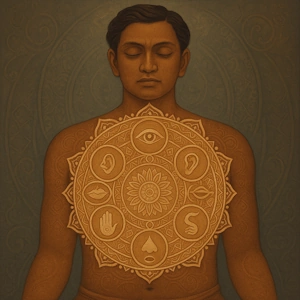
पुरुषः – पुरं शरीरं तस्मिन् शेते इति पुरुषः.
Puram means body. One who exists in all bodies.
नवद्वारं पुरं पुण्यमेतैर्भावैः समन्वितम्
व्याप्य शेते महात्मा यस्तस्मात्पुरुष उच्यते
The body is compared to a city — a city with nine gates.
Which are the nine gates of this city? The nine openings in the body: two eyes, two ears, two nostrils, the mouth, and the openings for excretion.
These are the points through which you transact with the world, you interact with the external world. These are the gates through which most of the materials and information go in and out of the body. Also skin.
He has pervaded it and exists in it. Hence he is called Purusha.
नवद्वारे पुरे देही हंसो लेलायते बहिः ।
वशी सर्वस्य लोकस्य स्थावरस्य चरस्य च ।
That Paramatma does his leela occupying this city of nine gates. The movable and immovable around this city are all under his control. They are what he plays around with. He lives within this city with the nine gates. He only interacts and transacts with the whole world sitting inside this city, and that is his leela. Hence he is called Purusha — not because he is a male as is commonly thought. Purusha means the occupant of this Pura.
There is another meaning:
पुरा आसीतिति पुरुषः — He was here before everything.
पूर्वमेवाहं इह आसमिति तत्पुरुषस्य पुरुषत्वम् — I was here before, before everything. Before all — that is the Purushatva of Purusha.
पुरुषु सीदति इति पुरुषः — Puru means the great ones, great beings — Devas. He is seated among them. His place is among the great Devas. Hence he is called Purusha.
पुरूणि सीदतीति पुरुषः — Puruni means results, Seedati means gives. He only gives the results of one’s karma, both good and bad. This is another meaning of Purusha.
पुरूणि स्यति इति पुरुषः — Here Puruni means worlds: the three worlds — Swarga, Bhumi, and Patala, or the fourteen worlds. Syati means ends. He ends the three worlds at the time of Pralaya.
पुरूनपि स्यति पुरुषः — He ends, eliminates even the Devas at Pralaya. After Maha Pralaya even the Devas don’t exist. Who causes Maha Pralaya? Sri Hari alone.
पूरणात्सदनाच्चैव ततोऽसौ पुरुषोत्तमः — He is called Purushottama because he fills everything and exists in everything.
पुरु बहु सनोतीति पुरुषः — He gives in abundance, hence Sri Hari is Purusha.
मुक्तेभ्योऽपि वाङ्मनसा अपरिच्छेद्य गुणविभवस्वानुभवं ददाति — Not only does he satisfy worldly desires. Even to Jeevan Muktas, who do not have any desire, he gives that experience which cannot be described by words and fathomed by mind.
Giving means not just material objects and wishes, not just material desires. Of course, he alone grants all of them. But he alone gives those spiritual experiences to the Muktas. He is the one and only giver in the world. If there is anything being given and anything being received, just understand that Sri Hari is behind it. Sitting inside every giver, he is the one who prompts the giver to give.
-
Why call the body a city with gates?
Because the senses are fixed entry and exit points. Through them, signals, needs, and choices flow. Master the gates, and you master how life shapes you. -
Who is the real occupant inside this city?
The conscious witness that knows thoughts, feelings, and sensations. It remains present while the body and mind change. -
If there is an inner witness, why do we feel like the body and mind?
Habit and attention fuse us with sensations and thoughts. Shifting attention to the knower breaks that fusion. -
What are the nine gates for in practice?
To notice how seeing, hearing, smelling, tasting, speaking, and excretion affect clarity. Guarding the gates reduces agitation and builds inner steadiness. -
Is skin also a gate?
Yes. Touch delivers powerful signals. Simplicity in clothing, space, and routine keeps the nervous system calm. -
Is the supreme inside the body or beyond it?
Both. Immanent as the inner witness, transcendent as the source that is not limited by any form. -
What does ‘existing before everything’ imply?
Cause does not depend on effect. Time, space, and law arise from the source; they do not bind it. -
If one ruler gives the results of karma, do I still have free will?
Yes. You choose actions; Bhagavan governs outcomes with justice. Freedom is in choosing wisely; results align with the moral order. -
Why would even exalted beings be temporary?
Anything that begins also ends. Recognising this pushes attention toward the unchanging reality. -
What is ended at cosmic dissolution?
All names, forms, and worlds fold back into the source. The witness reality remains untouched. -
What does abundance mean here?
Not just wealth. It means boundless capacity to give life, understanding, peace, and liberation. -
How can someone without desires be given anything?
They receive direct awareness of reality beyond words and thought. It is fulfilment without dependence. -
If all giving comes from one source, what is my role when I give?
You are the instrument. Offering with humility aligns you with the source and purifies intention. -
Does calling the source ‘Purusha’ make it male?
No. ‘Purusha’ means the indwelling occupant, not a gender. It points to presence, not masculinity. -
How do karma and compassion fit together?
Karma ensures order; compassion softens hearts to act rightly. Justice explains outcomes; compassion transforms future choices. -
What is the practical use of seeing life as ‘leela’?
It loosens rigid control and victimhood. You still act responsibly, but without bitterness, because the whole play rests in a wiser order.




English
Vishnu Sahasranama
Click on any topic to open
7
30
Astrology
Bhagavad Gita
Bhagavatam
Bharat Matha
Devi
Devi Mahatmyam
Ganapathy
Garuda Puranam
Glory of Venkatesha
Hanuman
Kathopanishad
Mahabharatam
Mantra Shastra
Mystique
Practical Wisdom
Purana Stories
Radhe Radhe
Ramayana
Rare Topics
Rigveda Explained
Rituals
Sages and Saints
Shiva
Spiritual books
Sri Suktam
Story of Sri Yantra
Temples
Vedas
Vishnu Sahasranama
Yoga Vasishta
26
17
10
0


