Meaning of the Divya Nama - Aprameya
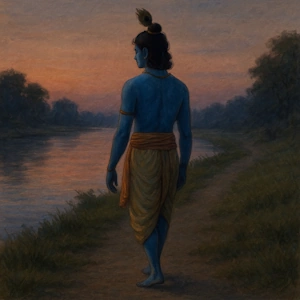
अप्रमेयः -
The system of Advaita Vedanta identifies six means of knowing, six ways of knowing.
First, pratyaksha – to know with one’s own senses. It should be with one’s own sensory organs. It can’t be that my father has seen it, so it is there, he never lies. It can’t be hearsay – it has come in the newspaper that there are people living on moon, NASA says that there is water in Mars. This is not pratyaksha. It has to be conclusive. It cannot keep on changing. You can’t say, oh I didn’t look into that aspect of it, if you consider that also it may change. I didn’t look through a microscope. Whatever you want to do, do it completely and then come to your conclusion. You can’t mix observation with inference.
This is external perception. Now there is internal perception, available to a select few through intuition, expanding perception to a universal level and also correlating previous states of the object to its current state.
Sri Hari is not someone you can know through your sensory organs. We don’t live in an age where Lord Krishna, through his mercy, lived among men.
And internal perception is also very difficult. Wherever this internal perception is present, they have to do time travel.
To know him through pratyaksha means – through sensory organs – is impossible, and through internal perception, extremely difficult.
The second – anumana – inference.
What is inference?
See smoke and say there is fire – this is inference.
To come to a new conclusion about truth through reasoning applied to observations or previously established facts. For inference to take place, there has to be a hypothesis, a cause or reason and examples based on which you can come to the conclusion.
In Sri Hari’s case, what hetu or reason will you attribute for coming to an inference, like inferring fire from smoke? So Sri Hari cannot be inferred.
I was lost in the forest, suddenly an old man came from nowhere and showed me the way out. That must be Sri Hari’s providence. That won’t stand the test of anumana or inference. It can be mere coincidence. This doesn’t have a relation like what smoke has to fire. Without fire there can’t be smoke. In this case, you can’t conclusively use the method of anumana also. It could be mere coincidence.
The third – comparison or analogy – upamana.
You are going to a new place and there is an animal which is there only in that place. You have never seen it before.
There is a friend of yours. He has already seen this animal. This is what your friend tells you – it is the size of a cow, it has the skin of an elephant, horns like a deer and it barks like a dog. Now when you go there, you can actually identify the animal at the first sight. This is called knowledge through comparison.
In spite of endless descriptions about the beauty of eyes, feet, hair, and comparison with lotus petals and anjana and what not, can you still perceive his form in totality? Because the comparisons are not sufficient. The objects with which the comparisons are made are not even near the truth.
So he cannot be known even through this method.
The fourth method – postulation – अर्थापत्ति.
We think only science has all these methodologies.
You left somebody at the airport. The departure of his flight is at 11:00 am. He called you just before the flight was taxiing for takeoff. The flying time is 2 hours. By 1:00 or 1:30 you come to the conclusion that he would have landed. This is postulation.
Now here you are depending on so many things outside and independent of the passenger to come to this conclusion, like the flight schedule, on-time records of the particular airways, the weather.
Now in Sri Hari’s case, there is nothing that is independent of him, outside of him, no parameter that he doesn’t influence. So we can’t even use this method.
The fifth method – anupalabdhi – negative proof – non perception.
There is no fan in this room – absence of fan. It is a valid means of knowledge. Perception of something present is valid. So is non-perception of something not present.
Can he be known with this method? Where is he not present? What is not present in him? Can absence of something at some place or some point in time be used to know him?
The sixth method is called – shabda – testimony.
This is to rely on the words of experts. You can’t and need not reinvent the wheel every time. Facts established beyond doubt can be taken for granted.
Even with thousands and thousands of scriptures written about him, he cannot be known, because they have described only a minute, minuscule part of him.
So in Sri Hari’s case, the six means of knowing are helpless.
Hence he is called अप्रमेय.
The yogis, who have controlled their desires, who have controlled anger, they are not able to know him fully. They have broken the barriers imposed by maya on the five senses. They can see as far as they want. They can hear from as far away as they want. They can do space and time travel as and when they desire. Still they cannot understand him fully.
Even though he is everywhere, pervaded everything, he cannot be understood fully.
यं नायं भगवान् ब्रह्मा जानाति पुरुषोत्तमम्
Even Bhagwan Brahma hasn’t understood him fully.
You can never know him, understand him fully. Even Brahma has not been able to do that. But you can become one with him.
न ह्यादिमध्यान्तमजस्य यस्य विद्मो वयं सर्वमयस्य धातोः
न च स्वरूपं न परमप्रभावं न चैव सारं परमेश्वरस्य
Conversation between Brahma and Rudra –
We don’t know his beginning, middle or end. We don’t know his form, his power and his essence. Hence he is अप्रमेय – unknowable.
-
If Bhagavan is beyond full knowing, what is the point of seeking him?
Seeking shapes you. Bhakti trains the heart to align with truth even when the mind runs out of concepts. You do not shrink because you cannot measure him; you grow because you turn to him. -
How does bhakti work when the mind demands proof?
Bhakti redirects the mind from proof hunting to presence building. You cultivate steadiness through nama japa, seva, and honesty in conduct. The mind quiets, and what remains is a clean channel for his grace. -
What does grace actually change in daily life?
Grace gives clarity without noise. You choose better, speak cleaner, and waste less energy in overthinking. Results follow: fewer regrets, stronger relationships, and a calm center during chaos. -
If I cannot see Bhagavan, how do I relate to him without pretending?
Be simple and direct. Speak to him as you are, keep a small daily vow, and track it. Consistency beats drama. He answers sincerity. -
How do I keep faith when prayers seem unanswered?
Tighten process, not resentment. Shorten the ask, increase effort, and set a time-bound discipline. The heart that refuses bitterness becomes receptive; outcomes start aligning. -
What is a practical sign that my bhakti is maturing?
Triggers lose grip. You recover from anger faster, apologize quicker, and stop justifying small wrongs. Inner ease becomes your baseline, not a lucky mood. -
How does this help physical health?
Bhakti lowers inner friction. Breath settles, sleep deepens, and cravings reduce. Add three anchors: early light exposure, unhurried meals, and 20 minutes of brisk walk with japa. Body cooperates when mind softens. -
How should a family notice and support this path?
Replace lectures with rhythms. Fix a shared quiet time, one weekly family seva, and a device-free meal. Relationships stabilize when rituals are lived, not argued. -
How do I avoid superstition while staying devoted?
Keep three filters: truthfulness, non-harm, discipline. If a belief demands lying, hurting, or laziness, discard it. Dharma aligned practice stands scrutiny. -
What do I do when fear spikes at night or during illness?
Switch to a script: slow breath, nama japa, a brief surrender statement, and one small next action. Do it exactly the same way each time. Fear loses novelty; courage becomes muscle memory. -
How do I deal with spiritual pride once I taste a little peace?
Serve quietly where you cannot be praised. Credit Bhagavan, blame your lapses on your own impatience, and keep learning. Pride cannot breathe in gratitude. -
How can I bring children into this without forcing them?
Make devotion visible, not heavy. Short stories, shared singing, and small acts of help at home. Curiosity grows when joy is obvious and rules are fair. -
What is the role of work and money in a life turned toward Bhagavan?
Work becomes worship. Earn clean, spend clear, give consistently. Anxiety about money drops when purpose decides the budget. -
How do I pray for someone who wronged me without becoming weak?
Pray for their clarity and keep your boundaries. Forgiveness is inner hygiene; boundaries are outer intelligence. Both together keep you free. -
What does surrender look like in a tough medical journey?
Follow treatment fully, keep a written routine, and hold one unbroken daily vow to Bhagavan. Surrender is disciplined cooperation with reality, not passivity. -
If I still feel nothing, am I doing it wrong?
Not feeling is a phase, not a verdict. Keep the vow, keep the walk, keep the nama. Dry wood looks dull until it suddenly lights; your effort stacks, then it turns to flame.





English
Vishnu Sahasranama
Click on any topic to open
7
30
Astrology
Bhagavad Gita
Bhagavatam
Bharat Matha
Devi
Devi Mahatmyam
Ganapathy
Garuda Puranam
Glory of Venkatesha
Hanuman
Kathopanishad
Mahabharatam
Mantra Shastra
Mystique
Practical Wisdom
Purana Stories
Radhe Radhe
Ramayana
Rare Topics
Rigveda Explained
Rituals
Sages and Saints
Shiva
Spiritual books
Sri Suktam
Story of Sri Yantra
Temples
Vedas
Vishnu Sahasranama
Yoga Vasishta
26
17
10
0


