Mahabuddhir Mahaveeryo ....
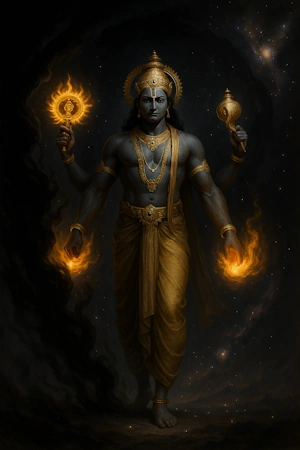
महाबुद्धिर्महावीर्यो महाशक्तिर्महाद्युतिः ।
अनिर्देश्यवपुः श्रीमानमेयात्मा महाद्रिधृक् ॥ १९॥

mahabuddhir mahaveeryo mahashaktir mahadyutih
anirdeshyavapuh shreemaan ameyatma mahadridhrik
महाबुद्धिः (Mahabuddhih)
He is Mahabuddhi — the One of great intellect, the Infinite Wisdom.
Not the dry intellect of books and arguments.
Not the cunning of worldly men.
But the shining, living wisdom that created the blueprint of existence itself.
He is the master artist who painted the galaxies,
the architect who mapped the cycle of karma,
the silent thinker behind the roar of the Vedas.
He is Mahabuddhi — the mind behind all minds.
महावीर्यः (Mahaveeryah)
He is Mahaveerya — the One of immense heroic power.
Not the reckless courage of a fool.
Not the empty bravado of kings.
But the unyielding, focused, divine courage
that faces the chaos of formlessness and says: Let there be order.
That faces death and says: I am beyond you.
He is the invincible seed from which all strength springs.
He is Mahaveerya — the hero whose very breath is conquest.
महाशक्तिः (Mahashaktih)
He is Mahashakti — the Great Power, the primordial energy.
Every movement in the universe — the spin of atoms, the march of seasons, the surge of devotion —
is a ripple of His Shakti.
He is the river and the tide,
the seed and the storm,
the whisper and the thunder.
Without Him, life would be an empty shell.
He is Mahashakti — the breath of existence itself.
महाद्युतिः (Mahadyutih)
He is Mahadyuti — the One of tremendous brilliance, the Great Radiance.
He does not merely emit light.
He is the very cause of light.
The sun owes its blaze to Him.
The fire owes its flame to Him.
The mind owes its sparkle of understanding to Him.
He is the unspoken brilliance that clothes the void in glory.
He is Mahadyuti — the first and final light.
अनिर्देश्यवपुः (Anirdeshyavapuh)
He is Anirdeshyavapuh — the One whose form cannot be described.
You cannot paint Him.
You cannot define Him.
You cannot capture Him in thought or word.
He is beyond shape and size,
beyond male and female,
beyond being and non-being.
He is the silent mystery smiling behind all appearances.
He is Anirdeshyavapuh — the formless form, the indescribable beauty.
श्रीमान् (Shreemaan)
He is Shreemaan — the abode of all auspiciousness, the possessor of eternal wealth.
But His wealth is not counted in gold or pearls.
It is counted in virtues — compassion, wisdom, strength, patience, grace.
He is the jewel box of the universe,
the treasure that kings and sages bow before.
He is Shreemaan — the eternal king whose riches never diminish.
अमेयात्मा (Ameyatma)
He is Ameyatma — the One whose soul cannot be measured.
No boundary can encircle Him.
No measuring stick can capture His essence.
He is the sky beyond the sky,
the ocean beyond the ocean,
the Self beyond the self.
He is Ameyatma — the infinite one whom the heart senses but the mind cannot fence.
महाद्रिधृक् (Mahadridhrik)
He is Mahadridhrik — the One who holds great mountains.
Literally and symbolically.
He lifted Govardhana on a single finger to shelter the cowherds.
He upholds the burdens of all creatures without breaking a sweat.
The mountains of karma, the mountains of grief, the mountains of pride —
He carries them all, and yet remains free as the wind.
He is Mahadridhrik — the Atlas of the cosmos, smiling, playful, invincible.
This verse, is not just a chant.
It is a rolling thunder across the soul.
Mahabuddhi. Mahaveerya. Mahashakti. Mahadyuti. Anirdeshyavapuh. Shreemaan. Ameyatma. Mahadridhrik.
Each name is a drumbeat, a trumpet call, a shining sword raised high.
Each name wakes up the hidden strength within you.
Each name whispers:
Rise, O soul! You were never small! You are His child! You are infinite too!
-
If wisdom is infinite, how can the human mind even connect to it without drowning in its vastness?
Through chanting any nama from the Vishnu Sahasranama, the mind learns to focus. Repetition acts like a bridge — it reduces distraction and makes the intellect receptive. Over time, this steady rhythm helps human intelligence align with higher wisdom without being overwhelmed. -
What makes courage here different from ordinary bravery seen in soldiers or athletes?
Ordinary bravery faces an opponent or situation, but this courage faces chaos itself. It is the inner refusal to collapse under despair. Chanting the Sahasranama strengthens resolve, giving families the backbone to stay calm when life’s storms rise. -
If power is everywhere in nature, why call it His and not just a neutral force?
Raw energy without direction leads to destruction. This power is conscious, channelled, and purposeful. When we recite the names, we are tuning ourselves to that higher current, learning to use our own energy in disciplined ways rather than scattered bursts. -
Light is explained as originating from Him, but how can something so physical be tied to the divine?
Every form of light — sunlight, fire, even the spark of thought — depends on a principle deeper than physics. That principle is divine brilliance. Reciting any nama with focus is like polishing the inner mirror; clarity and joy naturally appear, just as light dispels darkness. -
Why stress that His form cannot be described if symbols and stories are constantly used?
Symbols are teaching aids, not the final picture. They point but cannot capture. Chanting names trains the mind to accept mystery — to know that some truths can be experienced but not boxed in words. This humility itself transforms relationships and softens ego. -
What use is it to know that He holds mountains, when we never face such literal tasks?
The mountains here are burdens of life — debt, grief, conflict, responsibility. He holds them with ease to show that support is real and available. Japa of the Sahasranama gives inner steadiness so that one can carry family duties without breaking down.
-
How can you claim there is a mind behind all minds when human intellect is clearly shaped by biology and evolution?
Biology explains the mechanics, not the origin of intelligence itself. The order and coherence of natural laws show that thought is not random but rooted in a greater underlying intelligence. That directing source is what is meant by the mind behind all minds. -
Heroism usually means risking your life. How does calling him the seed of strength prove anything real?
Heroism here is not about reckless death-defiance but about sustaining order when chaos threatens to erase it. Strength has to come from an inexhaustible root, not temporary bravado. The idea is that all genuine courage draws from a deeper, unbreakable source. -
Energy is observable in physics. Why attach divinity to what is measurable and predictable?
Physical energy explains how systems behave, but it doesn’t explain why energy itself exists or why it follows consistent patterns. By calling it divine power, the text points to the source that underlies both the existence and direction of energy. -
Light has a clear physical cause. Why say it owes itself to him?
The sun and fire emit light due to reactions we can track, but those reactions themselves depend on finely tuned laws. The claim is that brilliance is not an accident but comes from a deeper cause that ensures these laws remain stable and effective. -
If his form cannot be described, isn’t that just a convenient escape from proof?
Not being describable does not mean non-existent. It means the reality exceeds the categories of shape and size we use. Just as numbers describe space but cannot capture love, words describe symbols but not ultimate reality. -
No one holds mountains. Isn’t this pure myth without relevance?
The lifting of a mountain is a symbol, but it also conveys a principle: overwhelming burdens can be sustained by a power greater than individual effort. The relevance lies in showing that what seems impossible at the human level can still be carried by a higher support.





English
Vishnu Sahasranama
Click on any topic to open
7
30
Astrology
Bhagavad Gita
Bhagavatam
Bharat Matha
Devi
Devi Mahatmyam
Ganapathy
Garuda Puranam
Glory of Venkatesha
Hanuman
Kathopanishad
Mahabharatam
Mantra Shastra
Mystique
Practical Wisdom
Purana Stories
Radhe Radhe
Ramayana
Rare Topics
Rigveda Explained
Rituals
Sages and Saints
Shiva
Spiritual books
Sri Suktam
Story of Sri Yantra
Temples
Vedas
Vishnu Sahasranama
Yoga Vasishta
26
17
10
0


