Maheshvaso Mahibharta ....
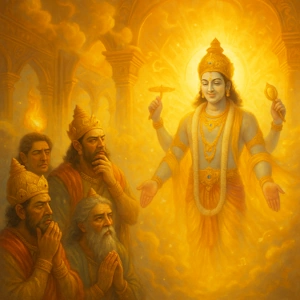
महेष्वासो महीभर्ता श्रीनिवासः सतां गतिः ।
अनिरुद्धः सुरानन्दो गोविन्दो गोविदां पतिः ॥ २०॥

maheshvaso mahibharta shreenivasah satam gatih
aniruddhah suranando govindo govidam patih
महेष्वासः (Maheshvasah)
He is Maheshvasa — the One who wields a mighty bow.
This is not just any bow.
It is the bow that curves the very horizon.
The bow whose twang sends terror through the armies of evil.
He does not pick up weapons to conquer for selfish gain.
He picks them up to protect dharma,
to shelter the trembling,
to smash the tyrants who think the world belongs to them.
He is Maheshvasa — the protector with the bow of justice,
the warrior who bends even fate to His will.
महीभर्ता (Mahibharta)
He is Mahibharta — the bearer of the earth, the sustainer of the worlds.
The earth rests on His strength,
not just physically, but spiritually.
The weight of human sins, the burden of endless cries, the heavy grief of countless souls —
He carries them all,
with patience deeper than the oceans.
He is Mahibharta — the silent Atlas,
smiling even as He bears the unbearable,
the pillar beneath the dance of life.
श्रीनिवासः (Shreenivasah)
He is Shreenivasa — the abode of Lakshmi, the residence of prosperity, beauty, and auspiciousness.
Lakshmi, the goddess of all that is sweet, pure, and uplifting,
chooses His heart as Her eternal home.
Why?
Because where He is, there is no decay, no darkness, no sorrow —
only the ever-fresh bloom of divine abundance.
He is Shreenivasa — the sacred treasure chest of the universe,
where all blessings come to life.
सतां गतिः (Satam Gatih)
He is Satam Gati — the goal, the refuge, the final resting place of the righteous.
The saints, the sages, the seekers —
they walk many paths, they endure many storms,
but ultimately, they fall at His feet like rivers merging into the sea.
He is the home after exile,
the harbor after storm,
the embrace after endless lifetimes of wandering.
He is Satam Gati — the sweet end of every true journey.
अनिरुद्धः (Aniruddhah)
He is Aniruddha — the unconquerable, the unstoppable.
Nothing can bind Him.
No force can check His will.
No power can cage His spirit.
He breaks the chains of time.
He shatters the walls of death.
He is the storm that cannot be trapped,
the fire that refuses to be quenched.
He is Aniruddha — the free, eternal surge of divine will.
सुरानन्दः (Suranandah)
He is Surananda — the delight of the gods.
When the gods despair,
when heaven trembles under the assault of demons,
when the pillars of righteousness seem ready to fall —
His very sight fills them with renewed hope.
A smile from Him is nectar.
A glance from Him is rescue.
He is the secret wellspring of joy behind every victory of light over darkness.
He is Surananda — the hidden music in the heavens.
गोविन्दः (Govindah)
He is Govinda — the protector of cows, the nurturer of the meek and the humble.
Cows — symbols of innocence, simplicity, life-giving bounty —
He guards them as one would guard a sacred fire.
But more deeply, He is Govinda because He protects the meek souls,
the ones who, like cows, wander trustingly in a world full of wolves.
He is the gentle protector,
the tender shepherd of souls.
Govinda is the whisper that says:
Do not be afraid. I am with you. Always.
गोविदां पतिः (Govidam Patih)
He is Govidam Pati — the Lord of all knowers of wisdom.
The true knower, the true wise one —
whether a scholar, a sage, a devotee —
ultimately surrenders at His feet.
Because knowledge, too, seeks its own source.
Wisdom bows before the One who is wisdom itself.
He is Govidam Pati — the king of the wise,
the crown above the crowns of the learned.
This verse is not just a collection of beautiful names.
It is a marching drum calling the soul to battle,
a sweet lullaby promising refuge,
a shining sword held aloft in triumph.
Maheshvasa. Mahibharta. Shreenivasa. Satam Gati. Aniruddha. Surananda. Govinda. Govidam Pati.
Each name a world,
each world a heartbeat of the divine.
-
If he already has a bow that terrifies evil, why chant his names instead of just relying on his power?
Chanting any nama from the Vishnu Sahasranama connects you directly to that protective force. The bow exists in stories, but its energy is invoked through sound. Even repeating one nama 108 times creates a shield of awareness, which steadies the mind and strengthens family bonds against fear. -
If he carries the burden of the earth, why should I add my small problems to that weight?
Your chanting is not adding weight, it is handing over what you cannot carry. Reciting any nama slowly allows stress to dissolve into his strength. This lightens the load on your body and helps you stay calm with loved ones. -
If he is the home of all abundance, what is the point of my chanting when wealth is uncertain?
Wealth is more than money; it is health, harmony, and dignity. Chanting any nama 11 times daily keeps your heart aligned with that abundance. Families who anchor themselves in such chanting often find stability even when finances fluctuate. -
If the righteous finally reach him anyway, why chant at all?
Chanting shortens the distance and clears confusion. Instead of wandering in circles, reciting the Sahasranama steadily acts like a compass. It gives clarity in daily choices and brings unity within the family journey. -
If nothing can bind him, what does my chanting achieve?
Your chanting doesn’t change him, it changes you. Repeating a nama 108 times releases your own inner chains of fear and anger. This freedom reflects in your health, your work, and the way you relate to people around you. -
If he is the joy of the gods, why would ordinary humans chant his names?
Because joy is not limited to the heavens. When you chant any nama from the Sahasranama slowly, you touch the same source that refreshes even the gods. It fills your home with quiet happiness that supports family harmony and physical well-being.
-
If he already has a bow that bends the horizon, how is that different from mythic exaggeration?
The bow is a symbol of unchallengeable authority. In traditions across cultures, weapons represent power to enforce justice. Here it signals that no ruler or tyrant can ultimately claim the world, because power rests in a force beyond them. -
If he carries the earth, why hasn’t he prevented ecological collapse or human suffering?
Carrying the earth means sustaining its very existence, not micromanaging every human choice. The planet continues to orbit, seasons turn, and life persists despite repeated shocks. That underlying stability is attributed to the bearer of worlds. -
If prosperity lives in him, why is poverty still so widespread?
Prosperity in this context is not limited to material wealth. It means the principle that renewal and abundance are possible, even after ruin. Civilizations rise again after collapse, and families rebuild after loss — that continuity is the mark of what is called prosperity. -
If the righteous end up with him anyway, why is effort needed at all?
The point is direction, not compulsion. Rivers flow into the sea whether calm or turbulent, but their journey is shaped by terrain. For seekers, aligning with the goal makes the path smoother and the arrival certain. -
If he is unconquerable, does that not make him irrelevant to human struggle?
Being unconquerable means he remains the measure beyond all temporary victories or defeats. Every empire falls, every ideology fades, yet life endures. That endurance is what the name points to. -
If he is the joy of the gods, how does that affect ordinary humans who never meet these gods?
The gods in this language are forces of order, light, and stability. Their joy signals that the structure of existence has not collapsed. Humans share in that by living within a cosmos that still holds together rather than dissolving into chaos.





English
Vishnu Sahasranama
Click on any topic to open
7
30
Astrology
Bhagavad Gita
Bhagavatam
Bharat Matha
Devi
Devi Mahatmyam
Ganapathy
Garuda Puranam
Glory of Venkatesha
Hanuman
Kathopanishad
Mahabharatam
Mantra Shastra
Mystique
Practical Wisdom
Purana Stories
Radhe Radhe
Ramayana
Rare Topics
Rigveda Explained
Rituals
Sages and Saints
Shiva
Spiritual books
Sri Suktam
Story of Sri Yantra
Temples
Vedas
Vishnu Sahasranama
Yoga Vasishta
26
17
10
0


