Lord Rama Begins to Reveal His Inner Struggle
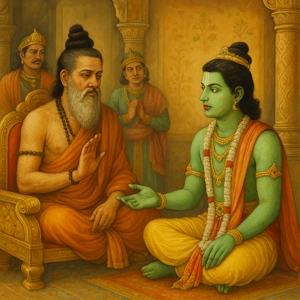
When sage Vishwamitra asked him what is troubling you, Lord Rama opened up.
I was born here, in this palace. Completed my education. Then I went on a pilgrimage. I roamed all over. Went up to the ocean in all directions.
I don’t trust this world anymore. I will tell you why.
My mind developed power of discretion after I undertook this pilgrimage. I am able to see things clearly now. I started thinking. Can this world ever give happiness? No. Because –
Why do you take birth – only to die after some time. Death is sad. You know death cannot give happiness. And you are certain to die. So you are taking birth only to die.
Can death give peace and happiness? No, because you have to take birth again and suffer. मृतिबीजं भवेज्जन्म जन्मबीजं भवेन्मृतिः
Birth is the seed of death. Death is the seed of birth.
Even going by experience, death is painful. Death happens mostly after suffering old age. If you have seen how people die, you know it is not a great experience.
So is birth — labour pain, bleeding, crying — even for the child it is not a pleasure-giving experience.
Both birth and death — they are not experiences that give pleasure.
The events as they are. We celebrate a childbirth. But, look at the event. There are also some deaths which are considered a relief. But look at what precedes this. There is no pleasure in it. It is always pain.
Agreed that birth and death are painful, but life in between these two can give pleasure. Life is capable of giving pleasure, happiness.
There are two kinds of living beings — movable and immovable.
Movable are us — humans, animals, birds. Immovables are the trees, plants.
For the immovables — pleasure, if they have something called pleasure. For example, a tree is dry. There is no water. Then it rains. It gets water. This should give the tree happiness.
But then the tree has no role in this. It cannot make effort to get water. It cannot try to get water. Water has to come to the tree. So the tree has no role to play. Someone else is in command. Someone else is controlling this.
In the case of movables, the so-called pleasure comes out of effort.
If food gives you pleasure, you have to take it with your hand, put it in the mouth, then only it gives pleasure.
For the movable living beings, the so-called pleasure comes out of effort.
This distinction should be clearly understood.
But then, are these objects which we think are capable of giving pleasure — are they reliable?
Who will you call reliable, dependable — somebody who will always care for you, will always give you happiness?
But these objects are not like that.
Their presence gives pleasure. Their absence gives sadness, grief.
Good food can make you happy for some time. But its absence? You will be in grief.
Can you call them reliable?
It is a dependence. It becomes a sort of addiction.
Watching a TV program that you like entertains you for some time. Gives you happiness for some time.
But, one day if electricity is not there, there is no signal. You become restless, start complaining.
The same program, by its absence, is giving you trouble now.
Are these kinds of objects of pleasure reliable?
You can never rely on such objects of pleasure. Because there is no assurance about their availability.
Mind assumes so many things.
When you see a bag full of nails, we think that they are together. They are related to each other. They are a group. But the nails — they are not related to each other. Each one is independent. They have no connection between each other. We think they are together. This is a play of the mind. This is what we do with most of the things.
Those Americans. Those Russians. These North Indians. These South Indians. They are individuals. We are just falsely grouping them together.
We see something and we start imagining.
See a car, you start imagining, you start visualizing — I will get this car. It will improve my status. We will go here. We will go there. You will see yourself sitting in that car, driving that car.
This is the play of the mind. It can make anything out of anything.
You are at the airport. A person sitting next to you leaves a bag behind and goes somewhere. You start imagining.
Is he a terrorist? Is it a bomb?
This is how your mind plays.
And it is this mind that you are trying to pamper. You spend your whole life trying to pamper this mind.
To experience pleasure, pain, fear — the mind doesn’t even need a real object or incident. It can simply imagine things and undergo experiences.
It is this kind of mind that you are putting all kinds of efforts to pamper.
Do you think it is that tasty food which is giving you that pleasure?
You are sitting in a restaurant relishing your favourite dish. A dog comes running in, barking, biting people.
Can you still enjoy that food?
It is still there in your mouth, but then?
So, where is this pleasure centre? Is it in your mouth, on your tongue? No.
It is in the mind. When the mind is disturbed, you don’t get the pleasure anymore.
So, if you think objects can give pleasure, that is wrong. That is ignorance.
This is what Prahlada also told his friends.
We don’t even know what pleasure is.
We confuse removal of pain or removal of grief to be pleasure.
Food can give you happiness only when you are hungry.
On a full stomach you can’t enjoy food anymore.
So for enjoyment of food, hunger has to be there — which is a pain, which is a grief.
The more hungry you are, the more you enjoy your meal.
The pleasure that objects can give — for that, pain is a pre-requisite.
Longing is a pain. Longing for something is a pain.
Oh I don’t have this. I should have this. It will trouble you. It is a pain.
And the object you are longing for — when it comes, it can only remove that pain or grief. It can’t do anything more than that.
-
Life becomes disillusioning when one begins to think deeply and observe the world without filters.
-
A true pilgrimage is not about distance but about awakening the inner eye to see how the world actually functions.
-
Dispassion arises when one sees that birth leads only to death, and death leads again to birth — a loop without peace.
-
Pain is embedded both in entering and exiting life; neither birth nor death offers real joy.
-
Even the so-called joys of life exist sandwiched between suffering — effort before, fear of loss after.
-
The cycle of birth and death (called samsara) is powered by desire and ignorance — not by real happiness.
-
Life's pleasures seem real only because the mind is constantly projecting meaning and value onto things.
-
Sense-objects are not reliable sources of happiness — they please in presence but torment in absence.
-
A pleasure-giving thing turns into a pain-causing one the moment it's taken away — that's not true joy, it's dependency.
-
The mind wrongly assumes connections between things and people — it creates imaginary groups and meanings.
-
Even without any real event, the mind can create pleasure or fear just by imagination.
-
We pamper this unstable, projecting mind as if it's the center of truth, while it keeps us trapped.
-
Pleasure is not in the object — it's in the state of mind. A disturbed mind cannot enjoy even the most delicious food.
-
Removal of pain is mistaken as pleasure — but it's just neutralizing discomfort, not gaining joy.
-
Hunger makes food enjoyable. Without hunger, the same food gives no thrill. So pain becomes the base of pleasure.
-
Longing itself is painful. And when the object is attained, it merely ends the pain — it doesn't add joy beyond that.
What triggers Rama's disillusionment with life?
He begins to see the world clearly after his pilgrimage. He notices that everything — birth, death, pleasure — is entangled in suffering. This clarity shakes his earlier trust in worldly experiences.
Why does inner reflection feel more real than outward activity?
Because you start noticing the patterns — like how every joy ends in fear or grief. That realization makes surface-level happiness feel hollow.
Isn't this just youthful melancholy?
No. This isn't depression; it's sharp observation. Disenchantment born from clarity isn't weakness — it's maturity.
Why is the cycle of birth and death called pointless?
Because it traps you in repetitive experiences of sorrow. You are born only to die, and die only to be reborn again. There's no lasting peace anywhere in the loop.
Can’t you enjoy life in between birth and death?
You can, but only briefly and never without cost. Every joy here is rented, not owned — it comes bundled with anxiety and effort.
But isn't birth itself a miracle?
The miracle is wrapped in blood, pain, and helplessness — both for mother and child. Look at the facts, not the celebration.
Why is the pleasure of objects called unreliable?
Because they comfort only when present. The moment they're missing, you feel incomplete or restless. That kind of dependency is fragile.
What’s wrong with enjoying something while it lasts?
Nothing, if you’re aware it’s fleeting. But most people get attached, and the absence of it causes them suffering.
Isn’t it better to enjoy what we get instead of overthinking?
Blind enjoyment leads to addiction. True wisdom is knowing when something controls you instead of you choosing it freely.
What does the mind really do with reality?
It adds its own filters, assumptions, and stories. It sees random objects and stitches imaginary meanings and emotions into them.
Why does the mind create illusions like this?
Because it cannot stay still. It needs something to chew on, to project, to own. So it makes drama out of dust.
Aren’t some assumptions useful for survival?
Sure, but they’re dangerous when you forget they’re just assumptions. When they harden into 'truths', they start blinding you.
Can the mind experience fear or pleasure without real events?
Yes. It can imagine joy, pain, or terror out of nothing. A barking dog or an abandoned bag can trigger full-blown panic — even when harmless.
Doesn’t this prove how powerful the mind is?
It does — but uncontrolled power causes chaos. A projector is useful only when it plays the right film.
Isn’t emotional response to imagination part of creativity?
Only if you can switch it off. If imagination hijacks reality, then you're not creating — you're being dragged.
Is food itself the source of pleasure?
No. The mind interprets the experience as pleasure only when it's calm and ready. Disturbance kills taste instantly.
Why do we think food makes us happy then?
Because we forget the role of inner state. The same meal feels heavenly or disgusting depending on the mood.
So where is the real pleasure located?
In the mind — or rather, in the silence of craving. When mind is still, joy flows. When mind is agitated, even nectar tastes bitter.
Why is removal of pain mistaken for pleasure?
Because the relief feels good. But it’s not the same as actual positive joy — it’s just a return to zero.
So is all pleasure really just pain ending?
Most of it, yes. Hunger gone feels like joy, but it's really just relief. That’s not true contentment.
Does this mean we should avoid all joy?
No — it means we should see joy clearly. Don’t be fooled into chasing shadows and calling them light.
How does longing create suffering?
Because it constantly reminds you of lack. The gap between what you want and what is — that’s where suffering grows.
Isn't longing natural?
Yes, but natural doesn’t mean peaceful. Fire is natural too — but it burns unless controlled.
So desire leads only to sorrow?
Desire creates unrest. Fulfillment only ends that unrest. It never adds something lasting. The net emotional gain is zero.





English
Yoga Vasishta
Click on any topic to open
7
30
Astrology
Bhagavad Gita
Bhagavatam
Bharat Matha
Devi
Devi Mahatmyam
Ganapathy
Garuda Puranam
Glory of Venkatesha
Hanuman
Kathopanishad
Mahabharatam
Mantra Shastra
Mystique
Practical Wisdom
Purana Stories
Radhe Radhe
Ramayana
Rare Topics
Rigveda Explained
Rituals
Sages and Saints
Shiva
Spiritual books
Sri Suktam
Story of Sri Yantra
Temples
Vedas
Vishnu Sahasranama
Yoga Vasishta
26
17
10
0


