We Are Like Sold Animals
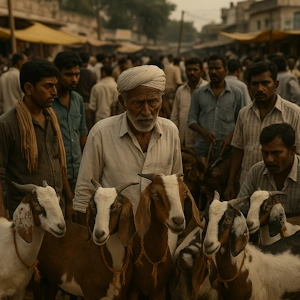
The ideas of pleasure and pain superimposed on objects like – oh, this food will make me happy, that place will make me feel miserable.
They are not the only creations of the mind.
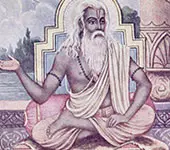
Lord Rama is explaining to Sage Viswamitra why he is gloomy. After the pilgrimage, he has come to realize all these. Even concepts like birth and death are fallacies created by the mind. This entire world is a creation of the mind.
But after you realize this, can that mind give you happiness? Forget external objects — can that mind at least give you happiness after realization?
No.
Then the mind goes blank. Once you have understood the ways of the mind, then the mind goes blank. Even that mind cannot give you happiness. External objects cannot give happiness. They can only remove pain, which you think what happiness is.
External objects and the world itself is a creation of the mind. You have understood this and expect that now at least happiness will come. The self-realized mind — which could take a position that — oh, I was only creating problems for myself — even that mind cannot give happiness.
मनश्च असदिवाभाति शुन्यमिव आभाति
It goes blank.
Be careful, we are talking about happiness, not peace. They are not the same.
Why are we even thinking that there can be happiness in this world? Why are we even presuming that there can be happiness in this world?
Like animals in a desert under the influence of mirage, running here and there thinking water is there — this is how we are — chasing happiness, looking for happiness, and getting disappointed every time.
We are like sold animals. Helpless. Sitting helpless. All freedom lost. Total helplessness.
Even when you know that this is all maya — illusion — still, there is no escape from it. Helplessness of sold animals — that is what we are going through.
This realization that this is all maya also is not helping.
An animal falls into a trap. A pit has been dug, covered with twigs and leaves to cover it up. The animal falls into it. It is trapped. After some time, after a long time, it realizes — oh, I have been trapped, I am inside a pit.
This realization comes. But how does it help? Just because the realization comes, can it escape? Can the animal come out?
This is the state we are in.
What am I going to do by inheriting a kingdom? What am I going to do with pleasures and comforts? Who am I? Why am I even here?
Let illusions remain illusions — let us not complicate them any further.
Then the Lord asks Sage Vishwamitra questions:
किमिदं परिणश्यति ?
किमिदं जायते भूयः ?
किमिदं परिवर्धते ?
If this world is for real — why is it coming to an end?
If this world is unreal — why is it getting created again?
If it is neither real nor unreal — what are these phenomenons — like animals, plants multiplying, increasing in number?
So, it is not even like the world is there now, now it is gone. Not just two states. There are states in between. How is this to be explained?
जरामरणमापच्च जननं संपदस्तथा
आविर्भावतिरोभावैर्विवर्धन्ते पुनः पुनः
So many of these transformations — old age, death, progress, fall, rise and fall, prosperity, poverty, presence, absence — what are all these? Are they real, unreal, or neither real nor unreal?
We are being shaken by these experiences like how trees on mountaintops are shaken by a storm. That is our condition.
And whoever is talking — both the ignorant and those who talk as if they know the truth — they are like those flutes making sound while the wind blows through them.
They have nothing of their own. They know nothing of their own. It is some wind blowing through them which makes them make sound, talk.
My thoughts are like a fire kept in a hole in a tree which is withered and dry. This fire is consuming me. My thoughts are like this fire.
My heart is heavy. I want to cry. I don’t, thinking about my friends and relatives — if I break down, they will all break down. Still, I am crying, without tears in my eyes.
There is no happiness on my face. Sometimes I am pretending to smile. I can see this myself. I am witnessing myself.
A man who was rich has fallen, lost everything and become poor. How he would think about his glorious past and feel good — this is how I am at times, thinking how my life used to be.
But one thing I am sure — these pleasures, prosperity — they spoil you, they corrupt you. They delude you and eventually make your life miserable.
Nothing excites me — family, children — nothing excites me anymore. These are all traps I know that will lead to misery. I have realized this.
My state in this body is also like that of an animal which has fallen into a trap.
We are surrounded by this darkness called ignorance — this night called ignorance. Even the lamp, which is real knowledge — even that lamp has extinguished.
All these objects of pleasure, passions, likes, dislikes — they are robbers trying to attack you from all sides, trying to snatch the only precious gem that you have got, which is viveka — discretion.
Who can save you, who can protect you from these robbers who are trying to take away your viveka buddhi?
All tattva jnanis — they are the soldiers who will come to your rescue and protect you from losing your only precious asset — your viveka buddhi.
The Lord is telling all these to Sage Vishwamitra.
-
The mind wrongly paints external objects as causes of pleasure or pain, but they hold no such power on their own.
-
Even birth, death, and the world itself are mental projections, not independent realities.
-
Once a person realizes this illusion, even the mind loses its grip — it cannot offer joy anymore.
-
Realization doesn't bring emotional bliss; it just ends the chase, leaving the mind blank.
-
External pleasures don’t create happiness — they only dull pain temporarily, which people confuse as joy.
-
Knowing that the world is maya (illusion) doesn’t automatically free you from it; the entrapment remains.
-
This struggle is like a trapped animal — even after realizing it’s trapped, it can’t escape.
-
The world behaves in confusing ways — growing, dying, multiplying — yet defies all neat categories of 'real' or 'unreal'.
-
Life brings rise and fall, joy and pain, but no explanation fully accounts for their nature.
-
People, whether ignorant or wise, often just echo borrowed ideas without original insight.
-
Deep sorrow can burn silently inside like fire in a dry tree — visible only to oneself.
-
Social roles and past joys become sources of pain once clarity arises.
-
Prosperity and pleasure corrupt awareness — they pull you deeper into delusion.
-
The body becomes a trap, just like a pit dug in a forest for prey.
-
Distractions, passions, and preferences are like bandits trying to rob you of viveka — your power of discernment.
-
Only true tattva-jnanis (knowers of truth) can help protect and restore that inner clarity.
What does it mean when the mind can't bring happiness after realization?
Realization shows that both joy and sorrow were mental fabrications. Once seen through, the mind loses its usual tools of stimulation, leaving a blank stillness. There's no thrill anymore, only silence. The craving dies.
Why does realization not feel blissful like people say?
Because it’s not about feeling good. It’s about seeing clearly. Once illusions drop, you no longer chase excitement. That calm may look like emptiness at first.
Isn’t a blank mind just depression or burnout?
No. Depression is pain from unfulfilled desire. This is the absence of desire itself — neither high nor low — just still awareness.
If external pleasures don’t create happiness, why do we feel good when we get them?
What you call pleasure is often just relief — removal of inner restlessness. The object didn't give joy; it briefly distracted or eased an internal itch.
Then what is true happiness, if not this?
True happiness isn’t tied to anything outside. It’s a deep, steady clarity untouched by gain or loss. What you usually feel is the pleasure of forgetting pain, not real joy.
But I enjoy food, music, friendships — are they all fake?
Enjoy them, but see them for what they are — momentary sensations. They’re not the source of happiness, only temporary diversions. Don’t confuse sugar with nourishment.
How is the world a projection of the mind?
The mind superimposes meaning, labels, and value on things. Without that, the world is just patterns of form and motion. Birth, death, success — these are mental interpretations stitched onto raw experience.
If the world is mental, does that mean nothing exists?
Things exist as appearances, not as fixed truths. Like dreams — vivid while they last, but without substance when examined deeply.
Is this just philosophical fancy?
No — look closely. The same event can make one person laugh and another cry. That tells you it’s not the event, but the mind’s filter, that creates the reality.
Why doesn’t realization free us from maya immediately?
Because maya isn’t just false ideas — it’s habit. Even after knowing it’s a dream, your body and emotions are conditioned to react. Knowing alone isn’t liberation.
So what’s the point of realizing then?
It stops you from sinking deeper into illusion. You stop fueling it. That awareness slowly weakens maya’s grip.
If knowledge can’t free us, what can?
Only lived clarity. When knowledge matures into constant inner detachment, maya loses its anchor. It’s a process, not a switch.
What’s the point of asking philosophical questions like 'is the world real or unreal'?
To show how concepts break down. Real and unreal don’t fully apply to this shifting world — it changes yet persists, appears yet dissolves. No single label fits.
Why not just accept the world as it is?
Blind acceptance keeps you trapped. Inquiry loosens your dependence and frees you from reacting automatically to appearances.
Isn’t this just overthinking?
Not if it leads to inner freedom. Overthinking binds. Inquiry liberates — when done with the intent to break falsehood, not feed ego.
What do metaphors like trapped animals mean here?
They show how realization isn’t enough without action. Like a deer that knows it’s trapped but can’t climb out — you see your bondage, but you’re still in it.
Why is this insight so important?
Because it humbles you. It kills the pride of ‘I know’. You start looking for deeper transformation, not just intellectual answers.
If I can’t escape even after realization, what hope is there?
Hope lies in persistence. The trap is mental — and what binds the mind can also be untied by the mind, with patient inner work.
Why compare people to flutes blown by wind?
It mocks the idea of authority. People just repeat what flows through them — they don’t own it. Their opinions are echoes, not insight.
Then whom should I trust?
Those who speak from lived truth, not borrowed theory. You’ll know them by their silence, not noise.
Isn’t all learning second-hand anyway?
Not when it awakens first-hand experience. True learning turns borrowed words into personal clarity.
Why does realization bring sorrow instead of joy?
Because it exposes everything you trusted as false. The heart grieves its own self-deception before it can be free.
So is sorrow a necessary step?
Yes. You must mourn the illusions before detachment sets in. It’s the inner funeral before rebirth.
Can’t I skip this sorrow and go straight to peace?
Not really. Avoiding sorrow keeps the illusions alive. Facing it dissolves them. Real peace is on the other side.
How does wealth and pleasure corrupt awareness?
They create false security and dull your questioning. You get drunk on comfort and forget your bondage.
Can’t I enjoy wealth and still be wise?
Only if you’re inwardly free. If not, wealth will own you — not the other way around.
Is poverty then better for spiritual growth?
Not necessarily. But discomfort makes you ask deeper questions. Comfort often puts the soul to sleep.
Why call the body a trap?
Because you identify with it, guard it, decorate it — but it’s fragile, temporary, and a carrier of suffering.
But don’t I need the body to do anything at all?
Yes, it’s a tool. But when you confuse the tool for the self, suffering begins. Use it, but don’t be bound by it.
Isn’t this just body-hating?
No — it’s body-disentangling. Respect the body, but don’t build your identity around it. That’s the trap.
What are these ‘robbers’ that steal viveka?
Cravings, attachments, and opinions. They crowd the mind, making it impossible to see clearly.
How can I guard my viveka?
Stay alert. Question your impulses. Keep your inner lamp lit through discrimination and company of the wise.
Aren’t these just poetic warnings?
They’re real. One rash decision, one unexamined belief, and you lose years to confusion. Viveka is fragile — guard it like treasure.
Who are the tattva-jnanis and how do they help?
They are those rooted in truth — not just knowing it, but living it. Their presence, words, or even silence cuts through illusion.
How do I find such people?
You’ll know them by what they awaken in you — not dependence, but clarity and strength.
Is it safe to rely on another for protection?
Only if they don’t want anything from you. A true jnani doesn’t bind — they free. They point you back to your own light.





English
Yoga Vasishta
Click on any topic to open
7
30
Astrology
Bhagavad Gita
Bhagavatam
Bharat Matha
Devi
Devi Mahatmyam
Ganapathy
Garuda Puranam
Glory of Venkatesha
Hanuman
Kathopanishad
Mahabharatam
Mantra Shastra
Mystique
Practical Wisdom
Purana Stories
Radhe Radhe
Ramayana
Rare Topics
Rigveda Explained
Rituals
Sages and Saints
Shiva
Spiritual books
Sri Suktam
Story of Sri Yantra
Temples
Vedas
Vishnu Sahasranama
Yoga Vasishta
26
17
10
0


