Body as Tree, Mind as Monkey
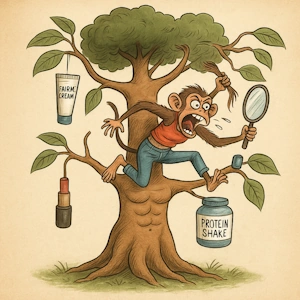
Lord Rama is comparing the human body to a ficus tree, a fig tree. This tree grows in a forest. Mind like a monkey jumping from branch to branch of this tree. The attention of the mind keeps on shifting from one aspect of the body to another. This is what mostly the mind does.
How do I make my hair not to fall? What dress would suit my height? With what color of dress should I decorate this body? How do I make my complexion fair? How can I develop six pack?
Not how alone. So many negative thoughts also. I am not handsome. My teeth don’t look nice. My smile is not attractive. Is there any time when your mind is not involved in thinking about some part of this body or the other? Including status, reputation, safety.
And like a monkey these thoughts are not steady also. They keep on shifting from one to another.
There are flowers on this tree. They are worries, anxieties, insecurities. They are there for everyone to see, like flowers. They attract others towards you. When they see that you are worried, some come and add to your worries. Some come to console you. Some come to take advantage of you.
Insects have eaten up this tree from all around. What are these insects? Worries are mental. They are in the mind. But these insects are actual sufferings, physical, mental. Somebody’s health is gone. Somebody’s money is gone. They are all sad. The healthy tree that once was or is supposed to be, it is now eaten up by insects all around.
There is poisonous snake which has made this tree its home. That is desire. The crow called anger, rage has also made its nest in this tree. Sometimes, a smile, a laughter, such flowers also are there in this tree as flowers, but rare. Most of the flowers are worries and anxieties.
This tree bears two fruits, only two fruits. The other flowers never mature into fruits. What can worries mature into? What can smile mature into? The only two fruits of this tree are punya and papa.
There are creepers spreading out of this tree, they are the hands. Apparently looking harmless. But see, what all mischief they keep on doing. All the leaves of this tree are moving, they keep on moving. These are the various organs. They keep on moving as long as pranavayu is there.
Other than the crow, there are other birds also who have made their nests on this tree. They are the indriyas, the jnanendriyas and karmendriyas.
The lower body is the trunk of this tree. It’s a tall tree. The shade of this tree is the comfort and confidence you feel when you are young. Kamadeva is a traveller who takes shelter under this shade. The hair are the roots of this fig tree growing downwards.
A vulture also lives on this tree, which is ahamkara. The vasanas as roots envelope the trunk of this tree. Because of this it is very difficult to cut this tree.
Lord Rama says, whether this tree survives or not, what difference does it make? What benefit does it give to anyone? This is the real nature of this tree.
Lord again compares the body to a house owned by ahamkara. Ahamkara is the owner of the house. His wife is desire. She keeps on moving about inside this house. The animals of this house are the sensory organs. Always restless, always seeking and ready to go out.
Kamadeva has painted this house with many colours, trying to make it attractive. The vertebrae, like arrows in a full quiver with no space in between, are rubbing against each other. It is suffocating. The intestines like ropes keep this body bound. Hunger and need to consume food from time to time have made this body bound, immobile.
I don’t like this body. I don’t find anything good about this body. Not only the intestines, the nerves, blood vessels. They are like ropes which hold this body in its place. This house is surrounded by trenches filled with blood.
In old age, all the colours painted by Kamadeva fade and disappear. It becomes just a house painted white with lime. The gray hair is being compared to lime.
I don’t like this body. I don’t want anything to do with this body.
This house is resting on the foundation called ignorance, false knowledge and notions. There is a servant called mind in this house. He has maintained this house so well. He keeps on repairing it, no matter what. With him working inside the house, this house will never fall.
There are noisy children in this house, making a ruckus throughout. Crying loudly, they are the miseries. There is a maid also in this house, bad behaviour. The only peaceful place in this house is the bedroom, the bed, which is sleep, license.
I have no fancy for this house, this body.
Says Lord Rama, in the 18th Sarga of Vairagya Prakarana of Yoga Vasishta.
-
The body is like a fig tree, with the mind behaving like a restless monkey, jumping between its parts and constantly thinking about how it looks or functions.
-
This monkey-mind doesn’t stay still — it obsesses over hair, skin, shape, beauty, reputation, and even imagined flaws, feeding anxiety.
-
Most thoughts are rooted in dissatisfaction and self-doubt, creating a nonstop inner storm.
-
The ‘flowers’ on this body-tree are our visible emotions — mostly worry, fear, and insecurity — which attract others to interfere, sympathize, or exploit.
-
Physical and mental pain are like insects eating away at the tree; they ruin what was once healthy, just as diseases and losses damage our well-being.
-
Desire is a venomous snake living inside the tree, while anger is a crow nesting in it — both are always present and destructive.
-
Rare moments of joy or laughter exist, but they are outnumbered by anxious and negative feelings.
-
Despite many emotional expressions, the only two karmic outcomes of living in this body are punya (merit) and papa (demerit).
-
Hands are like creepers extending from the body-tree — they look harmless but are often agents of wrongdoing.
-
The body's organs are like leaves constantly moving with breath; they are active only as long as life-force (prana) flows.
-
The senses (indriyas) are like birds nested in the tree — some gather knowledge (jnanendriyas), others perform actions (karmendriyas).
-
The lower body is the trunk, and the hair are the roots; pride (ahamkara) is a vulture living atop, making the tree hard to uproot.
-
Desires (vasanas) act like strong roots wrapping around the trunk, making detachment difficult.
-
The tree gives shelter to ego and pleasure-seeking urges, but does not offer lasting peace or meaning to anyone.
-
The body is also like a house, owned by ego (ahamkara), with desire as its restless wife and the senses as unruly animals.
-
Kamadeva (god of desire) decorates this house to make it attractive, but beneath the surface lies discomfort and bondage.
-
The body is kept tied by its own systems — intestines, nerves, and blood vessels act like ropes keeping it from freedom.
-
As the body ages, all superficial beauty fades — grey hair is like limewash on a once-colored wall.
-
This house rests on ignorance and false notions, yet the mind-servant keeps it intact by constantly patching it up.
-
The house is noisy with inner miseries (like children crying) and poor conduct (like a maid misbehaving), with only sleep offering some relief.
-
Lord Rama declares no admiration for such a body — it gives no true benefit and only adds layers of bondage.
What does it mean to say the mind is like a monkey in the body-tree?
The mind constantly leaps between different body concerns — appearance, status, and discomforts — never staying settled. It's restless and reactive, always focusing on what’s wrong or what needs fixing. This monkey-like nature fuels endless dissatisfaction.
Why is the mind so obsessed with the body all the time?
Because the body is the most immediate and visible part of ourselves. We're taught to measure worth by appearance, health, or reputation, so the mind keeps checking and rechecking where we stand.
Isn't body-awareness necessary for health and hygiene?
Basic care is fine, but obsession is the issue. When every waking thought is about flaws and comparison, it traps the mind in insecurity. That’s not health — that’s bondage.
What are the 'flowers' on the body-tree?
They are visible emotional states — mainly worries, anxieties, and insecurities. Others easily notice these emotions and react, sometimes by adding to our troubles.
Why do people exploit someone who's visibly worried?
Weakness attracts interference. Some will pretend to help but deepen the worry, while others may use your vulnerability for their gain.
Aren’t emotions natural and human?
They are, but constantly showcasing them makes you vulnerable. A stable mind manages emotions inwardly without advertising its wounds.
What do the insects on the tree represent?
They symbolize suffering — both physical pain and mental distress. These feed on the body and mind just like insects devour a tree.
How do invisible mental worries become real suffering?
Stress affects sleep, digestion, and immunity. Emotional distress can ruin physical health and relationships — the damage is real, not imaginary.
But pain is inevitable in life — how can it be avoided?
Avoidance isn’t the goal — clarity is. When you see pain as passing, you don’t let it consume your identity. That’s the way out.
What does the snake and crow on the tree signify?
The snake is desire — it silently poisons the mind. The crow is anger — loud and disruptive. Both live in the same body, shaping behavior and destroying peace.
How can we get rid of desire and anger?
By seeing their impact clearly. They promise pleasure or power but end in regret and damage. Awareness weakens their grip.
Isn’t desire necessary for growth?
Desire for wisdom or truth is different from craving. The first uplifts, the second enslaves. It’s not desire itself, but its direction, that matters.
Why are most flowers on this tree useless?
Because joy, laughter, or beauty rarely lead to deep change. Most emotions vanish fast. Only punya (merit) and papa (sin) — the two true karmic outcomes — remain as fruits.
So are feelings pointless?
Not pointless, but fleeting. Actions based on wisdom create lasting impact; emotions don’t leave such marks unless they push action.
How can we know if we’re collecting punya or papa?
Look at intention and impact. Selfless acts, done with clarity, bring merit. Harmful acts, driven by ego or desire, lead to demerit.
Why are the hands described as creepers?
Because they spread out from the body like vines — seemingly gentle, but capable of endless mischief and wrongdoing if not controlled.
Aren’t hands tools of karma — they can do good too?
Yes, but they follow the mind. If the mind is impure, hands become agents of harm. Their harmless appearance hides potential danger.
Isn’t it unfair to blame the hands?
They’re symbolic. It’s about how we act. The real issue is lack of awareness — not the hand itself.
What do the leaves and birds on the tree represent?
Leaves are the organs that keep functioning as long as breath exists. Birds are the senses (indriyas), some seeking knowledge, others taking action.
Why compare senses to birds?
Because senses are restless and prone to wander. They need constant attention, or they carry the mind into chaos.
Can we live without the senses being active?
We can’t shut them down, but we can guide them inward. Discipline turns distraction into strength.
What is the ego’s role in this body-tree?
Ego (ahamkara) is like a vulture — sitting high, always watching, feeding on pride and identification with the body.
Why is ego compared to a vulture?
Because it feeds on decay — it thrives when wisdom dies. It clings to identity even when everything else falls apart.
Can’t ego be useful — like confidence or dignity?
Ego builds illusions of self-worth. True dignity comes from clarity, not from clinging to a false identity.
Why is the body also compared to a house?
Because it hosts various residents — ego, desire, senses, mind, habits — all playing different roles and driving behavior.
Is the house well-kept or falling apart?
It looks good from outside, decorated by desire. But inside, it’s full of discomfort, bondage, and noise.
If it’s so messy, why maintain it at all?
Basic upkeep is fine, but blind attachment is the trap. The house is a tool, not the treasure.
What happens to this house as it ages?
All the colours of youth fade. What once attracted now turns pale and fragile. The shine disappears, leaving only traces of what once was.
Why compare grey hair to lime paint?
Because it's a dull cover-up. It shows how outer beauty is temporary and easily erased by time.
Does old age always mean decay?
Physically yes, but not spiritually. If you see clearly, age can be the doorway to wisdom — if not, it’s just slow collapse.
What keeps this flawed house still standing?
The mind. Like a dedicated servant, it keeps fixing and adjusting, no matter how broken the structure is.
Why doesn’t the mind stop?
Because it’s trained to hold things together — even illusions. Until it learns detachment, it will serve the false master.
Isn’t repair a good thing?
Yes, but not if the house is built on ignorance. Real repair starts with truth, not patchwork.
Who are the noisy children and maid in this house?
The children are miseries — always crying, always demanding. The maid is bad behavior — moving freely inside.
What is the only peaceful spot in the house?
Sleep. It’s like a bedroom — the only place where rest and relief are possible, though temporary.
Can sleep be a solution to suffering?
No — it’s a pause, not a cure. When you wake up, the same house, same chaos returns. Only inner clarity offers lasting peace.
What’s the final verdict on this house, this body?
It offers no true benefit. It binds, deceives, and drains. There’s no real reason to cherish or cling to it.
Isn’t that a very harsh conclusion?
It’s honest. Attachment makes it harsh; detachment makes it freeing. Seeing clearly doesn’t mean hating — it means not being fooled.
So should we neglect the body entirely?
No — use it wisely, don’t worship it. It’s a vehicle, not the destination.





English
Yoga Vasishta
Click on any topic to open
7
30
Astrology
Bhagavad Gita
Bhagavatam
Bharat Matha
Devi
Devi Mahatmyam
Ganapathy
Garuda Puranam
Glory of Venkatesha
Hanuman
Kathopanishad
Mahabharatam
Mantra Shastra
Mystique
Practical Wisdom
Purana Stories
Radhe Radhe
Ramayana
Rare Topics
Rigveda Explained
Rituals
Sages and Saints
Shiva
Spiritual books
Sri Suktam
Story of Sri Yantra
Temples
Vedas
Vishnu Sahasranama
Yoga Vasishta
26
17
10
0


