Lord Rama Compares the Body to an Untidy House
-
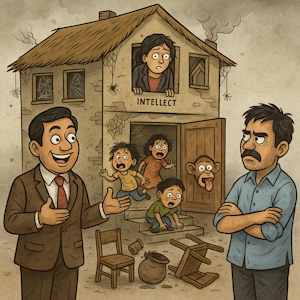
The body is compared to a cluttered, messy house filled with unwanted impressions from the senses — sights, sounds, smells, tastes, and touches — all stored and creating inner noise.
-
The intellect is portrayed as the restless mistress of this house, constantly peeking out through the sense organs, craving new inputs without cleaning up the old clutter.
-
Instead of organizing or simplifying, the intellect adds more distractions, accumulating attachments and desires, leading to a chaotic inner environment.
-
This constant seeking by the intellect results in emotional byproducts — anxieties and worries — described as her noisy children, born from imagination and mental overactivity.
-
The body itself is poorly constructed: hair forms the thatched roof, ears are hollow rooms, and the walls resemble haunted ruins overgrown with filth.
-
Hunger is shown as an aggressive, wild force living inside the body, always desperate, loud, and never satisfied — driving much of human behavior.
-
Even the mouth, the main gateway, is unappealing — lined with yellowed, broken teeth, and guarded by the tongue, compared to an undisciplined monkey.
-
The structure is weak and unstable, leaning and shaking due to the joints, unable to stay firm — symbolic of physical fragility and mental instability.
-
The mind, like a filthy rat, keeps corrupting the inner space, ruining any moment of peace or clarity that may arise.
-
Occasionally, there may be smiles and flickers of joy, but they quickly fade, returning the body to its usual state of inner darkness.
-
Disease is shown as the permanent tenant of this house-body, making it an undesirable place to live or find peace.
What does the image of a cluttered house say about our inner world?
It reflects how the mind becomes noisy and messy when filled with unprocessed sensory experiences. Everything we see, hear, smell, taste, or touch leaves behind traces. Without introspection or discipline, these traces pile up like junk in a house, making it hard to find clarity or calm.
Why do we keep adding more impressions if they only clutter the mind?
The mind, especially when driven by the senses, feels incomplete and keeps seeking stimulation. Without training, it mistakes accumulation for fulfillment. This leads to a cycle of seeking without ever pausing to clean up what's already inside.
Isn't exposure to the world necessary for learning and growth?
Yes, but unfiltered consumption creates confusion, not growth. Just like a house needs regular cleaning even if guests come in, the mind too must be purified through reflection. Otherwise, knowledge turns into noise, not wisdom.
How does the intellect behave in this metaphor?
The intellect is likened to a restless woman who constantly peeks out of the windows — the sense organs — always searching for something new. She is not satisfied inside and doesn’t attempt to bring order. Instead, she gathers more objects, more distractions.
Why doesn't the intellect just turn inward instead of peeping out?
Outward movement feels exciting and promises novelty. Turning inward demands effort and silence. Until the intellect realizes that peace lies within, it keeps chasing what’s outside, believing happiness is out there.
But isn’t curiosity a sign of intelligence? Why blame the intellect for being curious?
Curiosity is valuable, but aimless curiosity creates disorder. Without discernment, the intellect chases too much and loses its direction. A wise intellect knows when to look out and when to turn in.
Where do anxieties and emotional troubles come from?
They are shown as the 'daughters' of the restless intellect — born from constant imagination, worry, and overthinking. These mental children run wild, scream, and mess up the inner space, making it hard to settle or be at peace.
How can I stop birthing these emotional disturbances?
By calming the intellect, reducing unnecessary imagination, and not overfeeding the mind with drama or fear. When you stop mentally rehearsing worst-case scenarios, those noisy 'children' slowly disappear.
Aren’t worries natural responses to life’s uncertainties?
Yes, but when they multiply and dominate, they stop being helpful. Most worries don’t solve problems — they just fill the mind with clutter. Training the intellect to stay grounded makes space for calm, even amidst uncertainty.
What is the significance of the body being described as poorly built?
It reveals how fragile and unattractive the physical structure actually is. Hair is a weak roof, ears are hollow rooms, and parasitic filth grows unchecked. Despite all efforts to decorate it, the body remains unstable and degrading.
If the body is so faulty, why do we take so much pride in it?
Because we confuse appearance with worth. The ego attaches to form, forgetting it is temporary and prone to decay. Real dignity comes from inner discipline, not outer decoration.
Isn’t this body a divine creation? Why speak of it so harshly?
It is divine as a tool, not as a source of identity. The harsh imagery is to shake off blind attachment. Once you see its limits clearly, you use it wisely — not worship it.
What role does hunger play in this metaphor?
Hunger is portrayed as a feral creature living inside the body — always craving, barking, begging. It shows how physical needs often dominate our thinking, causing irritability, fear, and desperation.
Why is hunger such a powerful force?
Because survival instincts are hardwired. But when they rule us instead of being managed, we behave like slaves to the body. Spiritual growth starts when we gain control over such impulses.
Is it wrong to satisfy hunger? Isn’t it a basic need?
It’s not wrong to feed the body. What’s dangerous is letting that need control your emotions and decisions. Managing hunger with awareness keeps it in its place.
Why is the tongue compared to a monkey at the door?
Because it’s impulsive, uncontrolled, and attention-seeking — always moving, always demanding. It reflects how speech and taste, governed by the tongue, are difficult to discipline and often lead us into trouble.
Can such a small part of the body really cause that much chaos?
Yes. A careless word can break relationships. A craving can lead to excess. The tongue, though small, influences our karma more than we realize.
Isn’t food and talk part of enjoying life? Why restrict them?
Enjoyment becomes indulgence when there’s no control. Discipline doesn’t mean denying pleasure — it means ensuring the pleasure doesn’t enslave you.
What does it mean when the house keeps leaning and shaking?
It means the body is physically unstable, always aging, aching, and vulnerable. Just like a crooked house, it can collapse any time — reminding us not to over-invest in it as a permanent home.
How should we live if the body is so unreliable?
Use it as a tool, not a treasure. Care for it, but don’t identify with it. Put your efforts into inner stability rather than external looks or strength.
Isn’t physical health crucial for spiritual practice?
Yes, but it’s not the goal — it’s a support. Obsessing over perfect health is like polishing the walls of a crumbling hut. Maintain, but don’t cling.
Why is the mind called a rat in this imagery?
Because it quietly and constantly pollutes the space. Just as a rat nibbles, spoils, and defiles whatever it touches, the undisciplined mind corrupts our clarity, even without us noticing.
How do I stop the mind from behaving like that?
By training it with awareness practices, like meditation. Observing its movements without reacting helps weaken its grip. Over time, the rat becomes quiet.
Can a clean house stay clean if the rat is still inside?
No. Even if everything else is perfect, the mind can ruin it all. You need to address the root — not just sweep the floor, but remove the rat.
What does it mean that the house lights up with smiles but returns to darkness?
It means moments of joy in the body are temporary. A smile may appear, but the inner space remains unclean and unstable, so happiness fades quickly.
Should I not be happy if it's temporary?
You can enjoy the moment, but know its nature. Don’t chase fleeting highs. Build a deeper, steadier peace that doesn’t depend on surface moods.
If happiness fades, what’s the point of trying?
Because there's a deeper kind of joy — one rooted in contentment and detachment. That doesn’t fade with circumstances. But you find it only after clearing the inner house.
Why are diseases called the occupants of this house?
Because they reside within the body like permanent guests. No matter how well we care for it, the body attracts some illness or breakdown over time.
Isn’t that just part of aging?
Exactly — and that’s the point. Clinging to the body as a source of lasting satisfaction is foolish when its natural tendency is to degrade.
But can’t we fight disease with medicine and science?
We can delay or treat it, but not eliminate it forever. Even the best health care can’t stop death. So it’s wiser to prepare the mind than obsess over the body.





English
Yoga Vasishta
Click on any topic to open
7
30
Astrology
Bhagavad Gita
Bhagavatam
Bharat Matha
Devi
Devi Mahatmyam
Ganapathy
Garuda Puranam
Glory of Venkatesha
Hanuman
Kathopanishad
Mahabharatam
Mantra Shastra
Mystique
Practical Wisdom
Purana Stories
Radhe Radhe
Ramayana
Rare Topics
Rigveda Explained
Rituals
Sages and Saints
Shiva
Spiritual books
Sri Suktam
Story of Sri Yantra
Temples
Vedas
Vishnu Sahasranama
Yoga Vasishta
26
17
10
0


