Lord Rama Himself Listened to Ramayana from Lava and Kusha
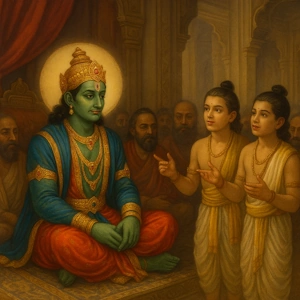
Sri Ramji's own sons, Kusha and Lava, were the first ones to learn Ramayana from Sage Valmiki because they were the most eligible and capable to receive Ramayana as prathama shishyas.
Then they sang Ramayana for the first time in an assembly of rishis, scholars, and sadhus.
Ashwamedha of Lord Rama was going on. These rishis and scholars had come to conduct that. Once rituals were over and they were sitting down, Kusha and Lava sang Ramayana for them. They were well focused on what Kusha and Lava were rendering.
The content of Ramayana is absolute truth — like the Vedas.
They are real incidents, not fiction.
They are as real as the Vedas.
Sage Valmiki is pointing this out by saying:
Here paathya means Yajurveda,
Geya means Samaveda,
Madhuram — Rigveda.
All the three pramanas of the Vedas. These are the three formats of Veda — poetry, prose, and songs.
Ramayana is completely as per Veda pramana.
Every principle in Ramayana is from the Vedas.
You won't find any deviation from the Vedic principles in Ramayana.
The dharma explained and clarified in Ramayana is Vedic dharma.
The life that Ramji lived was according to Veda dharma.
When they heard Kusha and Lava, the rishis became emotional. Tears welled up in their eyes.
They said again and again — great, greatest. They were in awe.
They appreciated Kusha and Lava. The rishis were dharmavatsalas.
They were straightforward. They had no pride in them.
They had no hesitation in appreciating these young boys.
They instantly recognized that Ramayana was all about dharma and appreciated it.
They appreciated also because Kusha and Lava sang with bhava, understanding the bhava with which Valmiki had written each verse.
It was not flat rendering.
You know this — even in classical music, you can sing strictly conforming to shruti, tala, and swara, but without bhava, technically it will be correct.
But when bhava according to the meaning of the verses is there, it will be even more sweeter.
Kusha and Lava had this quality in them.
They understood the meaning of each verse and sang according to the bhava.
The rishis appreciated both their talented singing as well as the content — the meaning of what they sang.
What all did they appreciate?
The sweetness of song,
The sweetness of the words.
Even though the incidents had already taken place, they felt that they were happening right in front of them.
The rishis were appreciating even while they were singing. This inspired Kusha and Lava to perform even better.
The munis started giving Kusha and Lava gifts.
They were brahmacharis, they were inhabitants of Valmiki's ashrama, so the gifts were also what would be suitable and useful for them — kalasha, valkala (tree skin which they wear as dress), hair band, kamandalu (the water pot), such things.
Then they blessed both of them with health, long life, comforts.
Valmiki Ramayana is perfect as a kavya in all respects.
Every single quality needed in a kavya is present in Valmiki Ramayana.
Valmiki Ramayana became the foundation upon which all future kavyas were built.
Poets learned how to write a kavya looking at Valmiki Ramayana.
The news of this rendering of Kusha and Lava spread, and Sri Ramji also came to know about it.
Bharata brought them to the palace.
Lord Rama paid respects to them.
They were respected because they were singing the Lord's glory.
Lord's glory is residing in them in the form of Ramayana.
Respecting them is like respecting Lord Rama himself.
See — Lord Rama worshipped the singers of Ramayana.
The Lord then sat on his simhasana, surrounded by his brothers and ministers.
He was under deeksha for the Ashwamedha Yaga that he was conducting then.
The Lord told his brothers —
Listen to their songs, from these boys who are as brilliant as the devas themselves.
They were wearing clothes befitting munis, but they had the lakshana of kshatriyas.
I am also keen to listen to this because they are going to sing Seetha's legend.
The Lord is suffering from viraha dukha.
He has lost body weight. He has become slim.
He wants to listen to the legend of his dearest.
The Lord himself calls Seetha's legend as mahanubhava.
As Seetha Devi's story, it is even greater because she allowed herself to be held captive —
So that the deva-strees can be freed from the fear of being abducted and held captive by Ravana.
That much is her kindness.
And kindness is the essence of Ramayana.
Thus, the Lord enthused Kusha and Lava to sing.
They started singing in the paddhati called marga.
There are two styles — deshee and marga.
They started singing in the marga paddhati.
The Lord also slowly got up from the simhasana without causing disturbance, went and sat among the audience.





English
Ramayana
Click on any topic to open
7
30
Astrology
Bhagavad Gita
Bhagavatam
Bharat Matha
Devi
Devi Mahatmyam
Ganapathy
Garuda Puranam
Glory of Venkatesha
Hanuman
Kathopanishad
Mahabharatam
Mantra Shastra
Mystique
Practical Wisdom
Purana Stories
Radhe Radhe
Ramayana
Rare Topics
Rigveda Explained
Rituals
Sages and Saints
Shiva
Spiritual books
Sri Suktam
Story of Sri Yantra
Temples
Vedas
Vishnu Sahasranama
Yoga Vasishta
26
17
10
0


