Let Ramayana In, Let It Lead You Right
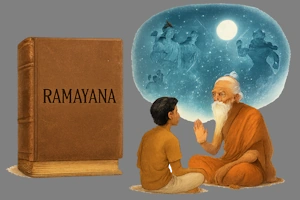
At the beginning of the 5th sarga of Balakanda of Ramayana, Sage Valmiki brings out a few important points about Ramayana.
He says Ramayana was born in the lineage of the Ikshwakus.
Not that Rama was born in the lineage of the Ikshwakus.
Why is this so?
Rama and Ramayana — they are one and the same.
If you want to achieve Rama, achieve Ramayana.
Allow Ramayana to settle into you.
Lord Rama himself will settle into you, occupy your whole body, mind, and atma.
रामेति द्व्यक्षरं नाम
Then the sage says —
Very interesting because there is mention of dharma, artha, and kama — not moksha.
But if you pay attention, it is clear —
Ramayanam dharma artha kama sahitam
Ramayana along with dharma, artha, and kama.
The very swaroopa of Ramayana is moksha — granting complete freedom to the body, mind, and atma — so that it is not forced by karma to take birth again and again and suffer in this world.
If you imbibe Ramayana and make Ramayana your guide for living the rest of your life, then you don’t have to take birth again and suffer.
For this, Ramayana would tell what a virtuous life is all about — dharma.
How to earn a living without making that an impediment in your spiritual progress — or rather, how you can make your livelihood itself a means for your spiritual progress — which is artha.
How to have desires, achieve desires, and still not make them impediments in your spiritual progress.
Normally, you are told to abandon all desires.
But Ramayana would tell you what kind of desires you can have and how to achieve them and still make spiritual progress.
Dharmartha-kama sahitam Ramayanam —
These three cannot be done away with.
You can’t just go into complete inaction.
In fact, there is no state called inaction.
You have to function in the world.
But that functioning itself — how to make that functioning contribute towards your freedom rather than bind you into more and more karma — this is what dharma is all about.
You need money, at least to take care of your own body.
Even someone who doesn’t earn out of effort, someone living on alms — he also has to manage the limited resources, without them impeding his spiritual progress into complete freedom.
This resource management is what artha is all about.
Then managing desires.
You want to attain complete freedom — moksha.
Isn’t that itself a desire?
Yes, it is.
If you want to achieve Vaikuntha and be with the Lord forever — that itself is a desire. It is called lokeshana.
What are these desires — kamas — the achievement of which will not impede your spiritual progress?
Ramayana will teach you this.
You don’t have to learn, mug up definitions — that won’t help.
You have to get Ramayana inside. Then Ramayana will work on its own.
It’s like how you get an excellent CEO to run your organisation.
You acquire him, take him inside — he will take over and thereafter he will manage everything.
In the same way, get Ramayana inside you.
Thereafter, Ramayana will take over and manage your life in the right way.
But how to get Ramayana inside you?
Not by reading Ramayana.
Valmiki Maharshi is very clear about this — shrotavyam.
You have to listen.
The path for Ramayana to settle inside you is through your ears — not through your eyes.
The sage is very clear.
And you have to listen without asuya.
What is asuya?
Intolerance about the qualities in another person.
Someone understands better.
The person who is narrating Ramayana to you — he himself sounds more knowledgeable than you.
You don’t like it.
Then you try to find fault with him.
This is what happens with 99 out of 100 listeners.
They get academic about what they listen.
We see this quite often in Vedadhara.
Whenever a spiritual quote is sent — we get responses like:
'It would be better if you mention the source of this quote also.'
How does it help?
Are you going to write an exam?
In an exam, when you quote, you may have to give reference.
If you are writing a PhD thesis, you will have to give references.
This is for your own growth — not for enhancing your bookish knowledge.
This is for you to understand the concept and expand your vision and wisdom.
Whether it has come from X book or Y book or Z book — how does it matter?
We are not giving this for you to go around and show off your spirituality.
So coming back — this is asuya.
Rather than seeing the content, seeing the quality of the package and being judgemental about the narrator or even the co-listeners.
Don’t do this.
Sage Valmiki says — this is how you should listen to Ramayana.
Then only it will serve the purpose.





English
Ramayana
Click on any topic to open
7
30
Astrology
Bhagavad Gita
Bhagavatam
Bharat Matha
Devi
Devi Mahatmyam
Ganapathy
Garuda Puranam
Glory of Venkatesha
Hanuman
Kathopanishad
Mahabharatam
Mantra Shastra
Mystique
Practical Wisdom
Purana Stories
Radhe Radhe
Ramayana
Rare Topics
Rigveda Explained
Rituals
Sages and Saints
Shiva
Spiritual books
Sri Suktam
Story of Sri Yantra
Temples
Vedas
Vishnu Sahasranama
Yoga Vasishta
26
17
10
0


