The Boy Who Would Change the World Meets the Sage Who Knew It
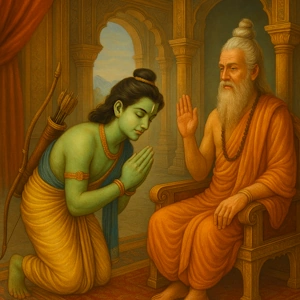
A messenger was sent to get Lord Rama to King Dasharatha’s court where Vishwamitra had come seeking to send the Lord with him to destroy rakshasas who were causing obstacles in his yaga. The messenger came back along with an attendant, and the attendant described the state of the Lord, which he thought was some kind of moha or a deluded state.
After hearing this, Sage Vishwamitra said, 'Bring him here, I will take care of it. I will remove this delusion of his, just as wind blows away clouds hovering around a mountain top. He will become normal, he will become peaceful. Once I do that, like us rishis, he will also attain the parama pada as described in the Vedas as 'तद्विष्णोः परमं पदम्'. Once this moha goes away from him, he will become as if he has drunk amruta. He will attain brahmarupa, jnanarupa, paramananda and complete peace. His body also will become strong and energetic. He will start behaving like how a person of his varna, that is kshatriya varna, and his ashrama, that is brahmacharyashrama, should behave. He will realize that there is nothing wrong in conducting oneself as a normal person would do in this world. All his confusions would go away. Bring him to me, I will make him realize that.'
Upon hearing this, Dasharatha felt relieved. Another messenger was sent for the Lord. This time, the Lord came along with Lakshmana and Shatrughna. The Lord wished everyone, as per custom. He also accepted the return wishes with humility. Dasharatha embraced him with affection and asked him to sit on his lap.
Dasharatha told him, 'You are intelligent. Why are you harming yourself, hurting yourself by being in this gloomy mood always? Those like you who follow the words of gurus and elders, they always attain the parama pada, whereas those who are deluded, they never reach anywhere. This is only as long as you don’t allow any kind of ignorance or delusion to overpower you. Delusion means incorrect knowledge, incorrect perception, incorrect perspective.'
Dasharatha says, 'Knowledge given by learned gurus and elders is the correct perspective. Any kind of knowledge which doesn’t have such authority, that just comes and goes. It is not permanent or sanatana. Such knowledge is what is called delusion. As long as you are guided by genuine knowledge, you are protected. But, if you allow yourself to be overpowered by incorrect knowledge, then your protection goes. You are out there in the open all by yourself.'
'Let’s take the case of a cult which was very active until recently. The idea of the founder of this cult was that if you take sensory pleasures and understand them and take them to the extreme, even they are capable of giving liberation. This idea was never there or was never prominent. This man suddenly comes up with this theory and builds up a spiritual empire around himself. Lacs of seekers started following him. Then he died, and with him, his theory is also gone. In the process, many lost their families, their careers, many became addicts. This is what is referred to when you say moha or delusion. Ideas that are not time-tested, or have gone the rigorous acid test of dharma.'
Dasharatha says, 'If you allow yourself to be overpowered by such wrong knowledge, then you are exposed to great risks. You don’t know where you will end up.'
Sage Vasishta said – 'Son, what is this? You have already conquered your senses. Why have you fallen into this delusion?'
Vishwamitra said – 'Tell me what is troubling you? These delusions, they like rats, burrow your mind. Tell me what is it that is troubling you? Is it one thing or many things? Or is it that you want something? You are looking for something?'
-
Delusion (moha) distorts a person’s perception, making them act confused, withdrawn, or overly serious, even when there’s no real threat or problem.
-
A true teacher can dispel this delusion as effortlessly as wind disperses fog, by offering the right insight and inner clarity.
-
Once this mental fog is cleared, the person regains strength, clarity, and peace, and begins to live in tune with their natural duties and roles.
-
A kshatriya in the brahmacharya stage, like Rama, is expected to be strong, alert, and dutiful — not lost in philosophical confusion or excessive brooding.
-
Acting normally in society is not a fall; living as per one's varna (social role) and ashrama (life stage) is itself part of spiritual maturity.
-
When delusion fades, the mind feels like it has tasted amrita — the nectar of immortality — brimming with knowledge, bliss, and balance.
-
Knowledge rooted in tested tradition keeps one protected; ideas born from ego or impulse, even if popular, collapse when the founder disappears.
-
Wrong teachings often seduce people with novelty, but if they haven't passed the fire-test of dharma, they lead to personal and social ruin.
-
Real guidance must come from gurus and elders whose wisdom aligns with sanatana dharma — the timeless moral-spiritual order.
-
Confusion comes when one allows new, unverified ideologies to override lived wisdom; once that anchor is lost, you're adrift.
-
Even a prince like Rama, with a pure mind and great potential, can get pulled into overthinking if his mind isn't handled with care.
-
Asking the person directly — 'What exactly are you struggling with?' — is the first step in removing delusion, instead of assuming or diagnosing from afar.
What is delusion and how does it affect a person?
Delusion (moha) is a distorted way of thinking that clouds one’s clarity, making them feel dull, lost, or overly melancholic without any practical reason. It hijacks the mind and pulls the person into unnecessary inward spirals.
Why would someone who has everything still feel lost or gloomy?
Even a capable person can fall into confusion if they start seeing the world through wrong lenses. Inner disconnection isn’t solved by outer success — it needs wisdom and reset.
Isn't emotional withdrawal a sign of deep thinking or spiritual maturity?
Not always. If the withdrawal comes from distorted perception rather than clarity, it's escapism. True maturity makes one balanced, not broken.
How can a teacher remove someone’s delusion?
Just as wind blows away mist, the presence of a wise teacher and their direct, clear insights can break the illusion clouding someone’s mind. They restore right seeing.
How do I know if I’ve found such a teacher?
You’ll feel lighter, clearer, and more grounded after meeting them. Their words dissolve your confusion, not inflate it.
Can’t I figure things out myself with books or thinking?
Books help, but ego can distort even the best knowledge. A living guide corrects your blind spots which you can’t see alone.
Why is it important to behave in line with one’s role and stage in life?
Each person has a role based on their varna and ashrama — social role and life stage. Acting in harmony with that keeps the mind anchored and duties clear.
Doesn’t that restrict my freedom to explore or be different?
Freedom without grounding often leads to confusion. Once you're anchored, exploration becomes productive, not disorienting.
Shouldn’t spirituality make me renounce all roles?
Not at all. Mature spirituality flows through your roles, not away from them. Escaping duties isn't spiritual — doing them with clarity is.
What happens when confusion clears from the mind?
The person feels light, fearless, and content — like they’ve tasted amrita, the nectar of bliss. They radiate wisdom without effort.
Is that the same as enlightenment?
It’s a glimpse of that state — the mind becomes quiet, ego relaxes, and the person lives joyfully in truth without fuss.
Sounds poetic — but how can I trust that experience?
Because it’s verifiable. You don’t need to believe — just observe someone in that state. Their peace speaks louder than theories.
Why is knowledge from tradition emphasized so strongly?
Because it has been time-tested and survives through generations. It’s not built on one man’s idea but on countless lives of realization.
Isn't it possible for something new to also be true?
Yes — but only if it aligns with dharma, stands the test of time, and doesn’t contradict essential truths. Novelty alone isn't truth.
Aren’t old traditions sometimes outdated?
They evolve — but the core truths don't. What changes is the expression, not the essence. Discarding tradition entirely is like throwing away the foundation of a house.
What’s the danger of following unverified spiritual ideas?
They can mislead masses into ruin. People may lose families, health, and sanity chasing false promises dressed as freedom.
How can I spot such misleading ideas early?
Check their source, fruits, and durability. If the founder dies and the path collapses, it wasn’t truth — it was charisma.
But if people find comfort in it, what’s the harm?
Comfort isn’t proof of truth. Drugs comfort too — but destroy in the long run. Truth heals without side effects.
Why did Rama, a trained and wise prince, fall into confusion?
Even the best minds can be overwhelmed by subtle doubts. Overthinking and intensity, if unchecked, can spiral into emotional paralysis.
Doesn’t that make him weak?
No — it makes him real. The strength lies in his willingness to face it and receive guidance.
If even Rama can fall into moha, what hope do the rest of us have?
That’s exactly the point — if it can happen to him, you’re not alone. And if he can rise from it, so can you.
Why did Vishwamitra ask Rama directly about his troubles?
Because clarity starts with honest expression. Rather than diagnosing from a distance, the sage invites Rama to verbalize his inner storm.
Can simply talking about it make things better?
Yes — if done with the right listener. Articulating confusion is often the first crack where light enters.
Isn’t that just psychological, not spiritual?
There’s no split. The spiritual path includes cleaning the mind — and that starts by facing it, not bypassing it.





English
Yoga Vasishta
Click on any topic to open
7
30
Astrology
Bhagavad Gita
Bhagavatam
Bharat Matha
Devi
Devi Mahatmyam
Ganapathy
Garuda Puranam
Glory of Venkatesha
Hanuman
Kathopanishad
Mahabharatam
Mantra Shastra
Mystique
Practical Wisdom
Purana Stories
Radhe Radhe
Ramayana
Rare Topics
Rigveda Explained
Rituals
Sages and Saints
Shiva
Spiritual books
Sri Suktam
Story of Sri Yantra
Temples
Vedas
Vishnu Sahasranama
Yoga Vasishta
26
17
10
0


