Long Life Is Irrelevant
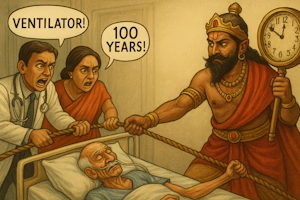
When Sage Vishwamitra came to Ayodhya to take Lord Rama with him for the protection of his yaga, the Lord was depressed. He was called to the court and the Lord started explaining the reasons behind his depression. He is explaining how futile the earthly life is the way it is lived.
People want to live for long. They don’t know for what, still they want to live for long, live full life, live till purnayu, hundred years, one twenty years. Not only one’s own life, they want their near and dear also to live for long, if possible, live forever. They will make all kinds of efforts to keep their near and dear living. If the pranavayu becomes feeble, they will put a ventilator and keep on pumping. This ends only when the doctor finds a richer patient or they have sold out all that they have had. Nobody wants to die. Nobody wants their people to die.
But there is absolutely no guarantee about this longevity. The longevity is like a dew drop at the tip of a blade of grass, just hanging there. It can fall any time.
There is mad man. You have given him everything — a house to live, ration for a long time, all kinds of comforts, everything that he might need, thoughtfully you have given. But, he would just get up and wander away whenever he feels like. He would simply disappear whenever he feels like. He is not bothered what you have provided him. Just like this mad man, ayu, life, leaves this body whenever it feels like. It doesn’t need a reason to leave the body.
Those who live without atma viveka, without understanding who they really are, living without discretion, immersed in worldly objects, worldly objectives — for them, the life itself, short or long, is a pain. Life is a burden for them, life is a suffering for them. Still, they want to live for long, live forever.
Life is comfortable only for such people who have known the only thing worth knowing — brahma tatwa — and they relax in what they have known. Their life alone is relaxed, their life alone is comfortable. They feel no gain, they feel no loss. They don’t look for pleasure, they don’t run away from pain. They know, they have realized that — they are all the same. They are just experiences. They are not true. They are not real. Only such people live a comfortable life. Only such lives are worth living.
Lord Rama is telling Sage Vishwamitra. We think this body is me. This body is myself. But has the body made you happy? Has the body given you perpetual happiness?
You can tie air with a rope. You can grab air and tie it with a rope and take it to wherever you want. This can be done. You can take a knife and cut akasha into pieces. Akasha will remain in pieces, split into pieces. You can go to the seashore, catch the waves one by one, string them together and make a garland out of them. All these are possible, still possible.
But to trust your ayu, your life, is simply impossible.
This life, ayu, the life force inside you is as small as a cloud of the autumnal season, as feeble as the flame of a lamp lighted without oil in it, as unstable as a wave. You will notice it only after it is gone. You will not even notice it once it is still within the body. Nobody is bothered about it while it is still within the body. Once it is gone, they make a big fuss about it.
I am confident that I can catch with my hands the reflection of the moon in the water. I am confident that I can catch a flash of lightning with my hands. I am confident that there is a lotus in the sky and I can pluck it with my hands. But, I have no confidence in ayu, the life force, the longevity. I have no trust in ayu. I know that these are not possible, but there is a rare chance that still they can be achieved. But to trust ayu, life force, longevity is just impossible.
The mare of a mule, the female of a mule — mule is a cross breed between a horse and a donkey. They are infertile. Very very rarely do they become pregnant. If they become pregnant and deliver a calf, that is the end of their life. Because the calf tears open the belly and comes out. It is not delivered in the normal way. The female mule is aware of this. But still, she wants to become pregnant. This is a certainty. Still, she wants to become pregnant.
Man is like this. He knows for sure that life ahead is going to be trouble. He hasn’t seen anything else in the past. Still, he wants to live for long, live forever.
This body is like a bubble, as unstable as a bubble. It can break any time. Do you want me to trust this bubble? Do you want me to be comfortable living within this bubble? By nature itself, by creation itself the body is like a bubble. It is not meant to be any other way. Do you expect me to live confidently within this bubble? Lord is asking.
A life can be called a worthwhile life only if in that lifetime the only goal worth achieving — which is mukti — if that is achieved. A life can be called a worthwhile life only if that is achieved in that lifetime after achieving which there is no pain anymore, no grief anymore.
Trees also live, birds also live, animals also live. But you can call someone’s life ‘life’ if through thought — careful, steady thought — he has got rid of all vasnas and has achieved tatwajnana and through this unburdened his mind, made his mind light. Only such life can be called life. Rest is all waste of time.
Your life on earth is worthwhile only if you are not going to be born into it again. If you are going to take a rebirth, there is no difference between your life and a donkey’s life. You also live for a few years. Donkey also lives for a few years.
All these advices, all advices given by shastras — they are a burden for those who identify themselves with their body. Spiritual knowledge is a burden for those who are immersed in worldly experiences. Mind is a burden for those who are restless. Body is a burden for those who have not realized what this all about, what this world is all about.
If your mind is not clear, if you are living under ignorance, confused that all that is happening around you is real, they are as they are, then everything — mind, intellect, body, even longevity — is a burden for you. Everything would seem to be heavy and unmanageable. The life would seem to be full of dangers, troubles.
Body would be a tree in which hundreds of diseases in the form of birds, different different birds, come and make their nest.
There is a small mound. A rat would work on it every day, without fatigue. And in some days, the mound will be gone. Where it stood, the ground will be flat. In the same way, time — kala — will go on chewing upon longevity, life, ayu, and then it will be gone.
Like how a poisonous snake inside a hole goes on drinking air, in the same way, the snake that is diseases, deadly diseases living inside the hole which is the body, goes on drinking the ayu, the life force. These diseases — they go on consuming the body like termites living inside a dry withered tree would consume it. After some time, there will be nothing left.
Death keeps on looking at ayu, longevity, like a cat looking at a mouse, ready to pounce upon it anytime.
Youth, vigour and strength would leave the body just like a good person would move away from bad company after realizing that it is not good for him. Time is a close friend of death. Always helps him in taking away life. They both are thick friends.
Longevity is the most insignificant thing in the world. Most irrelevant thing in the world. If you want to move in the right direction — towards true knowledge — then the obsession to live long should go. Because the longing for true knowledge understands the fallacy of a long life and does not give it any importance. For a seeker of true knowledge, longevity is irrelevant, insignificant.
-
People long for extended life without understanding its purpose, chasing years instead of meaning.
-
Most are terrified of death and spend heavily to delay it, but life slips away regardless of effort.
-
Life is as unstable as a dewdrop or a bubble — unpredictable, fleeting, and fragile.
-
Trying to control the timing of death is like trying to catch lightning or tie down the wind.
-
Life can end without warning, just like a madman randomly walks away from shelter and comfort.
-
For those without self-inquiry (atma viveka), life is a cycle of suffering no matter how long it lasts.
-
Only one who has realized brahma-tattva — the absolute truth — lives in true peace and balance.
-
Such realized people neither chase pleasures nor avoid pain; they see both as fleeting experiences.
-
Trusting life’s duration is foolish; the force that sustains it (ayu) is too subtle and uncertain.
-
The body is a temporary shell, easily broken and constantly under threat from disease and decay.
-
Diseases consume the body like termites hollowing out dead wood — slowly but surely.
-
Death waits patiently, like a cat eyeing a mouse, ready to pounce on life at any moment.
-
Time and death are close allies, always conspiring to strip away youth, strength, and breath.
-
Obsession with long life blinds the seeker from real knowledge — it keeps one bound to suffering.
-
Only a life that leads to freedom from rebirth (mukti) is truly successful and worth living.
-
If rebirth is guaranteed, there’s no difference between a human life and an animal’s.
-
Worldly knowledge, even spiritual advice, feels burdensome to those deeply attached to body and ego.
-
A confused mind sees even intellect and longevity as heavy, stressful, and threatening.
-
The wise don't identify with the body — they treat it like a bubble, not a permanent home.
-
Clarity comes only when one realises that true worth lies in inner lightness, not in years lived.
What makes people crave long life without purpose?
They equate longer life with more happiness, ignoring that more time doesn't fix inner confusion. Most chase years like trophies but never ask what those years are really for.
Why do we want our loved ones to live forever even if they suffer?
Because we’re emotionally attached and scared of loss. We confuse proximity with comfort, even if their suffering deepens.
Isn't it natural to want to avoid death?
It's natural, yes, but blind fear of death leads to irrational actions. Understanding its certainty brings freedom, not despair.
Why is life compared to a dewdrop or bubble?
Because it’s momentary and fragile. No matter how firm it seems, it can burst with a single change — illness, accident, or aging.
How can I stay calm when life is so uncertain?
By focusing on truth, not duration. When you understand the self beyond the body, you stop clinging to bubbles.
Isn't comparing life to a bubble too extreme?
No. Bodies are always vulnerable — one disease, one fall, and it ends. The metaphor is realistic, not exaggerated.
Why is trusting ayu — the life force — seen as foolish?
Because ayu is subtle, unpredictable, and can vanish without warning. It doesn't follow logic or fairness.
So what should I trust instead?
Trust what doesn’t change — awareness, inner clarity, the part of you that witnesses all shifts.
But don’t we need hope to live?
Yes, but hope must be rooted in truth. False certainty about lifespan leads to fear, not peace.
What happens to those who live without atma viveka?
They remain trapped in endless emotional reactions, chasing desires, dreading losses, and mistaking illusions for reality.
Can such people still find peace?
Only if they begin questioning their assumptions and start seeking what lies beyond the body and mind.
Isn’t worldly involvement part of life too?
Yes, but when it becomes your identity, suffering multiplies. Without self-knowledge, even pleasure becomes a trap.
What defines a truly relaxed life?
One that is free from chasing gain and escaping loss. A person anchored in truth flows with life rather than resisting it.
Can peace be achieved without giving up the world?
Yes, if one gives up attachment, not responsibilities. Peace is internal, not situational.
Aren’t emotions part of being alive?
They are, but when you see them as passing clouds, not who you are, they lose power over you.
Why is spiritual advice called a burden for the ignorant?
Because without the right mindset, such advice feels restrictive or unrealistic. The ego resists what threatens its control.
So who benefits from spiritual wisdom?
Only the seeker who is ready to listen without pride, who wants freedom more than comfort.
Isn’t knowledge always good?
Not when it’s misused or misunderstood. Even sacred truth can feel heavy if held with the wrong grip.
What’s the point of living if rebirth is guaranteed?
Then you're no better off than animals. Real living begins only when the cycle of birth and death is broken.
How can I escape rebirth?
By clearing deep-rooted vasanas (mental impressions) through steady thought, self-inquiry, and realisation of truth.
Isn’t one lifetime too short for liberation?
One moment of clarity can end lifetimes of bondage. It's not about time, it's about depth.
Why is the body seen as a disease nest?
Because it's constantly under attack — from microbes, age, stress, and decay. It hosts more ailments than joys.
Can we do nothing to protect it?
You can maintain it like a vehicle, but don’t confuse the vehicle with the traveller.
But isn’t body-care also a form of devotion?
Only when done with detachment. Otherwise, it becomes vanity dressed as discipline.
Why is time seen as death’s partner?
Because every passing moment brings you closer to the end. Time doesn’t heal — it consumes.
How can I make peace with time?
By aligning with timeless awareness. Then time becomes a tool, not a threat.
But time also brings growth and experience, no?
True, but without wisdom, growth means repetition. Experience alone doesn’t free — insight does.
Why is longevity called the most irrelevant thing?
Because it adds nothing if used poorly. Ten extra years of confusion don’t match one year of clarity.
Should I stop caring about how long I live?
Yes, and start caring about how you live — with purpose, detachment, and understanding.
But won’t this attitude make me careless?
No. In fact, it sharpens focus. When you stop fearing time, you use it wisely.





English
Yoga Vasishta
Click on any topic to open
7
30
Astrology
Bhagavad Gita
Bhagavatam
Bharat Matha
Devi
Devi Mahatmyam
Ganapathy
Garuda Puranam
Glory of Venkatesha
Hanuman
Kathopanishad
Mahabharatam
Mantra Shastra
Mystique
Practical Wisdom
Purana Stories
Radhe Radhe
Ramayana
Rare Topics
Rigveda Explained
Rituals
Sages and Saints
Shiva
Spiritual books
Sri Suktam
Story of Sri Yantra
Temples
Vedas
Vishnu Sahasranama
Yoga Vasishta
26
17
10
0


