How the Concepts of I and Mine Complicate Life
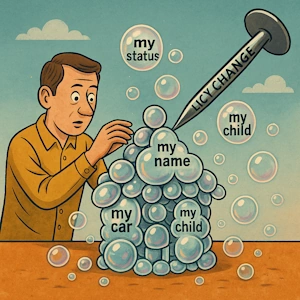
Lord Rama was disillusioned. Whatever he was taught were the objectives of life, how he should live—after a pilgrimage, he realized that they were all false. He was living a life of falsehood.
This made him gloomy and depressed. He explains all these to Sage Viswamitra, who had said, tell me your problem, I will get you out of it.
The Lord goes on to explain the falsehood of 'I' and 'mine', the feeling of 'I' and 'mine'.
The feeling that I am sitting there, I am going there, I am going to sleep, this is my name, this is my home, this is my father, this is my kingdom—both these concepts 'I' and 'mine' are false.
We are discussing the section of योगवासिष्ठ called वैराग्य प्रकरण.
And now we will be looking at the fifteenth chapter.
These two—I and mine—every single trouble in life comes out of these.
You think that they are there forever.
No.
In the communist regime, everything belonged to the state. There was no private property, there was no 'my home', 'my car'. Most of the 'mine' was gone with a single political move.
Concept of 'mine' is as fragile as that.
Still, we dedicate our life for creating these 'mines', protecting these 'mines', prolonging these 'mines'.
You need not even get philosophical to understand this.
Tomorrow, if your government says, no more private property. We will give you ration, sustain on that. We will give you place, live there.
Then you would realize that you wasted your whole life creating objects and spaces around you. Creating securities around you.
When you act out of the feeling of 'I' and create and recognize 'mine', then you are turning your face away from reality. You are acting out of ignorance.
'I' and 'mine', they originate out of ignorance.
Lord says, I am scared of these—I and mine, the ahamkara—like a deadly disease, I am scared of these.
The world is not simple.
There are objectives to be achieved, means of achieving them, success, failure, birth, death, afterworlds, paralokas. It is very complex—but one thing is certain, this world is only trouble after trouble, from one trouble to the next trouble, from one storm to the next.
In between, whatever you think is joyful, pleasure-giving—if you see, you will understand that they are just luring you into more trouble. The consequences of these enjoyments are only more trouble.
Thinking that marriage would give you physical pleasure, you get married. Then the marital problems begin, problems with in-laws. Then you want a child, for the pleasure of fondling your child. Child is born, child gets sick, look for funds for his or her studies, his or her career, then get him or her a suitable bride or groom?
Even what you think is going to give you pleasure—they are only making this more and more complicated.
And they all stem out of this feeling of 'I' and 'mine'—ahamkara.
This false feeling of 'mine'.
You do all these because you want pleasure for your body, or you want a 'my child'.
Seeing pleasure in another person’s body, seeing comfort in another person’s body is not good enough.
When you watch a movie, you see the hero defeating the villain, you are satisfied.
But in real life, this is not enough for you.
Another man experiencing pleasure is not enough.
I should.
Looking at another man’s child playing is not enough. There should be a 'my child'.
This is cause for all troubles.
Ahamkara is a net cast in the dark night. You wouldn’t even notice that it is there, inside you.
And you get caught in it, making your life more and more miserable day by day.
Feeling of 'I' and 'mine'—this destroys everything—tolerance, kindness, everything it would destroy.
I want to be in a state where I am not Ramachandra anymore, I don’t exist as an individual, as an entity. There is nothing that is mine. And I don’t even have a mind—a mindless state.
This is what I want to achieve, says Lord.
I ate and drank thinking that I am nourishing my body, I am giving comfort and enjoyment to my body.
I did spiritual acts thinking that they would take me to swarga.
But, when the concept of 'I' and 'mine' itself is wrong, what have I achieved by doing all these?
All these acts have become futile. I have wasted my life.
The only life worth living is one without 'I' and 'mine'.
I want to be peaceful. I don’t want to be stressed anymore. I don’t want to be under stress anymore.
The worldly experiences are dependent on the body, the sensory organs, and the worldly objects.
If your stomach is upset and there is going to be a feast, you are tense, you are stressed.
The pleasure of the feast is dependent on the condition of your body.
If your vision goes weak because of old age—you are stressed. You run from doctor to doctor—cataract, short sight, long sight, spectacles—the sensory organs can only create stress for you.
You get pleasure from ice cream because it exists. Its absence will become a cause of stress.
You want to have one and you are not getting it. This is stress.
Desires are there only as long as these false notions of 'I' and 'mine' exist.
This body is a forest. Ahamkara is a lion who rules over this forest, and he moves around freely all around in this forest, showing off his supremacy.
Natural pearls, pearls produced by pearl oysters towards which you had no contribution, you did not play any role in their production—you pick them up, make a garland out of it, wear it around your neck and say that—this is mine, this garland is mine.
This garland of mine enhances my beauty.
This garland of mine is worth fifty thousand rupees.
This garland of mine is exclusive, nobody else has got it.
This garland of mine may get stolen, I have to keep it safe.
She is jealous about my pearls. She is not talking to me anymore.
This is the comedy you are doing. This is how you are complicating your life by applying the concepts of 'I' and 'mine' to everything.
I want to get out of this. Please guide me, says the Lord to Sage Vishwamitra.
-
Lord Rama realizes that the life goals he was taught were hollow, and this discovery leaves him shaken and disillusioned.
-
The root of suffering lies in the mistaken notions of 'I' (ahamkara = ego-identity) and 'mine' (mamatva = possessiveness), which distort perception and drive actions.
-
Every stress, conflict, and attachment arises from the sense of personal ownership and self-centered identity.
-
These notions are not permanent or natural—they are built by ignorance and social conditioning.
-
Even massive political changes can erase the idea of personal ownership overnight, showing how flimsy the concept of 'mine' really is.
-
People build entire lives around 'my house', 'my job', 'my child', but these constructs can vanish with one law or accident.
-
Desires exist only because the ego wants joy for 'me' and possessions for 'mine'.
-
The ego seeks personal experiences—it isn't satisfied by seeing others enjoy; it demands to be the doer and the enjoyer.
-
Ahamkara is a silent trap—it feels natural, but it quietly binds the mind in stress and craving.
-
Body-based experiences are unreliable because they depend on health, sensory function, and external objects.
-
When pleasure hinges on the presence of a thing—food, comfort, people—its absence becomes suffering.
-
The ego not only craves pleasure but also wants exclusive claim over it—this turns even beautiful things into stress points.
-
Real peace comes when there is no self to claim, no mine to defend, and no mind to maintain.
-
All efforts, even spiritual ones, become futile if they're rooted in the ego’s idea of progress and reward.
-
True freedom means dissolving the ego-identity and possessiveness, even if the world continues as it is.
What is the central cause of Lord Rama’s distress?
He realizes that the ideals he was raised with—what to value, how to live—were all false. This recognition leads to deep gloom, as he sees his life was built on untruth. His grief isn’t emotional; it’s existential.
Why does this realization feel so painful?
Because when a person finds out that everything they believed in is hollow, it shakes their sense of self. It’s like waking up from a long dream and not knowing what’s real anymore.
Isn’t it better to live with comforting illusions than be depressed by harsh truths?
No. Illusions delay suffering but don’t prevent it. Truth might hurt at first, but it’s the only path to lasting clarity and peace.
What is the link between 'I' and 'mine' and all human problems?
Every sorrow begins when we think in terms of 'this is me' and 'this belongs to me'. That separation creates fear, competition, longing, and endless stress. The ego fragments what is whole and peaceful.
Why do these ideas feel so natural if they’re false?
Because we've been taught and conditioned from birth to think this way. It's like being born in a dream—you don’t question it unless someone shows you the exit.
Aren’t ‘I’ and ‘mine’ necessary to function in the world?
They are useful tools but dangerous identities. You can operate roles without believing they define who you are. Like an actor playing a part without thinking he is the character.
How can ownership and identity vanish overnight?
When regimes change or disasters strike, all claims of 'mine'—land, status, even relationships—can disappear instantly. It shows how these ideas are socially granted, not intrinsically real.
Does this mean we shouldn’t own anything?
You can use and care for things without becoming attached to them. The problem isn’t use, it’s identification and clinging.
If society respects ownership, isn’t that enough to justify it?
Social rules change. What is legal today may be illegal tomorrow. Basing your inner peace on external laws is like building a house on sand.
Why do people feel stress even while pursuing pleasure?
Because pleasure always comes with fear—fear of loss, change, or failure to get it. Every feast depends on the stomach, every romance on good health, every dream on chance.
Is it wrong to seek happiness from the world?
Not wrong—but unreliable. When your joy depends on external things, you’re always one loss away from misery.
Can’t we control these variables to avoid stress?
No. You can reduce some risks, but never eliminate them. Aging, decay, and uncertainty are built into nature.
Why is the ego never satisfied with others' joys?
Because the ego wants to be the center of experience. Seeing others happy doesn’t feed the ego—it craves personal reward, personal status.
Can sharing joy help weaken the ego?
Yes, when genuinely practiced. But often even generosity is tied to subtle pride or emotional return.
Is it selfish to want personal experiences of happiness?
Not selfish—but dangerous if you think those experiences define your worth or give lasting peace. Craving leads to bondage.
How does ego quietly trap a person?
It hides in plain sight. You say ‘I feel’, ‘I want’, ‘this is mine’ without noticing the assumption. It becomes so normal that you don’t question it.
How can one spot ego in daily life?
Notice when something disturbs you. Ask—what am I trying to protect or gain? Almost always, the answer will be rooted in ego.
If it’s hidden, how can anyone escape it?
Through observation and inquiry. Like detecting a background noise once someone points it out—you begin to notice and detach.
What does Lord Rama want instead of ego-based living?
He wants to dissolve the personal identity altogether. Not just change roles, but erase the sense of self that claims, owns, and desires.
Is such a state even possible while living in the world?
Yes. Many have lived without ego while fulfilling worldly duties. It requires inner detachment, not outward renunciation.
Wouldn’t that make a person passive or indifferent?
No. Without ego, action becomes purer—less reactive, more compassionate. It’s involvement without obsession.
Why does Lord Rama call his past actions futile?
Because they were done with the belief that 'I will gain something for me'. But when the self itself is an illusion, even noble actions become hollow.
Does that mean all effort is wasted?
Effort born from ego is wasted. But effort rooted in truth, without craving, becomes liberating.
Isn’t that a harsh judgment on one’s whole life?
It is honest, not harsh. Facing waste is painful, but it clears space for real purpose to emerge.
What is the role of sensory organs in stress creation?
They create dependency on physical conditions. Sight, taste, touch—all are limited and temporary. When they falter, suffering begins.
Should we suppress the senses then?
No. But don’t depend on them for happiness. Use them without letting them rule you.
Isn’t sense pleasure natural and harmless?
It’s natural, but not harmless when clung to. Like sugar—it tastes good, but too much makes you sick.
How does the ego exaggerate small things into huge problems?
It turns neutral objects into symbols of pride, status, or fear. A garland becomes a declaration, a possession, a source of jealousy or anxiety.
Can we admire things without making them personal?
Yes. You can appreciate beauty without claiming it. Detachment means you enjoy more, suffer less.
What’s the harm in saying ‘this is mine’?
The harm is when that label brings fear of loss, pride, or conflict. Possession breeds obsession.





English
Yoga Vasishta
Click on any topic to open
7
30
Astrology
Bhagavad Gita
Bhagavatam
Bharat Matha
Devi
Devi Mahatmyam
Ganapathy
Garuda Puranam
Glory of Venkatesha
Hanuman
Kathopanishad
Mahabharatam
Mantra Shastra
Mystique
Practical Wisdom
Purana Stories
Radhe Radhe
Ramayana
Rare Topics
Rigveda Explained
Rituals
Sages and Saints
Shiva
Spiritual books
Sri Suktam
Story of Sri Yantra
Temples
Vedas
Vishnu Sahasranama
Yoga Vasishta
26
17
10
0


