Time Destroys Everything
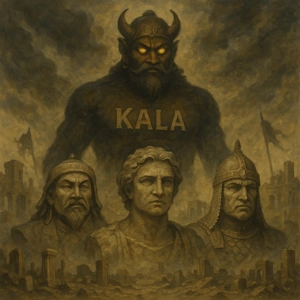
Genghis Khan, one of the most fierce conquerors of all times- gone at the age of 65.
Alexander the great- gone at the age of 67.
Atilla the Hun- gone at the age of 47.
Great empires gone- Maurya, Gupta, Chalukya, Pandiya.
Great scholars gone.
Lord Rama in the 23rd Sarga of Vairagya Prakarana of Yoga Vasishta is explaining the nature of Kala, Time.
Time doesn't discriminate between the powerful and the weak.
Between the rich and the poor.
Not that the rich live for long and the poor die early.
Time does whatever he wants, whatever he feels.
The point is, when everything is in the control of Time, Kala, everything in the world is controlled by Time, how can you trust the world?
How can you take anything for granted?
You thought that a particular Bank is safe, put money in it.
Then suddenly it closes down.
We have seen this happening.
Your best friend who has always been your pillar of support, for everything.
Suddenly gone, heart attack.
Your job, your friendly neighbourhood.
Nothing you can take for granted.
The breakfast should be good.
Yes, you enjoy it.
Next lunch, that should also be good.
After that dinner.
I want this, I want to enjoy this.
I want to have this every day.
This should be exclusively for me.
Does it ever stop?
In a lifetime, millions of desires.
Some achieved.
Some not achieved.
They don't stop.
Either you like something, dislike something, or you are not bothered; only three kinds of relationships possible in this world.
The objects of desire, they attract you like a net and trap you.
Your body is like a cage in which you are permanently trapped.
Both take away your freedom.
Only a fool will get obsessed with achieving desires.
It is like trying to grab the reflection of a mango in a mirror and relish it.
Your thinking itself that there are objects and beings around you for real, that itself is wrong.
On top of that, Time would take away from you even those uneal objects and beings.
Take away even the non-existent.
Make you frustrated.
Push you into dejection, disappointment.
There is nothing that Time doesn't destroy.
He is so powerful.
So hungry.
You can never satisfy his hunger.
He keeps on consuming.
We only experience a miniscule part of the real nature of Kala, Time; like days, nights, hours.
No, Time is a killer.
He kills everyone, everything.
That's what he does day in and day out.
Devouring, destroying.
The whole world is under his control.
He deals with it as he wants.
He is heartless, merciless, cruel.
He doesn't bother about the tenderness of a newborn before taking away its life.
He doesn't bother about the beauty of a blossomed flower before destroying it.
He just wants to devour, destroy.
He is not bothered about any rule, any system.
He has his own rules, his own system which nobody understands.
We make so many assumptions that a man's puranyu is 100 years, a well constructed building would last for 50 years.
No.
He is not bothered about what we assume, what we predict.
He does what he wants.
Always.
He has eaten so much, still his hunger doesn't go.
Like a magician, an illusionist, he is very much into the make believe called the world.
He creates so many things, makes us believe that they are there for real.
But what he enjoys is destroying.
He creates only to enjoy the destroying.
Like how we take so much care to cook food only to consume it and make it disappear.
When it comes to humans, he has another peculiarity.
The rows of teeth with which he crushes humans like leaves, those two rows of teeth are punya and papa.
With both, he is crushing us.
Punya leads a man into a good world.
But after some Time, Kala would end his stay there.
Papa would lead him to suffer in a bad world.
It's crushing at both places.
One at the end of a period.
The other throughout.
You can never stop him.
You can never break him.
You can never burn him.
He is so unreachable.
In your imagination, you can erect a building in a moment and demolish it the next moment.
This is what he also does.
He doesn't have to follow any process, any procedure.
He has devoured whole forests, oceans, planets, stars, galaxies; still his hunger is not satisfied.
A huge mountain for him is like a feather.
He destroys everyone: Devas, Manushyas, Rakshasas.
He doesn't discriminate.
Does he feel bad about what he is doing?
Never.
The only thing that he ever saves is himself.
He is the creator, he is the protector, and he is the eliminator: says Lord Rama.
-
Time (Kala) is the ultimate power that governs all events in the world — creation, preservation, and destruction — with no exception for strength, fame, or virtue.
-
No human, empire, or system — however mighty — can escape Time's reach; it destroys the conqueror and the commoner alike.
-
The belief that the rich or powerful are safer is an illusion; Time treats everyone the same and brings unpredictable ends.
-
Life's attachments — friends, careers, wealth, routines — can vanish without warning, making worldly reliance untrustworthy.
-
Desires are endless and never satisfy; even after fulfilling many, new cravings emerge and the cycle never ends.
-
Our likes, dislikes, and indifference are just temporary reactions; all relationships and objects only bind the mind further.
-
Chasing desires is foolish because it is like reaching for the reflection of a fruit — unreal and unrewarding.
-
Mistaking the world to be real adds another layer of suffering; Time then takes away even this illusion, leaving emptiness.
-
Time consumes relentlessly — not just beings, but thoughts, feelings, events, and illusions; nothing is spared.
-
He is beyond logic, beyond prediction, and doesn't follow human assumptions or expectations about lifespan or permanence.
-
Time doesn’t wait for process or permission; like a magician, he creates only to destroy, and enjoys that destruction.
-
His tools to crush human beings are their own karma — both merit (punya) and sin (papa); one brings temporary pleasure, the other suffering, but both end in ruin.
-
Time is invincible and untouchable — beyond human effort, immune to destruction, and inaccessible to logic or prayer.
-
He devours everything — forests, oceans, galaxies — without remorse, without satisfaction, without pause.
-
For Time, everything is weightless and meaningless — whether it’s a mountain or a star, a flower or a baby.
-
His only constant is himself — he alone survives his own dance of annihilation, unaffected and in control.
What does Time truly do in this world?
Time creates, sustains, and then destroys everything — not randomly, but as a constant cycle. He is the unseen power that never tires, never rests, and never spares anything.
Why can't we rely on the things or people around us?
Because everything, no matter how stable it seems, is under Time's control. Friends, jobs, even buildings vanish when Time decides — nothing is guaranteed.
Isn't that a gloomy way to look at the world?
It’s not pessimism — it’s clarity. Understanding Time’s nature frees us from false security and pushes us to seek something truly stable beyond the material.
Why is desire seen as dangerous in this teaching?
Desire keeps us trapped in an endless loop of wanting, chasing, and suffering. Even when fulfilled, it only leads to more desire, not peace.
What if I want to enjoy life while I can?
There’s nothing wrong with enjoying, but without awareness, desire becomes bondage. Knowing its nature helps you stay free even while living fully.
Can’t I balance desire and detachment?
Not easily. Desire is sticky — it promises joy but often delivers restlessness. Without inner clarity, it’s hard to stop once you're caught in its web.
What does it mean to say our world is an illusion?
It means that what we perceive as solid, real, and permanent is actually temporary and shaped by our mind. It’s a trick of perception, not truth.
So are people and relationships not real either?
They exist as experiences, but not as permanent truths. They come and go like dreams — meaningful while they last, but not eternal.
Isn't that a cold way to look at life?
It’s not cold — it’s liberating. When you see through illusion, you stop clinging and start living with wisdom and depth.
Why is Time called merciless or cruel here?
Because Time shows no preference — it takes everything, whether it’s a newborn or a wise sage, a beautiful flower or a strong kingdom.
Does Time not care about morality or justice?
Time doesn’t operate on human ideas of fairness. He obeys a deeper cosmic rhythm — not personal preferences or moral feelings.
How can something so brutal be accepted?
Because resisting Time only adds suffering. Accepting his nature allows us to live wisely, with humility, rather than in denial or arrogance.
How does karma (punya and papa) become Time’s tool?
Time uses our own actions — good and bad — to shape our experiences. Even rewards have an expiry, and suffering has its time too.
Is doing good still worth it, if Time crushes both?
Absolutely. Good karma leads to better experiences and less suffering, even if temporary. But it’s still within Time’s reach — not beyond it.
Why should I bother doing anything then?
Because action with awareness is different from blind chasing. Wise living doesn’t mean inaction — it means acting with insight, not illusion.
Why is Time compared to a magician?
Because like a magician, Time creates illusions — appearances of permanence, beauty, joy — only to destroy them and move on.
Why would he create if he only wants to destroy?
Creation and destruction are two sides of the same act for him. He builds like we cook food — not to preserve, but to consume.
Isn’t that a pointless cycle?
Only if you're stuck inside it. Once you see it for what it is, you're no longer fooled. You become a witness, not a victim.





English
Yoga Vasishta
Click on any topic to open
7
30
Astrology
Bhagavad Gita
Bhagavatam
Bharat Matha
Devi
Devi Mahatmyam
Ganapathy
Garuda Puranam
Glory of Venkatesha
Hanuman
Kathopanishad
Mahabharatam
Mantra Shastra
Mystique
Practical Wisdom
Purana Stories
Radhe Radhe
Ramayana
Rare Topics
Rigveda Explained
Rituals
Sages and Saints
Shiva
Spiritual books
Sri Suktam
Story of Sri Yantra
Temples
Vedas
Vishnu Sahasranama
Yoga Vasishta
26
17
10
0


