Knowledge Over Action: The Vedic View
We often think action is everything. Get things done. Take charge. Move fast.
But ancient Vedic wisdom tells us something radically different — action without knowledge is powerless. In fact, the power to know is more fundamental than the power to do.
Let’s walk through this.
Two Core Powers: Knowing and Doing
The Vedas say that Bhagavan — the Supreme Being — has countless powers, but two of them stand above the rest:
-
Jnana Shakti – the power of knowledge
-
Kriya Shakti – the power of action
All other powers are included within these two. These aren’t just spiritual concepts; they’re what run the world. Every movement, every thought, every creation — comes from one or both.
But here's the punchline: Jnana Shakti is superior.
Why? Let’s turn to a simple example.
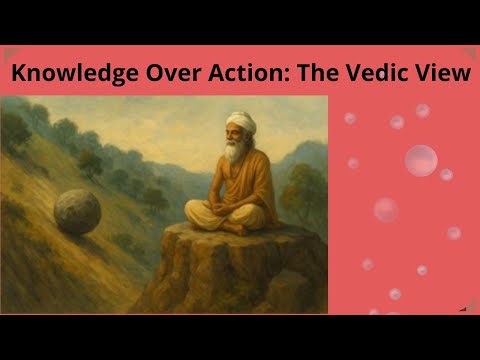
A Stone Rolling Down a Hill
Imagine a stone pushed down a slope. It rolls. It moves. It has motion — Kriya Shakti.
But does it know why it's moving? Does it choose where to go?
Of course not.
Now compare that with a human being who climbs the same hill. She knows her goal. She knows the path. She acts — but her action is informed by awareness.
That’s the difference.
A stone can move, but it cannot choose. It has activity but no direction. Without knowledge, action is just noise. And that’s what this teaching is about: Kriya Shakti without Jnana Shakti is blind.
The Role of Veda and Dharma
In this framework, the Veda is born from Jnana Shakti. It is pure, divine knowledge — not written by humans, but revealed to ancient seers (rishis).
And Dharma, the code of right living, flows from Kriya Shakti — it deals with action, conduct, duties.
So how do they relate?
Simple:
The Veda teaches what Dharma is.
Knowledge gives meaning to action.
Why You Can’t Invent Dharma
You can’t define Dharma by personal opinion, by majority vote, or by convenience.
You can’t make it up as you go.
Why not?
Because true Dharma is not just what you feel is right — it is what the Veda says is right. And the Veda, being rooted in Jnana Shakti, has the final say.
That’s why the scriptures clearly say:
‘For one who seeks to understand Dharma, the final authority is Shruti — the Veda.’
This is also why the Veda has full authority over all Arya Dharmas — rituals, ethics, vows, social duties, personal conduct — because only knowledge can lead these rightly.
Bottom Line: Knowledge Leads, Action Follows
A human can act meaningfully only because they can think.
Animals can act — but don’t understand Dharma.
Stones can move — but don’t choose.
Only knowledge gives freedom, choice, and direction to action.
So if you're trying to live a life of purpose, ethics, and alignment with Dharma, don’t start with What should I do?
Start with What should I understand?
Because in the Vedic view —
you must know before you do.
Q1. Why does Vedic thought place knowledge above action?
A: Because action without direction is chaos. Knowledge gives aim, timing, and purpose. Even Bhagavan is described as having both Jnana Shakti and Kriya Shakti — but Jnana leads. If you swap the order, you get speed without sense, motion without meaning.
Q2. What does the stone example really teach us?
A: The stone rolls, but it does not know. It moves, but it cannot choose. It has Kriya Shakti without Jnana Shakti. That is the condition of blind action — lots of activity, no authorship. Humans climb, choose, understand, and intend. That is what elevates their action.
Q3. Why does the Veda come from Jnana Shakti, not Kriya Shakti?
A: Because the Veda is not about doing things; it reveals what is worth doing. It is divine knowledge, not human opinion. It is the map, not the footsteps. That is why rishis receive it — they do not brainstorm it.
Q4. How does Dharma depend on knowledge?
A: Dharma governs action: duties, discipline, conduct, vows, rituals. But if you do not know what Dharma is, you cannot perform it correctly. So Veda speaks and Dharma follows. First Shruti defines the rule; then humans apply it.
Q5. Why can’t we invent Dharma based on feelings or voting?
A: Because personal taste shifts. Majority opinion changes. Convenience collapses under pressure. Dharma needs something sharper, older, and deeper than mood. That is why the Veda is the final authority — it sits on Jnana Shakti, not sentiment.
Q6. What makes humans capable of Dharma while animals are not?
A: Not physical strength, not speed, not instinct — but the ability to know. Humans can ask why and what for. They can examine consequences. They can align action with higher truth. That is how Jnana Shakti makes Kriya Shakti meaningful.
Q7. How does this teaching apply to spiritual life today?
A: Many people jump straight into techniques, routines, or activism. They ask 'What should I do?' before asking 'What should I learn?' Vedic wisdom flips the sequence. Understanding comes first, execution second. It is smarter to study the compass before marching into a forest.
Q8. What happens if someone uses Kriya Shakti without Jnana Shakti?
A: They become busy instead of effective. Productive instead of purposeful. Morally confused instead of clear. Think of it as spinning wheels without steering — you get motion, but you do not get direction.
Q9. Why does this teaching make 'knowledge' a form of power?
A: Because knowledge lets you choose. Choice is freedom. Freedom is authority. When you understand Dharma, you are not pushed by instinct, culture, or fear. You act because you know, not because you must. That is power in the cleanest sense.
Q10. What is the practical takeaway for someone who wants a dharmic life?
A: Stop asking only 'What should I do?' Start asking 'What should I understand?' Because once your mind knows the path, your action becomes sharp, ethical, and aligned. In simple form: learn first, act second.





English
Vedas
Click on any topic to open
7
30
Astrology
Bhagavad Gita
Bhagavatam
Bharat Matha
Devi
Devi Mahatmyam
Ganapathy
Garuda Puranam
Glory of Venkatesha
Hanuman
Kathopanishad
Mahabharatam
Mantra Shastra
Mystique
Practical Wisdom
Purana Stories
Radhe Radhe
Ramayana
Rare Topics
Rigveda Explained
Rituals
Sages and Saints
Shiva
Spiritual books
Sri Suktam
Story of Sri Yantra
Temples
Vedas
Vishnu Sahasranama
Yoga Vasishta
26
17
10
0


