Knowledge Is Today Sold In Modules
We were looking at forces that take over the mind and leave impurities behind – some of them are kama, krodha, lobha, moha, mada and matsarya.
We have already seen about kama, krodha and lobha and how they can be curbed through simple acts like pilgrimage, puja, daana.
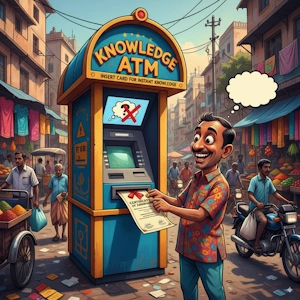
Now moha – what is moha? Ignorance. Ignorance can be of two types – false knowledge and incomplete or insufficient knowledge. Both are equally harmful. Today, we are living in a world where both these kinds of knowledge are rampant.
Today, knowledge has an agenda behind it. Knowledge is given as someone wants it to achieve a certain purpose. Knowledge is nobody’s monopoly. Knowledge like air and water is universal. Nobody has any right over it.
Knowledge was never sold before. In gurukula system – a guru dakshina is given after the curriculum is over. But that is not a fee. It is a sign of gratitude. And can be anything. Today, knowledge is sold, in modules. And we have no shame in doing it that way. Knowledge is charged by the hour. And we have no shame in doing that.
Individuals can not be blamed for this. If you have to pay to learn, then you, of course, have to charge to put it to use. It is the whole system that is at fault. Medical education was free once. Then doctors were looked upon as gods. Today it is very difficult in India to become a doctor unless you invest 25 lacs, 50 lacs or even a crore. You have to borrow, you have to pay interest to the bank. Can’t expect anything more out of the poor child. It is the whole system that is at fault.
Even when knowledge is given away free of cost, like those incessant forwarding that happens over WhatsApp or facebook, it is either reckless or with an agenda. People are not even bothered what they are passing on is genuine or not. Or when knowledge is given away free of cost it could have a spirituality based agenda, a cult is being developed or a political agenda or an activist agenda. That is how the system is – so false knowledge and incomplete knowledge is rampant in the plane of consciousness.
This is what Shastra calls moha. It was always there, but all the more now. And you base your actions, your decisions on this false knowledge or incomplete knowledge. How many people in the age group of 20 to 40 today even have a hint of how the universe is functioning? How everything is connected to everything else? How many would have even thought once that time could be an illusion, space could be only something that your mind comes out with, they are not absolute? How many would have even thought whether there could be or can not be a master plan how things are happening in this world?
And still, we are living, living every day, doing things, taking decisions, giving opinions, even advice to others, criticizing, appreciating. And all these leave dirt behind in the mind. One reason, not the only reason, one reason for all this is the way the west teaches you that you are responsible for yourself. This also has an agenda. Rulers don’t like groups, especially groups that they can’t influence. As long as the group is in my favour it is fine. Or it should be a group that I can make and break and manipulate as and when I want.
So as time progresses, we break down groups. We have done away with joint families and opted for nuclear families long back, now even nuclear families we don’t want, everything should be individual. Every human should be an individual number – either a social security number or an aadhaar number or similar numbers. From day one this is what the child is taught. Be a go-getter, peer comparison. Weekly assessments, daily assessments. So much of focus on oneself.
After some time this is only what the child would see. I am this, I know this, I don’t know this, he is better than me, she is behind me. If two marks have come less in the exam, hold the child responsible, hold the parent responsible, the sky has fallen. And by the time the child is in the teens, the thought process has already become absolutely self-centred, fragmented. Frustrations, self-blame, depression, suicidal tendency.
We have heard about youth committing suicide due to a failed love affair or parental objection to a love affair. Now, failure in the exam – suicide. Not able to clear NEET – suicide. Depression. A few years back a psychiatric counsellor once told, it will take a long time for our profession to pick up in India. Because here everybody is a counsellor. Parents are counsellors, friends are counsellors, neighbours are counsellors, every elder is a counsellor, every neighbour is a counsellor, every co-passenger is a counsellor. But this is going away fast.
We have no hesitation in saying, this is my private affair, don’t interfere, even to father, mother, in laws, husband, wife. We are becoming too self-centred, too much responsible and accountable for ourselves.
This is where the simple samskaras like pujas, chanting shloka, putting a tilaka on the forehead. A tilaka on the forehead – this will help me, this will protect me. There is something outside of me who can do that. Help me, protect me. I am not the lonely man on this island. There is someone I can look up to. I have studied well. I have done my part. Now God has to do his part. Elders used to say – half by yourself and half by God.
These are great strengths you see in times of trouble. With such an attitude you will never fall into depression, there will be no self-blame. Even fate, I am not advocating fatalism, that everything is predetermined or fate. But it is a great medicine in times of trouble. Blame it on faith, and you are out of your depression. Simple.
The moment you recognize a superpower or a master plan outside of yourself, you accept these and nurture them through simple acts like puja, saying a prayer, chanting a shloka, the simpler the better. Then less dirt is generated in your mind. Chitta becomes simpler, purer. This may not be complete knowledge, but slowly it can take you there, take you closer to that.
This self-centredness is one of the mohas. There are so many of them. But for most of them or even all of them, it all starts with this simple living, simple thinking, having faith in a superpower, doing small acts like offering a flower as a token of recognition – this is the cure, this is the vaccine. And with this kind of simple but broad thinking, less impurity is generated in the mind. Chitta shuddhi is achieved.
-
Certain forces corrupt the mind by leaving lasting impurities. These include kama (desire), krodha (anger), lobha (greed), moha (delusion), mada (pride), and matsarya (jealousy).
-
Moha is a state of inner confusion caused by false or incomplete knowledge. It makes people act on illusions rather than truth.
-
Today, knowledge is being packaged and sold with hidden motives. It is no longer about truth but about control, profit, and influence.
-
In earlier times, knowledge was shared freely and offered as a sacred trust. Now, it's commercialized and divided into hourly modules.
-
Charging for knowledge leads to charging for its use. This creates a cycle where people learn not to grow but to earn.
-
The modern education system burdens young minds with pressure and comparison, turning them self-obsessed and fragile.
-
By promoting competition from childhood, society breeds fear, insecurity, and loneliness, killing the spirit of collective wisdom.
-
False pride in individualism has weakened our social support systems. We’ve abandoned joint families and group belonging for isolation.
-
Western ideas like 'you are solely responsible for your life' fuel anxiety. They prevent people from accepting help or higher guidance.
-
Depression and suicide among youth often arise from the belief that failure is personal and absolute, not part of a larger pattern.
-
Even free knowledge shared today is rarely pure; it often serves an agenda—be it political, spiritual, or ideological.
-
A simple puja, a chant, a tilak—these small acts reconnect the individual with something greater, beyond the self.
-
Recognizing a superpower, or a master plan beyond the ego, creates mental clarity and emotional resilience.
-
Faith acts as an anchor. It gives people strength during chaos, not by escape, but by offering perspective.
-
You don't need complex theories to purify the mind. Small daily rituals and humble gestures clean the inner space.
-
When life feels overwhelming, surrendering to a higher order calms the mind and brings inner balance.
What is moha and why is it dangerous?
Moha means confusion or delusion that arises from ignorance—either false knowledge or lack of complete understanding. It pushes people to take decisions based on illusions. Both types of ignorance cloud judgment and lead to suffering.
Can someone have moha even if they are educated?
Yes. Formal education often gives fragmented facts, not holistic understanding. Without inner clarity, even a degree-holder can be trapped in false ideas.
Isn't incomplete knowledge better than none at all?
Not always. Partial knowledge can mislead just as badly as falsehood. A half-understood medicine or half-baked law can do more harm than good.
Why is modern knowledge often agenda-driven?
Because it’s no longer offered as a service but as a tool of influence. Institutions, corporations, and ideologies push selective knowledge to shape opinions and control behavior.
How can one tell if knowledge has an agenda?
If it tries to persuade more than inform, or if it pushes action before understanding, it's likely agenda-driven.
Isn't all knowledge motivated by something? What's wrong with that?
Motive isn’t the problem—manipulation is. Genuine teaching empowers the learner. Manipulative knowledge limits their choices.
What happens when knowledge is commercialized?
It stops being sacred. When learning is sold like a product, it loses its connection to truth and becomes just another transaction.
Is it wrong to charge for teaching?
Not inherently. But when pricing decides access, and profit dictates content, it corrupts the process of learning.
But don’t teachers need to survive too?
They do. The problem is systemic—when survival depends on selling modules, the purpose of teaching shifts from service to income.
Why are young people more confused and depressed now?
They’re raised in a system that glorifies individual achievement, peer comparison, and constant evaluation. This creates pressure without peace.
How does this start so early?
From school days—marks, medals, rankings, constant judgment. Kids learn to see themselves as success machines, not full humans.
Aren’t assessments necessary for growth?
Some structure is useful, but obsession with ranking destroys curiosity. It breeds insecurity and isolates the learner.
Why has group belonging collapsed in society?
Modern values push independence to the extreme. Joint families, community rituals, and social bonding are seen as old-fashioned.
What’s wrong with everyone being independent?
True independence includes the strength to connect. Isolation in the name of freedom leads to loneliness and instability.
Can’t new kinds of groups replace the old ones?
Not unless they’re built on trust and mutual care. Most modern groups are transactional—they come and go with trends.
Why is believing in a higher power mentally helpful?
Because it removes the burden of being the sole controller of life. It softens ego and invites trust in a bigger design.
Isn’t that just emotional crutch?
No. It’s a stabilizing force. Recognizing higher intelligence doesn’t weaken you—it humbles and strengthens you.
What’s the proof that it helps?
Countless lives have been held together by a simple belief—'I did my best, now it’s in higher hands.' That clarity prevents despair.
How do simple rituals purify the mind?
They shift the focus from ego to surrender. Lighting a lamp, chanting a shloka, or offering a flower reminds the mind that there’s more to life than just ‘me’.
Do these really work or is it just sentiment?
They anchor the mind. In the middle of chaos, even a symbolic act can bring clarity, calm, and direction.
Aren’t these just cultural leftovers?
Even if they are, they carry deep psychological wisdom. Ancient cultures survived by tying emotion, meaning, and action into one gesture.
What is chitta shuddhi and why does it matter?
Chitta shuddhi means purification of the inner mind. It removes emotional clutter and allows clarity, peace, and insight.
How can someone begin working on it?
Start small. Consistent, sincere actions like prayer, selfless service, and silent reflection begin the cleaning process.
Is it necessary to be religious for this?
Not at all. You just need humility and sincerity. Faith in something beyond your ego is enough to start clearing the dust.





English
Yoga Vasishta
Click on any topic to open
7
30
Astrology
Bhagavad Gita
Bhagavatam
Bharat Matha
Devi
Devi Mahatmyam
Ganapathy
Garuda Puranam
Glory of Venkatesha
Hanuman
Kathopanishad
Mahabharatam
Mantra Shastra
Mystique
Practical Wisdom
Purana Stories
Radhe Radhe
Ramayana
Rare Topics
Rigveda Explained
Rituals
Sages and Saints
Shiva
Spiritual books
Sri Suktam
Story of Sri Yantra
Temples
Vedas
Vishnu Sahasranama
Yoga Vasishta
26
17
10
0


