Palace Servant Reports Rama’s Condition in Court
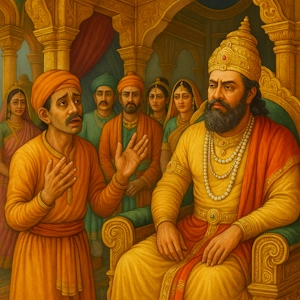
Vasishta advised Dasharatha, that you should honour your words. He had told Vishwamitra that he would obey whatever he says, and when he asked for Rama to be sent with him, Dasharatha started pleading, no I can’t do that, he is not old enough to face rakshasas and all that.
Vasishta said, this is not correct. If the king falters on dharma, what will the common man do? Everybody looks up to the ruler as the role model. If he wouldn’t honour his words, why would a common man do that?
See where the focus is. Vasishta is only concerned about dharma and the king’s conduct. No sentiments. Not even whether Lord Rama is strong enough or capable enough or not. You promised, and you have to honour.
That is the way to maintain dharma in the world. And our sages are focused on that. Vasishta is rajaguru. He is not worrying about Dasharatha’s emotions as a father.
A messenger was sent to the palace to get the Lord along with Lakshmana.
प्रतिहार महाबाहुं रामं सत्यपराक्रमम्
सलक्ष्मणमविघ्नेन पुण्यार्थं शीघ्रमानय
King Dasharatha realized, after listening to Sage Vasishta, what he should. पुण्यार्थं शीघ्रमानय — sending Rama is going to earn punya.
The messenger came back soon. The Lord is sitting there gloomy, like how a black bee would sit quietly on a closed lotus in the night.
रात्रौ षट्पदः कमले यथा
He says, I will come in some time. Then his attention goes elsewhere. He doesn’t want to be near anyone, it looks like.
One servant from the palace had accompanied the messenger. The king started asking him – how is he, what is he doing?
He said, your majesty, we are all so worried about him. He has become so gloomy and frail. Looking at him, we are all so concerned that even we are not able to eat properly. Look at my body, it has become a skeleton.
From the day he returned from the pilgrimage, he has been like this. Only after we compel him, he sometimes takes some little food. Even his daily rituals — sometimes he does, sometimes he doesn’t.
The bubbly girls playing around in the garden — he doesn’t even look at them.
Someone who knows that his stay in swarga is going to be over soon, he wouldn’t enjoy the pleasures anymore. The Lord’s state is something like that. Even while sitting amidst blossomed flowers in our beautiful garden, he has the same look on his face. He has no interest in any of the delicacies which are served to him. A sixteen-year-old boy — naturally he should have interest in girls. Whenever he sees them, he just murmurs, these girls can give only misery in life, nothing else.
किमिमा दुःखदायिन्यः प्रस्फुरन्तीः पुराङ्गनाः
इति नृत्तविलासेषु कामिनीः परिनिन्दति
This is what he murmurs when he sees them dancing around merrily.
A man of noble origin — if he is forced to live among uncultured crass people, he would prefer to stay away from everyone, sit alone, sit away — this is how the Lord behaves.
He is behaving like a sanyasi now. He doesn’t want anything. He is not interested in anything.
He sits alone, with his chin resting on his left palm, always in deep thoughts. He has no likes, no dislikes, he doesn’t want anything. He doesn’t seem to be interested in the affairs of the kingdom also.
He has become totally unpredictable — where he goes, what he wants, what he would like, what he wouldn’t like. Even we who are with him always — we don’t understand.
His virakti and vairagya are increasing day by day.
Not only the Lord, even Princes Lakshmana and Shatrughna have also become like him — weak and frail and silent. If anyone asks them, they say 'nothing'.
We have heard the Lord telling other boys — we are all just wasting our lives over these temporary meaningless stuff. We never strived to achieve the greatest goal. It has been such a waste.
If someone tells him, 'Lord, you are the emperor', he would just look at him as if it is some mad man blabbering, smile, and walk away.
He doesn’t listen to anyone. He doesn’t look at anything anymore.
He doesn’t get excited about anything.
अप्याकाशसरोजिन्या अप्याकाशमहावने
इत्थमेतन्मन इति विस्मयोऽस्य न जायते
If someone says, look there are beautiful flowers that have blossomed in the sky, which itself is a huge forest — will you believe it?
First of all, sky is not a forest. Then can there be even lotuses in the sky?
The first premise itself is false.
The mind itself is a fallacy. Then how can anything create excitement in the mind?
Meaning, these excitements that external objects create in the mind are not to be taken seriously, because mind — where these excitements are created — that itself is a fallacy. It doesn’t exist for real.
This is apparently the Lord’s thinking.
Even if there is a heavy downpour, it cannot break hard rocks. In the same way, even while living among beautiful girls, the Lord is untouched by the arrows of Kamadeva.
He says, wealth is the cause of all troubles, and gives away everything — whatever anyone would ask for.
He says the comfort of wealth is only an imagination, it is an illusion.
He says people cry for each and everything — oh I am going to die, nobody cares for me — why don’t they develop vairagya buddhi instead? Are they all so stupid?
Your majesty, you only tell us what we should do. How shall we deal with the Lord, so that he comes out of this state?
There are so many scholars there who are well-versed in practical life — how to live life as a prince, as a king, as an emperor. Can they not advise him?
No. He scorns them. He laughs at them.
He doesn’t have friends anymore. He doesn’t have enemies anymore. He doesn’t have likes anymore. He doesn’t have dislikes anymore. He has no desire for anything. He doesn’t have any attachment towards anything he has.
न मूढो न च मुक्तौऽसौ — but it looks like he is neither delusioned nor realized. He is somewhere in between.
Why is this so? He has discretion — viveka buddhi. He is able to recognize the unreal, so he is not moodha. But he has not attained peace. He is troubled and worried, so he has not attained realization. He has not become completely free.
This is why we are all worried. It looks like he has decided to give up his life.
What to gain by observing dharma? What to gain by becoming an emperor? Everything is false — the mothers, relatives, relations — they are all false, false notion. What is the point in living this life, when everything is false?
This is what he is thinking. We are worried that he would give up his life. This body cannot give me anything. It is burden. Only death can give me mukti.
He is upset because he thinks that all these — wealth, comforts, relations, kingdom — they have all become obstacles for him in attaining mukti.
We all think that the present state of the Lord is the delusion in which he is stuck.
मनसि मोहमपास्य — the servant is saying this present state is the delusion. Moha. He is neither here nor there.
But unfortunately, there is no one who is capable of getting him out of this state. There is no sun which can remove this darkness from his mind.
What do they all want? They don’t want him to continue this way.
प्रकृते व्यवहारे तं निवेशयेत् — he should be brought back to normal life, worldly life. They are not approving of his present state of half-baked vairagya. They want him to come back to normal life — with likes and dislikes, with friends and foes — which they think is the balanced normal life.
But look who is talking philosophy — a servant.
You know how? Who is he serving? Who is he living close to?
That’s why.
See his growth. See his progress. He may not have had realization yet, but see his observations — especially the ones relating to the sky and the lotus. Even to report something like this, you need to have real stuff inside.
-
A king must honor his promises, because the ruler’s conduct sets the standard for society. If he falters on dharma, common people will too.
-
Vasishta, as rajaguru, places dharma above personal emotion. Dasharatha’s attachment as a father is irrelevant in front of his duty as a king.
-
Rama is summoned with Lakshmana for fulfilling a sacred purpose, which itself earns punya (spiritual merit).
-
Rama is described as withdrawn and gloomy, like a bee resting on a closed lotus at night, uninterested in worldly life.
-
Servants report that Rama barely eats, avoids rituals, and has lost all interest in pleasures, company, or the kingdom.
-
His detachment resembles that of a sanyasi: no likes, dislikes, friends, enemies, or ambitions remain.
-
He murmurs that women and pleasures bring only suffering, and wealth is the root of endless troubles.
-
His reflections show deep viveka (discrimination): the mind itself is illusory, so its excitements are meaningless.
-
Even amidst beauty, like maidens or flowers, he remains unaffected, untouched by desire or delight.
-
Rama appears to be in a middle state: not deluded, because he sees the unreal, but not realized, because he lacks peace.
-
His vairagya (dispassion) grows daily, influencing even Lakshmana and Shatrughna.
-
Others around him are worried, thinking he may give up his life, seeing the world as false and burdensome.
-
Servants believe he must be drawn back into normal worldly life, though they unknowingly echo deep philosophical truths they absorbed by serving him.
-
His insights, like the analogy of the sky-lotus, reveal a rare depth of awareness, even if not yet matured into full realization.
What does Vasishta emphasize to Dasharatha about sending Rama?
He insists that the king must honor his word without wavering. A ruler is the role model of dharma, and if he fails, the people will lose faith in righteousness. Personal fears or attachments cannot outweigh a king’s duty to truth.
Why is dharma given higher weight than fatherly love here?
Because in public duty, private emotion cannot dictate action. A rajaguru guides the king to uphold order in society. If sentiment ruled decisions, justice and consistency would collapse.
Isn’t it harsh to ignore Dasharatha’s pain as a father?
It is, but the larger principle matters more. A society without trust in its leader’s word falls apart. The pain of one father cannot outweigh the stability of an entire kingdom.
Why is Rama described as gloomy and withdrawn?
He has lost all taste for worldly enjoyments. Food, rituals, gardens, and even the play of maidens fail to stir him. He sits apart, reflecting deeply, absorbed in thoughts of impermanence.
How can someone so young feel such detachment?
Age does not limit awareness. Sometimes sharp insight arises early, cutting through illusions that others chase for a lifetime. His pilgrimage may have triggered this awakening.
Could this just be depression rather than wisdom?
Not quite. Depression is rooted in helplessness and despair. Here, Rama shows clarity of thought, philosophical reasoning, and disdain for illusions — signs of viveka, not confusion.
What does Rama say about wealth and pleasures?
He dismisses them as causes of misery. Wealth breeds endless worry, and pleasures bring suffering. He sees that chasing these leads to bondage, not joy.
Why would someone turn away from pleasures that others crave?
Because once you see the trap, the glitter fades. Like spotting snakes inside a golden cave, you cannot enjoy the shine anymore.
But isn’t wealth necessary for survival?
Survival needs little, but obsession with wealth enslaves. Rama isn’t denying basic needs; he is rejecting the endless chase that distracts from higher truth.
What insight does Rama give about the mind?
He calls the mind itself an illusion. If the very field where excitements rise is unreal, then no excitement can be taken seriously.
How do we relate to this in daily life?
When we realize thoughts and emotions are fleeting shadows, their power weakens. You stop clinging to every rise and fall, and peace becomes possible.
Isn’t the mind real enough to affect us?
It affects us as long as we accept its authority. Like mist that looks solid from afar but vanishes when touched, the mind loses grip once seen clearly.
What troubles others about Rama’s state?
They fear he will renounce life itself. To them, his disinterest looks like imbalance, a dangerous rejection of worldly duties.
Why do servants describe him with philosophical depth?
Living close to him, they absorb his reflections. Even ordinary attendants echo profound insights, showing the transformative power of proximity to a noble mind.
Is their worry justified?
From their view, yes. They think balance means worldly engagement. But in truth, Rama’s detachment marks a threshold, a rare step toward realization.





English
Yoga Vasishta
Click on any topic to open
7
30
Astrology
Bhagavad Gita
Bhagavatam
Bharat Matha
Devi
Devi Mahatmyam
Ganapathy
Garuda Puranam
Glory of Venkatesha
Hanuman
Kathopanishad
Mahabharatam
Mantra Shastra
Mystique
Practical Wisdom
Purana Stories
Radhe Radhe
Ramayana
Rare Topics
Rigveda Explained
Rituals
Sages and Saints
Shiva
Spiritual books
Sri Suktam
Story of Sri Yantra
Temples
Vedas
Vishnu Sahasranama
Yoga Vasishta
26
17
10
0


