Kartaviryarjuna Blessed with Thousand Hands
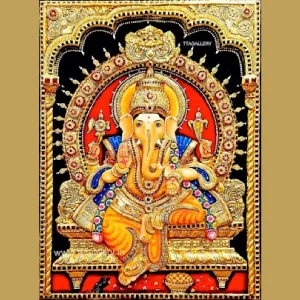
Kartaviryarjuna’s father, Kritavirya, performed the Sankashti Vratam for one year to have a child. When the child was born, he had neither arms nor legs. The mother cried bitterly, saying, 'Why was I given such a child? It would have been better to remain childless. I feel my past sins have not yet ended. Even the blessings of Lord Ganesha have turned out like this!'
Kritavirya also lamented, 'O Lord, they say You are merciful and grant blessings just by remembrance. Why has this happened to me who sought refuge in You? All my prayers,tapas, and charity have been in vain. Truly, no effort can overcome destiny.'
The ministers and advisors consoled him, saying, 'What is destined will happen. Just as a tree bears flowers and fruits at the right time, so will the fruits of your good deeds. Lord Ganesha will not abandon you.'
When Kartavirya turned twelve, Lord Dattatreya visited them. Seeing Kritavirya’s sorrow, Dattatreya said, 'I will give Kartavirya padesha of the Ekakshara Mantra of Ganesha. Let him perform tapas with this mantra. Everything will be set right.'
Accordingly, Kartavirya was taken to a forest, where a small hut was built for him. He lived there, consuming only air, and performed tapas for twelve years. Pleased by his devotion, Lord Ganesha appeared before Kartavirya.
Kartavirya asked for two boons from the Lord: unwavering devotion to His lotus feet and the removal of his deformity to relieve his parents’ sorrow. The Lord blessed him and granted him two legs and a thousand arms.
Lessons:
- Even what seems impossible can be achieved through devotion and effort.
- Greater the problem, greater the effort required. Kartavirya succeeded after twelve years of intense tapas.
- Do not lose hope if results are not immediate. Keep praying and persevering.
- Why did Lord Ganesha initially grant Kritavirya a child without limbs despite his sincere performance of the Sankashti Vratam?
This serves as a profound lesson on the nature of Prarabdha Karma or past destiny. Even divine blessings often manifest through the filter of one's previous actions. By granting a child with a deformity, the Lord tested the parents' faith and set the stage for a much greater glory. It highlights that divine grace does not always mean the immediate removal of difficulty, but rather the creation of a path toward an extraordinary transformation. - What is the significance of the ministers’ comparison of destiny to a tree bearing fruit at the right time?
This metaphor teaches the principle of Kala, or divine timing. Just as you cannot force a tree to fruit out of season despite watering it daily, spiritual rewards require the "ripening" of time. The advisors were pointing out that Kritavirya's prayers were not in vain; they were simply seeds underground that had not yet reached their season of blooming. - Why was Lord Dattatreya, rather than Ganesha himself, the one to intervene when Kartavirya turned twelve?
This illustrates the "Guru-Tattva" or the principle of the spiritual master. In many traditions, the deity does not approach the devotee directly until a Guru acts as a bridge. Dattatreya represents the guide who provides the specific tool—the Ekakshara Mantra—to channel the devotee's existing potential into a focused spiritual force. - What is the hidden meaning behind Kartavirya consuming only air during his twelve years of tapas?
Consuming "only air" refers to the yogic practice of Pranayama and Pratyahara, where the seeker withdraws all sensory dependence on the material world. It signifies a state of total internal focus where the physical body is sustained by vital life force (Prana) rather than gross food, showing that spiritual transformation requires the starvation of worldly ego to feed the soul. - Why did the Lord grant Kartavirya a thousand arms when he only asked for the removal of his deformity?
This reveals the "Atishaya" or the overflowing nature of divine grace. When a devotee asks for the bare minimum to solve a problem, the Divine often grants abundance that far exceeds human imagination. The thousand arms represent not just physical limbs, but the infinite capacity to act, protect, and uphold Dharma, turning a former weakness into an unparalleled strength. - What does the specific duration of twelve years for both his age and his tapas signify in a spiritual context?
In Vedic symbolism, twelve years often represents a cycle of completion or "Purnatva." It is the time required for a seed of discipline to fully transmute the character of a practitioner. It suggests that deep-seated karmic patterns or physical limitations are not rewritten overnight but through a sustained cycle of dedicated effort. - How does Kartavirya’s first request for "unwavering devotion" over "physical healing" change the outcome of his prayer?
By placing devotion (Bhakti) before his personal need for healing, Kartavirya demonstrated that his soul had evolved beyond his physical lack. This selfless priority is often the "secret key" in scriptures; when the seeker seeks the Giver rather than the gift, the Giver grants both the Spirit and the material solution automatically. - What mystery lies in the mother’s lament that Ganesha’s blessings turned out to be a curse?
This reflects the common human error of judging a divine process by its middle stage rather than its end. The mystery is that what looks like a "curse" is often a "wrapped blessing." Had Kartavirya been born with normal limbs, he might have lived an ordinary life; his deformity was the specific catalyst that led him to perform the tapas that made him a legendary world-conqueror. - What is the hidden power of the Ekakshara Mantra mentioned by Dattatreya?
The Ekakshara or "Single-Syllable" mantra represents the seed (Bija) of all creation. It is considered more potent because it is undiluted and requires extreme concentration. The story suggests that for the most difficult "impossible" problems, one must return to the simplest, most concentrated form of divinity to find the solution. - How does this story redefine the concept of "effort" in relation to "destiny"?
The story suggests that destiny is not a static wall but a fluid energy. While Kritavirya initially thought "no effort can overcome destiny," his son proved that "spiritual effort is the only thing that can rewrite destiny." It teaches that while we cannot change the past that caused a problem, we can use intense present action to change the future manifestation of that problem.





English
Ganapathy
Click on any topic to open
7
30
Astrology
Bhagavad Gita
Bhagavatam
Bharat Matha
Devi
Devi Mahatmyam
Ganapathy
Garuda Puranam
Glory of Venkatesha
Hanuman
Kathopanishad
Mahabharatam
Mantra Shastra
Mystique
Practical Wisdom
Purana Stories
Radhe Radhe
Ramayana
Rare Topics
Rigveda Explained
Rituals
Sages and Saints
Shiva
Spiritual books
Sri Suktam
Story of Sri Yantra
Temples
Vedas
Vishnu Sahasranama
Yoga Vasishta
26
17
10
0


