Jagadadijah

Let’s look at the meaning of the 147th divya nama of Vishnu Shasranama - जगदादिजः(jagadadijah) from -
भ्राजिष्णुर्भोजनं भोक्ता सहिष्णुर्जगदादिजः ।
अनघो विजयो जेता विश्वयोनिः पुनर्वसुः ॥
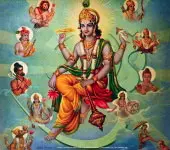
The divine name 'Jagadadijah' is a combination of three Sanskrit words: Jagat (world or universe), Adi (beginning), and Jah (born). It means 'He who was born at the beginning of the Universe.'
Explanation:
- Eternal Existence Before Creation:
Before the universe was created, a supreme being with the power to create it had to exist. This name shows that Bhagavan Vishnu existed before creation and is the source of all existence. He is the ultimate cause of creation. - Manifestation as Hiranyagarbha:
Bhagavan Vishnu is Hiranyagarbha, the cosmic seed or womb from which the universe is born. During pralaya (cosmic dissolution), all beings and objects merge into this miniature form. When creation begins again, the universe emerges from this aspect of Vishnu. - Virat Atma (Universal Soul):
This name also refers to Vishnu as the Virat Atma, the universal soul that pervades and sustains the universe. As the Virat Atma, Vishnu ensures the cycles of creation, preservation, and dissolution.
The Mahabharata supports this idea with the verse:
Gatishcha nastvam purvajo jagatah prabhuh
Rakshartham sarva-bhutanam Vishnustvam upajagmivan
(Udyoga Parva 12.11)
'You are our refuge. You are the first-born of the universe, the Lord of all creation. You took the role of Vishnu to protect all beings.'
This verse confirms Vishnu's primordial role as the first-born divine power and protector of the universe.
- Bhagavan existed before time began and is not bound by its flow. This shows that Vishnu transcends past, present, and future, making him the eternal overseer of creation.
- 'Jagadadijah' reminds us of the unchanging source of stability in a constantly evolving world. It encourages faith in the divine order and inspires introspection to connect with the eternal essence within us.
- 'Jagadadijah' represents the cyclical nature of the universe, with Vishnu as the source from which creation arises and into which it dissolves. This helps us understand the balance between creation, preservation, and destruction.
- As the source of creation, Vishnu is the origin of dharma, the universal laws that govern karma. Understanding 'Jagadadijah' emphasizes that our actions must align with the cosmic principles Vishnu embodies to maintain harmony.
-
If Vishnu existed before creation, what does that mean for our sense of time and change?
Chanting any nama from the Vishnu Sahasranama slows the restless mind and reminds us that beyond time and change, there is a steady presence. This helps in dealing with anxiety over the future and regrets of the past, restoring balance to both body and relationships. -
How does the idea of Vishnu as the first-born of the universe affect daily life?
Repeating any nama from the Vishnu Sahasranama 108 times roots us in the awareness that life is not random but guided by a higher order. This strengthens family unity, as members see their bonds as part of a divine plan rather than mere chance. -
What does it mean that creation, preservation, and destruction are cycles, not accidents?
Chanting the full Vishnu Sahasranama at a slow pace teaches acceptance of cycles in our own lives. Health issues, career ups and downs, even family disputes are understood as phases, not permanent traps. This awareness reduces stress and builds resilience. -
If Vishnu is the universal soul, how does connecting with him affect personal conduct?
Repeating any nama 11 times each morning creates a rhythm that aligns actions with dharma. This steady practice encourages honesty, fairness, and patience in family and work life, making one a source of harmony rather than conflict. -
Why is it said that stability comes from remembering Vishnu in a changing world?
Chanting any nama from the Sahasranama calms the nervous system, lowering tension and improving physical health. It also builds emotional steadiness, which makes relationships more secure since people around us feel our presence as grounding and reliable.
-
How can you claim someone existed before the universe if existence itself begins with the universe?
The point is not physical existence within time, but the necessary cause behind time itself. For a universe to appear, a source beyond it must already be present. That source is identified as Vishnu, standing outside the limits of time. -
Isn't 'first-born of the universe' just a poetic way of saying 'we don't know what came before'?
It is more precise than that. 'First-born' refers to the initial principle from which all else flows. Instead of ignorance, it asserts a definite cause that sustains order rather than random chaos. -
Why equate Vishnu with Hiranyagarbha, the cosmic seed, instead of calling it energy or matter?
Because Hiranyagarbha is described as both container and cause, not just inert stuff. Energy and matter only explain what already exists. Hiranyagarbha explains how the possibility of existence itself comes forth. -
If the world keeps dissolving and reappearing, how do you prove there is a cycle at all?
The evidence lies in observed patterns: night and day, seasons, birth and death. These repeating rhythms suggest that larger cosmic cycles mirror the same principle. The claim is that Vishnu anchors these cycles. -
How can Vishnu be called the universal soul when individuals clearly have separate minds?
Individual minds are like waves, distinct yet part of the same ocean. The universal soul is the ocean itself, the base upon which all distinctions rise and fall. Without that shared ground, no separate mind could exist. -
Why bring in dharma if you are just explaining creation?
Because creation without order collapses. Dharma is the set of laws that keep cause and effect consistent, just as gravity keeps planets in place. To say Vishnu is the origin of dharma is to say he is the guarantee that the universe is not lawless.





English
Vishnu Sahasranama
Click on any topic to open
7
30
Astrology
Bhagavad Gita
Bhagavatam
Bharat Matha
Devi
Devi Mahatmyam
Ganapathy
Garuda Puranam
Glory of Venkatesha
Hanuman
Kathopanishad
Mahabharatam
Mantra Shastra
Mystique
Practical Wisdom
Purana Stories
Radhe Radhe
Ramayana
Rare Topics
Rigveda Explained
Rituals
Sages and Saints
Shiva
Spiritual books
Sri Suktam
Story of Sri Yantra
Temples
Vedas
Vishnu Sahasranama
Yoga Vasishta
26
17
10
0


