Ishe Tvorje Tva Explained - Part 3
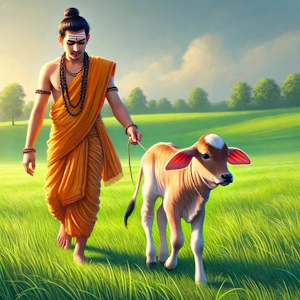
अथेमानि त्रीणि पलाशजातानि भवन्ति श्लक्ष्णको लोमशको व्रततिरिति। लोमशकस्येवैषा छेत्तव्या भवति। यावन्मात्रे गौर्निकर्षेत, न तत ऊर्ध्वं छिन्द्यात्। अपशव्याऽत ऊर्ध्वं स्यात्।
There are three kinds of Palasha branches:
- One with a smooth surface.
- One with a hairy surface.
- One that looks like a creeper.
Only the branch with a hairy surface should be used. The branch should be at a height reachable by cows, not above. Anything that grows above this height is not fit to be used with cows.
सा या प्राची वोदीची वा बहुपर्णा बहुशाखाऽप्रतिशुष्काग्रा भवति तामाच्छिनत्ति इषे त्वोर्जे त्वा इति।
A branch growing on the eastern or northern side of the tree, with many leaves, many sub-branches, and a tip that is not dry, should be cut and brought.
Sayanacharya goes on to explain the importance of Palasha. Taittiriya Brahmana 3.2.1 says:
तृतीयस्यामितो दिवि सोम आसीत्। तं गायत्र्याहरत्। तस्य पर्णमच्छिद्यत। तत्पर्णौऽभवत्। तत्पर्णस्य पर्णत्वम्।
Soma was in heaven earlier. Gayatri brought Soma to earth. The wing of Soma got cut, and that became Palasha Parna (leaf).
कद्रूश्च वै सुपर्णी च (तै.सं.६.१.६)।
Kadru and Suparnee were divine mothers and co-wives. There was competition between them regarding their beauty. Kadru defeated Suparnee and enslaved her as per a mutual agreement.
The meters such as Jagati, Trishtup, and Gayatri were the children of Suparni. Kadru told Suparnee, 'If you get Soma from heaven, I shall release you from slavery.' Accordingly, Suparnee asked her children to go to heaven and get Soma.
First, Jagati went up. Jagati originally had fourteen letters. Jagati could not get Soma and lost two letters in heaven during the process. Jagati returned to earth without Soma, losing two letters.
Then, Trishtup went up and failed in getting Soma. It lost two letters and came back.
Finally, Gayatri went up. Gayatri originally had only four letters. Gayatri got Soma to the earth and acquired the four letters lost by Jagati and Trishtup in heaven. Thereafter, Gayatri had eight letters.
During the struggle, Soma’s wings fell on earth. The wings sprouted as the Palasha tree. Hence, Palasha is called Parna.
न चात्र पर्णस्य कथं वृक्षत्वं संपन्नमिति विस्मेतव्यम्। विधातुरीश्वरस्याचिनत्यशक्तित्वात्। अन्यथा बीजात् वृक्ष इत्यत्रापि क्व बीजं क्व वा वृक्षः इत्यपि विस्मयः केन वार्येत। सर्वत्र पर्णेभ्यो वृक्षः प्रसज्येत इत्ययमतिप्रसङ्गोऽपीश्वरसङ्कल्पाभेवेन परिहर्तव्यः। स च संकल्पः कार्यैकसमधिगम्यः। तस्माद्वेदार्थे – कुतर्कैर्न चोदनीयम्।
How can a tree grow out of wings? Because of the power of intent of the Almighty. If a tree can grow out of a seed, why not out of a wing? Then why do trees not sprout out of every wing that falls on earth? Because the Almighty does not desire so. Such arguments are not to be used when dealing with Vedas.
See, there were such questions being raised even in those days, and the Acharya gives a befitting reply.
वत्सानपाकरोति – 'वायव:स्थ' इति। वायवो गन्तारः। उपायवः उपगन्तारः।
हे वत्साः मातृसकाशात् गन्तारो भवत। पुनर्दोहकाले उपगन्तारो भवतेति। वायुशब्देनैषामभिधानं वाय्वधिष्ठातृकत्वमेषां प्रदर्शयितुम्।
Oh calves, go away from your mothers. Come back again at the time of milking. The governing deity of calves is Vayu, who is the presiding deity of antariksha.
हे वत्साः तृणभक्षणाय प्रथमं मातृसकाशादपेत्य स्वेच्छयैवारण्ये गन्तारो भवत। सायं पुनर्यजमानगृहे समागन्तारो भवत।
Oh calves, go away to the forest for grazing as much as you wish. Come back in the evening to the yajamana’s house.
अथवा वत्सानां परंपरया वायुदेवताकत्वात् तदभेदविवक्षया वायुरूपत्वं ब्रुवन्नध्वर्युः तद्रक्षार्थं वत्सान् वायुदेवतायै समर्पयति – says Sayanacharya.
The calves are traditionally associated with the deity Vayu. By addressing them so, Adhwaryu is entrusting their protection to Vayu.
वायुः स्वप्रचारेणान्तरिक्षमधितिष्ठति। अन्तरिक्षे च विस्रम्भसंचाराय बहुलमवकाशं प्रयच्छन् वत्सान् पालयति।
Vayu roams around in antariksha and protects the calves as they graze around and enjoy themselves.
प्र वा एनानेतदाकरोति। यदाह। वायवः स्थेति (तै.ब्रा.३.२.१)। अध्वर्युरिमं भागमुच्चारयतीति। यदेतेनोच्चारणेन वत्सन् वायुतादात्म्यलक्षणप्रकृष्टाकारवतः करोति।
By addressing the calves as 'Vayus', the Adhvaryu is equating them to the deity Vayu by his nature.
उत्तरभागं व्याचष्टे – 'उपायवः स्थेत्याह। यजमानायैव पशूनुपह्वयते। इति।
They are called back for the sake of the yajamana, for the benefit of the yajamana.





English
Vedas
Click on any topic to open
7
30
Astrology
Bhagavad Gita
Bhagavatam
Bharat Matha
Devi
Devi Mahatmyam
Ganapathy
Garuda Puranam
Glory of Venkatesha
Hanuman
Kathopanishad
Mahabharatam
Mantra Shastra
Mystique
Practical Wisdom
Purana Stories
Radhe Radhe
Ramayana
Rare Topics
Rigveda Explained
Rituals
Sages and Saints
Shiva
Spiritual books
Sri Suktam
Story of Sri Yantra
Temples
Vedas
Vishnu Sahasranama
Yoga Vasishta
26
17
10
0


