Medha Janana Sukta Explained
The first sukta of Atharva Veda Samhita is ye trishapta. There are two Samhitas of Atharva Veda that exist even today: Shaunaka Samhita and Paippalada Samhita. There were supposed to be nine Samhitas; only two exist now.
The differences between different Samhitas could be in the sequence of mantras. By the way, Samhita means a complete collection of mantras. Mantras are assembled as suktas. A sukta may have 2 or 3 or 10 or 20 mantras. A collection of suktas is called Samhita. This is common to both Rigveda and Atharva Veda. Yajurveda is in yajus or prose.
So, from Samhita to Samhita, the sequence of mantras can change. Some mantras are there in one Samhita and not in others. Swaras, particularly the way in which swara is applied, can change.
Shaunaka Samhita starts with ye trishapta and Paippalada Samhita starts with shanno deveeh. Paippalada Samhita is present in Odisha as of today.
We will try to see the meaning of the four mantras of the sukta that starts with ye trishapta, which is the very first sukta of Shaunaka shakha of Atharva Veda. This sukta is called medha janana sukta – literally meaning mantras for generation of intelligence.
One particular application of this sukta is at the time of upanayana. The child prays with these mantras right at the time his learning begins for generation of faculties of intelligence.
When mantras are applied, it is not just chanting. It is a combination of chanting, materials, and procedures. Each combination gives a different result. Mantras are not to be used as you want. That is called misuse of mantras. Very clear guidelines are there. If they are not followed, they don’t work – or they can work in a way you may not want.
The reason we are giving these mantras here is not for you to pick them up and start chanting. Listening to them helps to some extent. There are also principles as to how listening can help. Not getting into that now – we will see that some other time.
The instant reaction whenever a mantra is given is requests for lyrics and meaning – it is not so casual. You get impressed by Pt. Bhimsen Joshi or M.S. Subbulakshmi and say, 'Where are the lyrics, let me also sing.'
Veda mantras, like Carnatic music or Hindustani music, require years of dedicated and intensive training under an able guru before you start chanting. So, the mantras we give here are not meant for you to start chanting.
Stotras and shlokas, which you can chant, we give the lyrics – but not in the case of mantras.
Another important reason why we are giving mantras is that they should motivate you. You should know that these things exist, get motivated, and start learning from a genuine source.
Ayurveda had almost become extinct. Then TV programs, newspapers, magazines, social media – they all played their role. People started realizing how superior a system Ayurveda is, how complete a system Ayurveda is – and new life is infused into it now.
So creating awareness is very important. That’s what we are doing – that these things exist.
So once again – mantras are given not for you to chant. You can listen to them. And wherever meaning is given, try to understand that.
Coming back to medha janana sukta, as we saw before, these mantras are primarily used during upanayanam. There are many procedures done with these mantras during upanayanam:
उदुम्बरपलाशलकर्कन्धूसमिदाधानम् – Udumbara, palasha, and karkandhu are all yajna vrikshas. Their samidha or twigs are offered in Agni by the manavaka or brahmachari during upanayana chanting this mantra.
व्रीहियवतिलानाम् आवपनम् – Sowing of paddy, barley, and tila is done in the palika – a plate made of wood or clay.
क्षीरौदनपुरोडाशरसानां भक्षणम् – The boy takes rice cooked in milk and remnants of other offerings made in Agni chanting this mantra.
Here rasa means ghee, curd, water – all liquids: dadhi, ghritam, madhu, udakam.
आज्यमिश्रधानाहोमः – Homa of grains mixed with ghee.
सुप्तस्योपाध्यायस्य कर्णानुमन्त्रणम् – This is interesting. The brahmachari should chant these mantras in the ears of the guru when the guru is asleep – not when he is awake.
Why when he is asleep? Maybe because he hears it as a person when he is awake, and when he is asleep it is the divinity inside him that would hear – I am just inferring something.
There are a few more things to be done with these mantras during upanayanam.
The term used here is anumantranam, different from abhimantranam.
Chanting a mantra and at the same time remembering its meaning and also why it is being chanted is called anumantranam.
In addition to this, if you are also looking at the object or person for which or whom the mantra is meant, it is called abhimantranam.
So, anumantranam + looking = abhimantranam.
मन्त्रं उच्चारयन्नेव मन्त्रार्थत्वेन संस्मरेत्
शेषिणं तन्मना भूत्वा स्याद् एतत् अनुमन्त्रणम्
एतदेवाभिमन्त्रस्य लक्षणं चेक्षणाधिकम्
There is another principle about rituals.
People often ask – how many times, how much?
कर्मभूयस्त्वात् फलभूयस्त्वम् – The more you do, the more shall be the result.
Simple – chanting 10,000 times will be more effective than chanting 1,000 times.
Feeding 100 people will be more effective than feeding ten people.
But in some rituals, the quantum is specified – you should not exceed that.
In rituals of Rigvedis following Ashwalayana Sootra, or even in Bodhayana system of Yajurveda, before a homa begins, you have to declare the number of ahutis going to be given, to which deities they are meant, and the dravya going to be used.
You cannot deviate from that later. This is called anvadhanam.
If you have said two, it has to be two – it can’t be three.
In addition to medha janana, there are many more prayogas with this mantra – for acquiring properties, for wealth, for strength, for winning battle, for papakshaya.
Mantras are the same, but procedures vary.
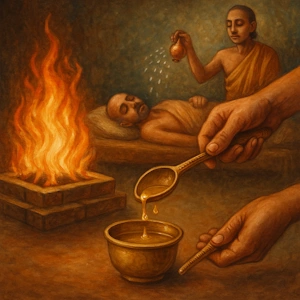
For diseases, homa of ghee should be done with these mantras. Sampata should be taken.
Sampata means – after ahuti is offered in Agni, a little bit of ghee that remains in the ladle, maybe one drop, is collected in a vessel – it is called sampata.
Sampata because it has actually touched the tongue of Agni and come back – so it is very powerful.
These drops are collected in a cup after each ahuti. This is mixed in water and with that water, sponging of the patient is done.
Shastra is clear about these healing procedures:
द्विविधा व्याधयः – Diseases are of two kinds:
आहारनिमित्ता अन्यजन्मपापनिमित्ताश्चेति
-
Arising out of food – due to bad eating habits (viruddhahara), what you call lifestyle diseases, due to overeating, under-eating, pollution, pollutants in the food, food poisoning, malnutrition.
तत्र आहारनिमित्तानां वैद्यशास्त्रोक्तचिकित्सया उपशमनम् – Cure of such diseases is through medical science. -
पापनिमित्तानाम् तु होमबन्धनपायनादिभिर्भैषज्यकरमभिरुपशमनम् – If the disease is due to purva janma papa, then homa, wearing amulets, and all such methods are used.
ये त्रिषप्ताः...
This is the first mantra.
There is a term trishaptah – meaning tri saptah – three sevens. This is the beauty of the Veda. Let’s see how much and how far a single term in Veda can convey.
Three sevens or three and seven.
What is three?
-
Three worlds – patala, bhoomi, and swarga or bhur, bhuvah, svaha – earth, mid-region, and heaven.
-
Their presiding deities – Agni of bhumi, Vayu of antariksha, and Surya of swarga – three again.
-
Three gunas – sattva, rajas, and tamas.
-
Trimurtis – Brahma, Vishnu, and Maheshwara.
Seven:
-
Seven rishis – Atri, Bhrigu, etc.
-
Sapta grahas – the seven physical planets (leaving aside the shadow planets Rahu and Ketu).
-
Sapta marudganas – seven groups of seven each – sons of Rudra, very fierce.
-
Sapta lokas – bhuloka, bhuvarloka, swarloka, maholoka, janoloka, tapoloka, satyaloka.
Or the seven worlds below – atala, vitala, sutala, talatala, rasatala, mahatala, patala. -
The seven meters – Gayatri, Ushnik, etc.
-
Seven Suryas – seven forms of Surya that are visible in the sky and give out light not harmful to beings:
Arogo, Bhraja, Patara, Patanga, Svarnara, Jyotishiman, Vibhasa
There is also the eighth form of Surya, Kashyapa, who lights up only Meru Parvata –
स महामेरुं न जहाति – he does not leave Meru Parvata.
So sapta could also mean these seven forms of Surya benevolent to the world.
Sapta Sindhus – the seven samudras or seven punya nadis.
Or three times seven – twenty-one –
द्वादश मासाः पञ्च ऋतवः त्रय इमे लोका असावादित्य एकविंशः
All put together – twenty-one, says Yajurveda.
Or: pancha bhutas + pancha pranas + pancha jnanendriyas + pancha karmendriyas + antahkarana = 21.
Now, divinity assuming various forms is present, roams about these three or seven or three plus seven or three times seven and supports all of them – the power and strength of all these.
ये त्रिषप्ताः परि यन्ति विश्वा
भूतानि बिभ्रतः ।
वाचस्पतिः बलं तेषां
तन्वो अद्य ददातु मे ॥
May Lord Vachaspati place the power and strength of divinity present in all these various forms into me.
Why Vachaspati? Because all these powers have to come in the form of mantras, which the brahmachari is going to learn. He will get those powers through mantras, and by using mantras, he will be able to access the powers present in all these and turn them in his favour whenever he wants.
And Vachaspati is the lord of speech, of words, of mantras.
So this is the very first prayer –
May Vachaspati place all these powers in me in the form of mantras.
It is said that those who know mantras speak – and Devas listen.
Mantra is the language in which you communicate with divinity. Mantra is the divine language.
So when mantras are uttered, Devas listen – and when prayed to with mantras, Devas grant those wishes.
Second Mantra – पुनरेहि...
Hey Vachaspate! Come to me again and again.
Mantras are not learned in a day. Mantras are learned over years.
The blessings of Vachaspati are required every day over these years. Hence, Vachaspati should come and bless again and again.
Vachaspati is also Vasospati – Vasoh Pati – Vasu is wealth.
There is nothing that cannot be achieved with mantras.
So, lord of speech, lord of mantras, is also lord of wealth.
He should ni ramaya – always favour me, give me happiness, by being with me both as power in mantras and wealth that arises therefrom.
Mayyevaastu – whatever I hear, my lessons – I should not forget them. They should always stay inside me.
Third Mantra – इहैवाभि...
Both kinds of results are prayed for – aihika and amushmika – here and hereafter, in this world and the next (paraloka).
Ubhe vitanubhe – like the string connects both ends of the bow, in the same way, my learning should connect both this life and the next.
This learning is not just for earning here – it is also for paraloka.
Both together – ubhe.
Mantras that he is going to learn are going to connect both his life on earth and life in paraloka.
They will give him abundance and happiness in iha-loka and paraloka.
Again, prayer to Vachaspati – mayyevaastu – whatever I learn should be firmly placed within me.
He should place them in such a way that they remain with me forever – this knowledge should remain with me forever.
Fourth Mantra –
We are calling out to Vachaspati. We are invoking Vachaspati.
And he should in turn call to us all the sadphala – like medha shakti and all the good results that can be achieved through mantras.
Because now it is up to Vachaspati to call mantras and place them inside the brahmachari.
Vachaspati rihvayatam – we have called you, now you please call them – all those Devatas, all those powers, all those good results. Place them within us.
Because once Vachaspati calls for Veda mantras and places them within the student, then he will have all the power to achieve whatever he wants.
Sam shrutena – may what we learn always remain with us.
May whatever we learn never go away.
A very beautiful prayer.
The student recognizes that all powers reside in mantras. Through mantras, everything can be achieved.
He asks for those powers to be transferred to him. Vachaspati is the Devata who would do this – because he is the lord of vani, speech, mantras.
He should place all these powers inside the student – not at once – but over the long period of learning, the long period of his stay at the gurukula.
He should come every day and bless him.
Vachaspati should make sure that whatever he learns is not forgotten.
These mantras are going to act as a bridge to paraloka, where also he is looking forward to happiness.
Now that Vachaspati is prayed to, it is up to him to summon all the other divine powers and place them within the student.





English
Vedas
Click on any topic to open
7
30
Astrology
Bhagavad Gita
Bhagavatam
Bharat Matha
Devi
Devi Mahatmyam
Ganapathy
Garuda Puranam
Glory of Venkatesha
Hanuman
Kathopanishad
Mahabharatam
Mantra Shastra
Mystique
Practical Wisdom
Purana Stories
Radhe Radhe
Ramayana
Rare Topics
Rigveda Explained
Rituals
Sages and Saints
Shiva
Spiritual books
Sri Suktam
Story of Sri Yantra
Temples
Vedas
Vishnu Sahasranama
Yoga Vasishta
26
17
10
0


