Importance of Offering Namaskara in Puja
In Shiva Puja, we have seen up to Naivedya Samarpana.
From Avahana up to Naivedya Samarpana, we have been seeing the significance of each step — the tattwa behind each step — in detail.
Now, the last two steps of Shodasha Upachara Puja: Namaskara and Visarjana.
Namaskara is to show respect, to show humility.
It is also called Nati.
Do you know what are considered to be the ornaments for different people?
-
नीतिर्भूमिभुजां – the ruler should be just, unbiased
-
नतिर्गुणवतां – good people should have humility; those with qualities should have humility
-
ह्रीरंगनानां – hree means modesty or shyness (in a positive sense); this is the ornament for women
-
धृतिर्दम्पत्योः – mutual affection for husband and wife
-
शिशवो गृहस्य – children are the ornaments of a home
-
कविता बुद्धेः – imagination and creativity of the intellect
-
प्रसादो गिराम् – pleasantness of words
-
लावण्यं वपुषः – beauty of the body
-
स्मृतिः सुमनसः – gratitude of good people
-
शान्तिर्द्विजस्य – peaceful nature of scholars
-
क्षमा शक्तस्य – tolerance and patience of powerful people
-
द्रविणं गृहाश्रमवतां – wealth of the householder (only then can he provide to others)
-
स्वास्थ्यं सतां – health of people with good habits
These are the ornaments. Here Nati is humility. Namaskara is the expression of humility.
Namaskara is of three types:
Kayika – done with the body
Vachika – done with words
Manasika – done with the mind
Kayika Namaskara has three types:
-
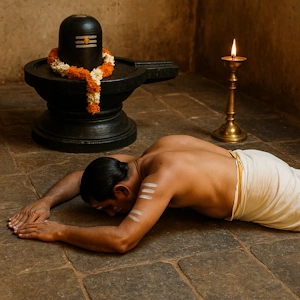
Uttama – You lie face down with your knees and head touching the floor. This is Sashtanga Namaskara. In the case of women, the chest should not touch the ground — called Panchanga Namaskara.
-
Madhyama – You kneel down and touch the ground with your head. For men, this is the madhyama type; for women, it gives the full benefit of uttama.
-
Adhama – While standing, you join your palms together in Anjali Mudra above your head, without kneeling or lying down.
Why three types?
The best is the Uttama type. Wherever possible, you should do that.
If there is space constraint and you can't lie down — say, the sanctum sanctorum is small — do the second type.
If you're standing in queue to take darshan and can't do either, when you reach before God, do the third type.
But Shastra says that Gods like it best when you do the full-fledged Sashtanga Namaskara (or Panchanga in the case of women), which is a sign of complete surrender.
Vachika Namaskara – Namaskara with words.
If you don’t do the physical namaskara but only say a namaskara mantra — either a Veda mantra or Purana mantra which has the term namaha in it or pranamami, pranatosmi —
then it is the Madhyama type of Vachika Namaskara.
If you just say it, it is madhyama.
If you say it with bhakti, it is Uttama.
If you don’t say a mantra but express your humility in your own natural language, then it is the Adhama kind.
Even if you don’t know any mantra, say it in your own words. Soon, you will get mantras to say.
Even if you don’t have bhakti, say namaskara or do namaskara — soon you will be blessed with bhakti.
Manasika Namaskara – Only with the mind.
Neither with the body nor with mantra or words.
Here, if your mind is going toward a Devata whom you love, and out of love you are doing it — then it is the Uttama kind.
If it is due to emotion such as fear — then it is Adhama.
Say there is an idol of a Yakshi. Your feeling towards it is one of fear, not like how you feel toward an idol of Krishna.
Still, you recognize and at least offer Namaskara mentally — this is Adhama Manasika Namaskara.
If it is just casual — you have neither bhakti nor fear, you don’t even know which Devata it is — others are doing, so you also do it —
this is the Madhyama kind of Manasika Namaskara.
Kayika Namaskara — avoid doing at night.
Not only to Devatas — even women, elderly people, Gurus — they all should be offered Namaskaras.
Here also, there are some rules to be followed.
In a temple, other than to God, only your own Guru can be offered Namaskara to — nobody else.
If a number of dignitaries are sitting together, then you should only do one Namaskara commonly to all of them — not individually.
This is why in pujas, even if there are a number of Acharyas, the Yajamana should not go to each one of them and do Namaskara.
It should be one common Namaskara meant for all together.
Do not do Namaskara or Pranama to someone from far away — even if it is an idol.
Don’t do Namaskara to someone who is in the middle of water — like taking bath in a river.
If someone is passing by fast or running — don’t do Namaskara at that time.
Don’t offer Namaskara to someone who is angry.
Don’t offer Namaskara to someone who is arrogant and doesn’t bother to even look at you.
Offer Namaskara to a person only if he is going to recognize and bless you.
Otherwise, just forget it. He is not worthy of Namaskara.
Now the last step: Visarjana.
Sarjana is activation — which is the same as Avahana.
Visarjana is the opposite of that — deactivating.
After the puja, you are deactivating the idol or Linga — only to be reactivated at the time of the next puja.
This is also called Nishkalikarana.
This we have already seen in detail at the time of discussing Avahana.





English
Shiva
Click on any topic to open
7
30
Astrology
Bhagavad Gita
Bhagavatam
Bharat Matha
Devi
Devi Mahatmyam
Ganapathy
Garuda Puranam
Glory of Venkatesha
Hanuman
Kathopanishad
Mahabharatam
Mantra Shastra
Mystique
Practical Wisdom
Purana Stories
Radhe Radhe
Ramayana
Rare Topics
Rigveda Explained
Rituals
Sages and Saints
Shiva
Spiritual books
Sri Suktam
Story of Sri Yantra
Temples
Vedas
Vishnu Sahasranama
Yoga Vasishta
26
17
10
0


