How You Live Decides How You Leave
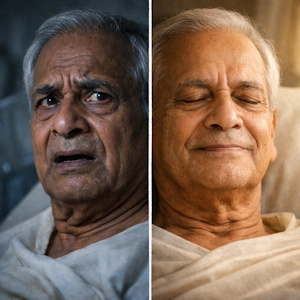
People imagine death like a clean switch.
One moment alive. Next moment gone.
That is not how it happens.
Death is not a single moment. It is a process.
And that process exposes everything you have built inside.
The Body Withdraws
The body does not collapse instantly.
It withdraws.
Energy starts pulling back from the outer system.
Hands and feet lose strength. Movement reduces. Control over small actions slips first.
Then comes fatigue. Heavy. Unnatural.
Even lifting a hand feels like effort.
Breath changes.
It is no longer smooth.
Sometimes fast. Sometimes irregular. Sometimes shallow.
The body is trying to hold on. But the system is weakening.
Digestion slows. Senses dull.
Vision fades. Hearing becomes distant.
The body is not cooperating like before.
This is not dramatic.
It is slow.
Quiet.
Unavoidable.
Control Slips
This is where most people get shocked.
In life, you assume you are in control.
At death, that control starts slipping.
Speech becomes unclear. Words don't come properly.
You know what you want to say. But expression fails.
Then memory fluctuates.
You recognize some people. Forget others.
Moments of clarity. Moments of confusion.
The system is no longer stable.
And this is important.
Because at this stage, you cannot fix things.
No last-minute planning works here.
No sudden discipline appears here.
Whatever you practiced in life… that is what continues.
The Inner State Surfaces
Now the inner state becomes active.
If a person has lived with fear, fear rises.
If a person has lived with attachment, clinging increases.
If a person has lived with anger, restlessness appears.
This is not philosophy.
This is mechanics.
When external control drops, internal patterns take over.
And these patterns are not gentle.
They are dominant.
They come with force.
Because this is what you repeated your whole life.
Habits, Not Ideals
Clarity starts breaking.
Logical thinking weakens.
Decision-making ability drops.
You cannot analyze.
You cannot reason properly.
The mind becomes reactive.
Not intelligent. Reactive.
And what drives that reaction?
Your strongest habits.
Not your ideals.
Not your knowledge.
Your habits.
This is why someone who read a lot about dharma can still panic at death.
Because reading is not equal to conditioning.
Only repetition builds conditioning.
Here is the gap most people never close.
They accumulate knowledge. They never build the pattern.
The Connection Loosens
Now something deeper happens.
The connection between body and subtle system loosens.
You feel it as detachment.
Sometimes as confusion.
Sometimes as resistance.
Sometimes as strange calm.
This varies.
There is no single experience.
Two people can lie on adjacent beds.
Same illness. Same situation.
One is calm. One is disturbed.
Why?
Because what is happening outside is identical.
What is different is what each person built inside over decades.
Death does not create your state.
It reveals it.
The Final Phase
Breath becomes uneven.
Long gaps.
Then shorter bursts.
Then again silence.
The system is trying to exit.
At this point, external communication almost stops.
But internally, activity is high.
Whatever dominates your mind now becomes your direction.
This is the critical point.
Not your last words.
Not your last ritual.
Your last active pattern.
That is what leads you forward.
The Harsh Truth
At the time of death:
You cannot suddenly become peaceful. You cannot suddenly become detached. You cannot suddenly become focused.
You become what you have trained yourself to be.
Daily thinking becomes final thinking.
Daily reactions become final reactions.
Daily habits become final direction.
Why This Matters
People prepare for everything.
Career. Money. Family.
But they ignore this one event which is guaranteed.
And when it comes, they expect it to go smoothly.
Without preparation.
That is not how the system works.
What Preparation Means
It does not mean reading more.
It does not mean performing more rituals.
It means training the mind daily.
Small things.
How you respond when something goes wrong.
How you handle loss in ordinary life.
How quickly you return to calm after disturbance.
These small daily patterns are exactly what the mind falls back on when it can no longer think clearly.
That is the preparation.
Not grand gestures.
Daily practice.
Simple Clarity
Death is not a surprise test.
It is a final display.
Of your inner condition.
If the system is stable, exit is smooth.
If the system is disturbed, exit is chaotic.
No decoration can change this.
Only preparation can.
And preparation begins now.
Not later.
Now.
1
Question: Why is death described as a gradual withdrawal instead of an instant event
Answer: Because the system shuts down in layers. Physical strength reduces first, then control, then sensory clarity. This staged withdrawal exposes inner patterns step by step. It is a process, not a switch.
2
Question: Why does control slip even when awareness is still present
Answer: Because control depends on the body functioning properly. As the body weakens, the ability to act drops. Awareness can remain, but expression and execution fail. That creates a gap between knowing and doing.
3
Question: Why do inner patterns dominate when the body weakens
Answer: Because external support systems collapse. When control, speech, and reasoning weaken, the mind falls back on what is strongest inside. Repeated habits take over because they require no effort.
4
Question: Why are habits more important than knowledge at the time of death
Answer: Because knowledge needs clarity and focus to operate. At death, both reduce. Habits operate automatically. What was practiced repeatedly becomes the default response when thinking power drops.
5
Question: What truly determines the direction at the final phase
Answer: The dominant inner pattern at that moment. Not last words or last actions, but the strongest tendency active in the mind. That becomes the direction because it is what remains when everything else weakens.
1
Objection: Many people die suddenly without this gradual process
Reply: Sudden death skips visible stages, not internal condition. The inner patterns still exist and become active immediately. The process may be compressed, but it is not removed.
2
Objection: If habits matter so much, what is the role of knowledge and rituals
Reply: Knowledge and rituals are tools to build correct habits. If they remain at the level of information, they do not help at the final stage. Their purpose is to shape daily patterns.
3
Objection: This makes death sound too mechanical and predictable
Reply: It is structured, not mechanical in a lifeless sense. The system follows order. Inner condition leads to specific responses. That predictability is what makes preparation possible.
4
Objection: If everything depends on past patterns, is there no chance at the last moment
Reply: Last moment effort has limited impact because control is already weak. The system responds to what is strongest, not what is newly introduced. That is why preparation is placed in daily living.
5
Objection: This creates pressure and fear about how one will die
Reply: It should create clarity, not fear. The focus shifts from worrying about the end to shaping the present. When daily patterns improve, the final phase naturally becomes more stable.




English
Garuda Puranam
Click on any topic to open
7
30
Astrology
Bhagavad Gita
Bhagavatam
Bharat Matha
Devi
Devi Mahatmyam
Ganapathy
Garuda Puranam
Glory of Venkatesha
Hanuman
Kathopanishad
Mahabharatam
Mantra Shastra
Mystique
Practical Wisdom
Purana Stories
Radhe Radhe
Ramayana
Rare Topics
Rigveda Explained
Rituals
Sages and Saints
Shiva
Spiritual books
Sri Suktam
Story of Sri Yantra
Temples
Vedas
Vishnu Sahasranama
Yoga Vasishta
26
17
10
0


