Are Pitrus Individuals or Cosmic Groups?
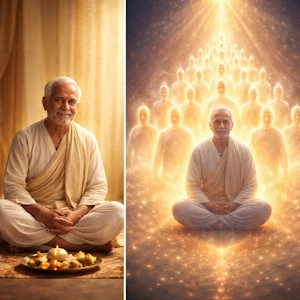
Are Pitrus Individuals or Cosmic Groups?
This question looks simple.
But it cuts straight into how Shraddha actually works.
People assume one fixed idea.
Either your exact grandfather is sitting somewhere waiting.
Or everything is just symbolic energy with no individuality.
Both extremes miss the structure.
Understand this carefully.
Pitrus operate at two levels at the same time.
Individual and collective.
First, the individual layer.
Yes.
Your grandfather.
Your father.
Your lineage.
They do not disappear immediately after death.
They continue in a subtle state.
With memory.
With identity.
With connection to the lineage.
That is why Shraddha uses names, gotra, and lineage details.
Because the system is not random.
It is targeted.
When you offer with proper sankalpa, it is not going into a general pool.
It is directed.
Like sending something with a clear address.
So at one level, Pitrus are absolutely individuals.
Now understand this through a simple comparison.
Think of a policeman.
He is an individual.
He has a name.
A family.
A personal identity.
You can call him directly.
You can interact with him personally.
That is like your ancestor as a Pitru.
Specific.
Identifiable.
Connected to you.
But at the same time, he is not operating independently.
He is part of the police force.
He follows a system.
A hierarchy.
A structure.
Orders flow through that system.
Resources move through that system.
Authority comes from that system.
He cannot act outside it.
Now apply this directly.
Your ancestor is like that individual policeman.
But the Vasu-Rudra-Aditya framework is like the larger force.
Now the second layer.
The Vasu, Rudra, Aditya structure.
This is where most people get confused.
These are not random deities inserted into the ritual.
They are functional stages.
After death, the departed does not remain in one fixed state.
There is progression.
In Shraddha tradition:
Recent departed are linked with Vasu level
Intermediate with Rudra level
Further evolved with Aditya level
This is not mythology.
This is classification.
A system to organize how offerings reach different levels of subtle existence.
Think of it like this.
When you send something to a policeman, it does not bypass the system.
It moves through departmental channels.
In the same way, your offering is meant for a specific ancestor.
But it moves through an organized structure.
The Vasu-Rudra-Aditya framework acts like that channel.
They regulate.
They transmit.
They ensure proper reach.
So what is actually happening?
You are offering to your specific ancestor.
But through an organized cosmic structure.
Not in isolation.
This is why mantras mention both.
Individual lineage.
And Vasu-Rudra-Aditya groups.
Now the deeper clarity.
As time passes, individuality becomes less rigid.
The person does not vanish.
But identification loosens.
Think of a new recruit.
Strongly identity-based.
As he grows in the system, he functions more as part of the force.
Less personal.
More role-based.
Same person.
Different level of identification.
That is how Pitrus evolve.
Early stage.
Strong individuality.
Later stage.
More alignment with collective levels.
Still existent.
But more integrated into the system.
So do not reduce it to one idea.
Pitrus are not just your grandfather sitting somewhere.
And they are not just abstract forces either.
They are individuals moving within a structured collective framework.
Straight understanding.
Shraddha is precise.
It respects individuality.
But it operates through cosmic order.
You are not just remembering ancestors.
You are interacting with a system that connects lineage to the larger structure of existence.
1
Question: Why does Shraddha use personal details like name, gotra, and lineage if Pitrus are also part of larger cosmic groups
Answer: Because the system preserves individuality. The offering is not thrown into a vague spiritual field. It is directed toward a specific lineage and specific ancestral connection. Personal details make the offering precise, while the larger structure ensures proper transmission.
2
Question: Why are both the individual ancestor and the Vasu-Rudra-Aditya framework mentioned together
Answer: Because both are active at the same time. The ancestor remains a distinct being connected to the family line. But that being functions within an ordered cosmic system. The framework is not replacing the ancestor. It is the structured channel through which the relationship operates.
3
Question: What does it mean that Pitrus exist at both individual and collective levels
Answer: It means the ancestor does not lose identity, but also does not function in total isolation. Just as one person can be both an individual and part of an institution, a Pitru remains a distinct being while also participating in a larger organized order.
4
Question: Why is the policeman comparison useful for understanding Pitrus
Answer: Because it removes confusion. A policeman is a real person with a personal identity, yet he acts within the police force and not outside it. In the same way, the Pitru is a real ancestor, but operates within the Vasu-Rudra-Aditya structure and not as a disconnected entity.
5
Question: What is the deeper meaning of the shift from Vasu to Rudra to Aditya
Answer: It shows progression in subtle existence. The being does not remain frozen in one condition. Over time, individuality becomes less rigid and more integrated into the larger cosmic order. The person is still present, but functioning less through personal fixation and more through structured alignment.
1
Objection: If the ancestor is still an individual, why involve cosmic groups at all
Reply: Because individuality does not cancel system. A person can remain distinct while functioning through a larger order. The cosmic groups are not unnecessary additions. They are the mechanism through which ancestral support and reception are properly organized.
2
Objection: This sounds contradictory. Either the Pitru is my exact ancestor or it is a collective force
Reply: It is not contradictory. Many real systems work this way. A person can be both an individual and a member of an organized force. The same principle applies here. The Pitru is your ancestor, but not outside the cosmic structure.
3
Objection: The Vasu-Rudra-Aditya idea sounds like later ritual complexity added to a simple ancestor practice
Reply: No. It reflects classification, not complication. As soon as a system recognizes stages, levels, and transmission, some organized framework becomes necessary. The Vasu-Rudra-Aditya pattern gives that framework.
4
Objection: If individuality becomes less rigid over time, does that mean the ancestor eventually disappears
Reply: No. Less rigid does not mean erased. It means the being is less bound to narrow personal identity and more integrated into a larger order. Continuity remains, but the mode of existence becomes more collective in function.
5
Objection: Why not simply remember ancestors with gratitude instead of involving all this structure
Reply: Because remembrance and ritual are not the same thing. Gratitude is an inner feeling. Shraddha is a precise interaction with an ordered system. One may honor emotionally, but the ritual engages functionally.




English
Garuda Puranam
Click on any topic to open
7
30
Astrology
Bhagavad Gita
Bhagavatam
Bharat Matha
Devi
Devi Mahatmyam
Ganapathy
Garuda Puranam
Glory of Venkatesha
Hanuman
Kathopanishad
Mahabharatam
Mantra Shastra
Mystique
Practical Wisdom
Purana Stories
Radhe Radhe
Ramayana
Rare Topics
Rigveda Explained
Rituals
Sages and Saints
Shiva
Spiritual books
Sri Suktam
Story of Sri Yantra
Temples
Vedas
Vishnu Sahasranama
Yoga Vasishta
26
17
10
0


