Lord Rama Unveils the Unreliable Nature of the Mind
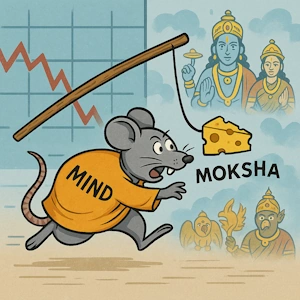
Lord Rama has been denouncing many of the things that we consider as important life, or what we think life is all about – like – enjoyments, wealth, longevity, concept of 'I' and 'mine'.
In the sixteenth chapter of Vairagya Prakarana of Yoga Vasishta, he goes on to talk about the mind.
He is explaining to Sage Vishwamitra why he is dejected. Why he is dejected with his own life.
The Lord says – one should serve noble persons. Be with them. Be of service to them. Else, mind becomes unstable. Only when you get to see noble persons, how they conduct themselves in their life, and also get to listen to them, then only there is a chance that the mind attains some amount of stability.
The natural tendency of the mind is to go towards instability. A strong wind, how it pushes around a small feather — this is how the mind is pushed around, aimlessly. The mind can’t decide where it should go, it is always pushed around.
Distance is not a constraint for the mind. Like how a hungry dog would get out of the neighbourhood and would roam far and wide in search of food, the mind can also go anywhere. Any amount of imagination it can go to. Daydreaming – any amount it can do.
First of all, very few people get what they want. Even if they get – for example wealth, a lot of wealth – even then the mind will not be satisfied. The mind, its needs are like a piece of bamboo, open at both ends.
You know those who dwell in forest, the tribes, they use bamboo to collect honey. If you cut bamboo slightly below the joint from one end and slightly above the next joint at the other end, then one end is open and one end is closed. If you pour water into this it will stay, because one end is closed. But if you have a bamboo in which both sides are open, then even if you keep on pouring water it will never fill.
This is how satisfaction also is. There is never a state — 'Yes, I am satisfied. I don’t need anymore.'
A deer is taken away from its herd. You keep it tied up somewhere. It will never be happy, away from its own herd. The mind is also tied up, mind is in captivity. The rope which has tied up the mind is desires. Like that deer, mind can never be happy when it is tied up with desires.
The mind cannot stay independently. Mind is an organ. It is an internal organ. But it cannot sit minding its own business even for a moment.
There are some people who spend their whole day sitting under a tree in the neighbourhood, always looking around — what is he doing, what is she doing, where is he going, where is she going, why is he running, what is there in that bag? They keep on looking around. Their antenna keeps on rotating 360 degrees, on and on and on. Not one moment of stillness.
These are not of any concern to them. Still, they do it. This is what mind also does.
There are two terms used here – आलूनता and शीर्णता – referring to the gross organs like hands, legs, and subtle organs – the internal organs associated with thinking, intelligence, emotions. The mind cannot stay for one moment not thinking about these.
'Why is there pain in my leg?' 'Why are my eyes burning?' 'How can I make my hair healthy?' 'How do I reduce my tummy?' Not only these – 'Why am I like this?' 'Why am I not able to focus?' 'Why am I slow in studies?'
The list is huge. The mind keeps on wandering from one to other. There is no sequence or order even.
When the Ksheera Sagara was being churned, how the waves of milk, how the turbulence was being created — chaotic, without any order.
In the sea, when you sit on the seashore and watch, there is apparently an order — the waves always come towards you. But the waves in the mind are not like that.
This moment it will think about Sensex fall, and the next moment it would think about Vaikuntha, the third moment it would think about the child’s school bus.
You can’t predict what is going to occupy the mind. Even when you are listening to this, your mind will be into various other things. It is chaotic.
This mind can never find peace. It is not created to be peaceful. It is created in such a way that it should be restless, it should be miserable.
Lord Rama says – I can’t do anything about this mind.
Whatever look like sweet orderly waves — they themselves turn into a whirlpool later and drown me.
Enthusiasm comes, energy comes, that 'I should achieve this', but then the achievements themselves become the cause of misery.
We see this. Some people get facilitated, they are given awards. But then another section of the society throws mud at them. This is what affects them more. Hundred applauds and one mud slinging — that is where your mind would go. That is the nature of the mind. You get affected by that. It would look like even this award was meant to make you miserable.
A deer when it sees green grass at a distance, it simply leaps towards it, runs towards it. It doesn’t even think for a moment — is there a pit ahead, will I fall into a pit if I run without looking, so fast? The achievers — this is what happens to them. They don’t see the pits en route.
When you are overpowered by desire and ambition, this is what happens. You will not even bother to look what you are doing, whether it is right or wrong. What are the consequences. It is all about desire and success. You don’t bother about anything else.
Lord Rama says – श्वभ्रपातमचिन्तयन् – whether what you are doing will push you into naraka, this also you don’t see when overpowered by desire, ambition and obsession about success.
This is the very nature of the mind. This turbulence, this aimless wandering is the nature of the mind. Pushing someone into action based on this turbulence is the nature of the mind. It can’t be otherwise.
Like a lion in a cage, the mind is like a lion in a cage — it can’t stay still. Have you seen the expression on the face of the lion in a cage? It is worried. It is not peaceful. That’s why it is not able to sit still.
Even if you forcefully try to silence the mind — for how long?
You meditate, try to silence the mind. 'Chitta vritti nirodha' — but for how long? The moment you get up from your posture, the mind is back to its normal chaos.
'Jnaninamapi…'
Even the minds of jnanis, jeevan muktas — they are prone to be influenced. They are prone to getting chaotic again, turbulent again. It only depends on how strong is the stimulus.
Vyasa was dejected — 'Oh, I don’t have a child.'
Vishwamitra himself was attracted towards Menaka and ended his tapas. Even when such indriya nigrahis couldn’t control their mind, how can an ordinary person do it?
Like how a mystical swan takes milk away from water, the mind can take away whatever peace you have achieved, whatever happiness you have achieved — any time it wants.
I tried to contemplate – says the Lord. I became more restless, more confused.
This is what happens to many people today. They pick up books and start reading. Philosophy. They get more confused.
You know why? Because there is no shastra. There is no acharya.
The mind can be awakened only through a shastra by an acharya — not through these random, arbitrary readings.
If you want to scale Mount Everest, there is a method, there is path, you need a guide. If you make random attempts, whichever way you want, it won’t help. It won’t work. It has to be systematic.
See, it is not a hopeless situation.
The Lord is saying – I tried to contemplate on my own, and I failed. Because I didn’t follow a shastra. I don’t have a guru.
But as of now – Lord says – I am completely consumed by the horrific flames that my mind has created. I am caught in a net created by my own mind. I was attracted towards this net by grains strewn — the grains that were desires, my own desires — and I got caught in the net. Now I can’t come out.
I am devastated — like how a seashore is devastated by strong, tall, merciless waves.
These waves are nothing but the activities of my own mind. They have made me like a small blade of dry grass in a storm — absolutely lost, not under my own command anymore.
I can’t see a destination. I can’t see means to achieve anything worthwhile. I want to cross this ocean — the ocean called samsara. But my mind itself is standing like a huge wall in front of me, blocking my path.
I am like a bucket used to take water out of a well. Sometimes pulled up, sometimes dropped down.
We scare children — 'If you don’t eat, demon will come.' The child thinks there is demon for real, becomes scared and eats. But as the child grows, it understands there is no demon for real.
But in the childhood, it thinks that there is demon for real.
The Lord says – this is the state I am in. Maybe there is no mind. Mind is unreal. Whatever mind does is unreal. But I am still in the state of that child. I have not grown up.
A vulture, the moment it sees meat, it simply rushes towards it. There is no thinking — 'Is it good for me? Bad for me?' It doesn’t think. It just lunges at it.
The mind is also like that. Whatever the sensory organs show to the mind, it simply lunges at them, without even thinking — is it good, is it bad?
Mind gets disinterested also very fast. It can’t stay focused on something.
You give a toy to a child. It will look as if he is obsessed with it for some time. Then he would just leave it behind. This is what the mind also does.
Can such a mind really think in one’s own favour, one's own benefit?
Mind is like an ocean — turbulent and infested by deadly snakes. Not only can’t you do anything about the strong waves and the whirlpools and undercurrents, but the snakes — which are kama, krodha, lobha, moha, mada and matsarya — they also keep on attacking you.
The waves are so strong that it can even throw an elephant far away. And I am like that elephant.
Everything is centred at the mind. Mind is at the centre of everything. The world, swarga, naraka — all these concepts are that of the mind only. And if the mind itself is like this, unreliable — what about the rest?
Mind needs treatment.
तत्च्चिकित्सयं प्रयत्नतः
Lord says — every mind, every single mind needs treatment. Like how forests have grown on top of mountains, so much has grown on the mind — giving various effects — sukha and dukha.
But in a fire, the entire forest is destroyed. This fire is real jnana — knowledge.
I am sure this can happen. See, the narrative is turning positive. These are negations, not negatives.
Yoga Vasishta is not negativism — be very very clear. We have said in the beginning — Yoga Vasishta is about right living.
The Lord through his own example in Yoga Vasishta is showing us how to live.
This is what Yoga Vasishta is all about.
Here initially, the problems are being identified. Then the solution will come. Unless the diagnosis is correct and proper, there can’t be a cure.
This is what the Lord is doing now. By turning himself into depression and dejection, and showing us that he is doing some kind of introspection, self-diagnosis — he is telling us what the problems are with life.
Here, the Lord says — I want to conquer the mind.
The nature of the mind he has explained, and also confidence that it can be brought under control.
But, not by arbitrary methods. It has to be through shastra. Through authentic teaching. Authentic, systematic teaching.
He wants to do that.
One important point here — we have a lot of branded yoga schools now. Enrollment straight to yoga and pranayama. Nobody is denying the connection between breathing and mind. This is what the Lord also refers to when he says wind pushing around a light feather.
What about yama and niyama? First it should be yama and niyama, then mature into yoga and pranayama. At least yama and niyama side by side.
Are we even bothered to talk about yama and niyama in these training classes?
How will they work? This is the sad situation. Yoga has been turned into a product — which is marketed and sold like any other product.
This is the sad situation.
The trainers — do they even know what yama is, what niyama is?
This is what the Lord says — systematic, authentic learning from the right source — which is shastra. Only that helps.
-
The mind's default state is instability; unless anchored in noble company and disciplined thought, it keeps spinning aimlessly.
-
Just like a feather tossed by wind, the mind drifts wherever impulses carry it, with no direction or grounding.
-
Even unlimited external pleasures like wealth or power fail to satisfy the mind, which stays hungry like a bamboo tube open at both ends.
-
Desires bind the mind like a rope ties a deer; while it appears free, it suffers in silent captivity.
-
The mind constantly interferes, never at rest, always poking into sensations, comparisons, and opinions — even without relevance.
-
It jumps from topic to topic — money, heaven, school buses — like waves with no rhythm or logic.
-
The mind is fundamentally restless and thrives on dissatisfaction; it's not designed for peace but for movement and craving.
-
Achievements initially thrill the mind, but quickly turn into burdens, because the mind fixates on criticism, not applause.
-
Ambition clouds judgment; under its grip, people chase goals without checking for danger, like a deer leaping toward distant grass.
-
When dominated by desire, people ignore whether their actions are harmful, even if they lead toward ruin.
-
Forcing the mind to be still doesn’t last; even trained yogis and wise men fall into restlessness under strong stimuli.
-
Introspection without guidance leads to deeper confusion; unaided reading or contemplation often worsens mental chaos.
-
Progress requires systematic discipline — starting with ethics (yama), inner observances (niyama), then refined practices like pranayama.
-
True transformation needs a guru and authentic scripture (shastra); random attempts don’t work like planned expeditions do.
-
The mind creates its own traps; desires bait the soul like scattered grains, leading it into self-made bondage.
-
Negative mental waves devastate inner life like a seashore wrecked by tall, merciless waves; the person feels tossed, directionless.
-
All ups and downs — worldly or spiritual — are mental constructs. If the mind is unreliable, so is everything it projects.
-
The mind attacks from all sides — its whirlpools drown, its venomous emotions strike, leaving no space to breathe.
-
Just like fire burns down an overgrown forest, knowledge (jnana) can destroy the wild overgrowth of thoughts and desires.
-
The desire for liberation is valid, but one must walk a structured path with authentic tools, not shortcut experiments.
What makes the mind unstable by nature?
The mind is built to move — it constantly seeks new stimuli, reacts to inputs, and drifts into thoughts without control. Just like wind carries a feather, the mind floats with no anchor. Unless something strong grounds it, instability is its normal mode.
Why does the mind react more to noble company?
When you're around disciplined, grounded individuals, their calmness influences your thought pattern. Their actions and words model a different rhythm for the mind to follow. It slows down and begins to imitate stability.
Isn't the mind's wandering just imagination or creativity?
Imagination has direction; wandering doesn’t. Random thoughts that derail your peace aren't productive — they're mental noise, not insight.
Why doesn't wealth or success satisfy the mind?
Because the mind is designed to want more. Once it gets something, it quickly moves to the next desire. It's like a vessel with holes — no matter how much you pour in, it never feels full.
Can someone ever feel fully content?
Only if the mind itself is changed. External stuff won’t do it. You can simplify your life, but unless the mind stops craving, contentment won't come.
What if someone says their wealth has satisfied them?
Check after a few months — has their mind stopped comparing, fearing loss, or wanting more comfort? Likely not. Satisfaction isn’t a single moment; it’s sustained quietude, which wealth alone can’t give.
Why do desires feel like bondage?
Because they seem harmless until they control your decisions. Like a deer tied to a post, the mind under desire feels limited but can’t pinpoint why it’s unhappy.
How can we spot desires that trap us?
If a thought keeps returning, nagging, or dictating choices, it's likely a hidden desire. Especially when it overrides logic or peace.
Aren’t some desires good, like ambition?
Only if they’re rooted in awareness. Blind ambition makes you ignore danger, ethics, or your well-being — it drives you like prey chasing bait.
Why is the mind always looking at others' lives?
Because it's restless by nature. When it's not occupied meaningfully, it scans for anything — gossip, visuals, emotions — to keep itself entertained.
Is this really harmful?
Yes. It distracts from self-awareness. You lose hours in mental chatter that doesn’t help you grow or solve real problems.
Isn't curiosity about others natural?
Some curiosity is normal, but obsessive, irrelevant concern is a symptom of a scattered mind. It shows lack of purpose.
Can the mind ever truly be tamed?
Yes, but not by accident. It needs intentional discipline, correct teachings, and consistent effort. Like training a wild animal, it takes time and process.
Why do even wise people lose control of their mind?
Because the mind responds to strong triggers. Without vigilance, even a peaceful mind can get dragged back into turbulence.
Then what's the point of spiritual effort if peace is temporary?
Effort builds strength. The longer and more often you return to stillness, the quicker you recover each time you're disturbed.
Why does introspection increase confusion sometimes?
Because without structure, the mind just loops in self-doubt. It's like trying to diagnose a disease without knowledge — you imagine problems that aren’t even real.
How can one introspect properly?
Use a proven framework. Scriptures, with a teacher's guidance, offer tested methods. That’s how clarity replaces chaos.
Isn’t reading enough if the books are good?
No. Even good ideas, if misunderstood, can confuse. Without context or correction, you’re more likely to deepen the noise than find truth.
Why is yoga without ethics dangerous?
Because it trains power without purpose. Without yama (self-restraint) and niyama (inner discipline), practices like pranayama amplify ego and attachment instead of dissolving them.
Why don’t yoga schools start with yama and niyama?
Because they focus on selling quick results. Ethical training is slow, quiet, and non-glamorous — not ideal for commercial models.
Can't breath control alone calm the mind?
Temporarily, yes. But long-term peace needs value correction, not just technique. Otherwise the same mind gets disturbed again.
Why does desire block the path to liberation?
Because it builds walls in the mind. You might want freedom, but cravings create blind spots and emotional storms that derail your progress.
How can I know if desire is secretly controlling me?
If you feel agitated when not getting something — even if it’s 'spiritual' — that's a red flag. Peace doesn’t create pressure.
Isn’t ambition necessary to grow?
Yes — if directed wisely. But blind ambition is like sprinting with eyes shut. You might hit the target or crash into a pit.
What is meant by the mind being 'like an ocean of snakes'?
It means the mind is full of dangerous tendencies — anger, greed, pride, jealousy. Like deadly creatures in water, they can strike when you're unaware.
How do these emotions harm us?
They destroy peace, clarity, and relationships. Even one outburst of anger or greed can undo years of effort.
Can't we just avoid triggering them?
They’re already inside — avoiding isn’t enough. You need inner strength and clarity to neutralize them from the root.
Isn’t it all just a mental game — even heaven or hell?
Yes. Swarga (heaven) and naraka (hell) are ultimately mental states. If your mind is in turmoil, no place or reward can make you truly happy.
Then does changing the mind change everything?
Absolutely. When your mind shifts, your world shifts. What once felt painful becomes manageable, what once felt empty gains meaning.
Isn’t that too simplistic?
It’s precise. All perception flows through the mind. Change that filter, and reality changes — just like cleaning a dirty lens.
Can knowledge really destroy all this chaos?
Yes — like fire burns down a tangled forest, true jnana (knowledge of self) clears away accumulated confusion and cravings.
But what exactly is this 'knowledge'?
Not bookish info — it’s the direct insight into what you are, what life is, and how desire and ego distort both.
How can one be sure this works?
Because it’s repeatable. Many have walked the path, applied the teachings, and broken free. It's not theory — it’s tested clarity.





English
Yoga Vasishta
Click on any topic to open
7
30
Astrology
Bhagavad Gita
Bhagavatam
Bharat Matha
Devi
Devi Mahatmyam
Ganapathy
Garuda Puranam
Glory of Venkatesha
Hanuman
Kathopanishad
Mahabharatam
Mantra Shastra
Mystique
Practical Wisdom
Purana Stories
Radhe Radhe
Ramayana
Rare Topics
Rigveda Explained
Rituals
Sages and Saints
Shiva
Spiritual books
Sri Suktam
Story of Sri Yantra
Temples
Vedas
Vishnu Sahasranama
Yoga Vasishta
26
17
10
0


