How Kirtan is More Than Just Singing
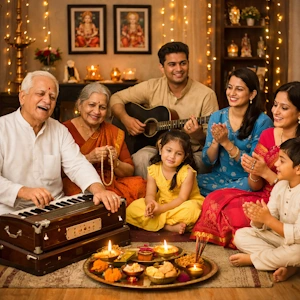
Most people think of Kirtan as a religious activity. A group of people sitting together, singing devotional songs. But according to the saints and scriptures of the Indian tradition, Kirtan is far more than that. It is described as one of the most powerful spiritual practices available to any human being.
What Kirtan Actually Is
Kirtan means singing the name and glory of God with love and feeling. It is not a performance. It is not entertainment. It is a direct act of connecting with the divine. The sound of God's name, when sung with sincerity, carries a spiritual energy that affects both the singer and the world around them.
We live in an age called Kaliyuga. This is described in Indian scriptures as a time of great confusion, moral decline, and suffering. Many spiritual practices that worked in earlier ages require intense discipline and controlled conditions. Kirtan does not. Saints say that in Kaliyuga, singing God's name with love is the most reliable way to cross over worldly suffering and attain salvation. It is perfectly suited to the conditions of our time.
What It Does to You
Most problems in human life come from a deep habit of identifying with the body. We think we are only this physical form. This creates fear, selfishness, and attachment. Kirtan is described as a direct way to break this habit. When a person sings and dances in Kirtan with genuine joy, body-consciousness slowly dissolves. Over time, the saints say, the body itself begins to reflect the nature of God. This is called internal purification, or Antah-shuddhi.
Kirtan does not just help the individual. It purifies the surrounding environment. It removes layers of worldly sorrow and fills the space around it with deep and lasting joy. The saints describe this beautifully. They say Kirtan builds a wall of joy around the world. It brings the divine abode, Vaikuntha, down to Earth. The place where Kirtan happens becomes sacred ground.
What the Scriptures Say
The saints go even further. They say that the essence of all scriptures points to one conclusion. Kirtan and the chanting of the divine name is the greatest means of achieving happiness in this world. Not wealth. Not status. Not comfort. The name of God, sung with love, is considered the highest path.
There is another important detail. When a devotee performs Kirtan, something extraordinary happens. God, the devotee, and the divine name come together in one sacred moment. The saints call this a Triveni Sangam, a confluence of three holy streams. In that moment, the distance between the human and the divine disappears completely.
Who Can Do It
Here is what makes Kirtan truly remarkable. It belongs to everyone. There is no restriction based on caste, class, background, or stage of life. A child can do it. An elderly person can do it. A scholar and a simple farmer can sit side by side and sing together. The saints are clear on this point. Kirtan holds no discrimination. It is a universal practice open to all of humanity.
The deeper takeaway is this. In a world full of complicated paths and conditions, Kirtan offers something rare. A simple, direct, and open door to God. You do not need special qualifications. You do not need a perfect life. You only need a willing heart and the readiness to sing.
-
Question: If Kirtan is not entertainment, why does it still feel joyful and uplifting?
Answer: Because the joy of Kirtan does not come from external stimulation, but from alignment with the inner self. When the mind drops its constant tension and merges into the sound of Bhagavan’s name, a natural bliss arises. This joy is not excitement, it is a quiet expansion of being. That is why it uplifts without exhausting. -
Question: What makes sound in Kirtan spiritually powerful compared to ordinary speech?
Answer: In Kirtan, the sound is not random. It carries the name and qualities of Bhagavan, which the tradition holds as non-different from Bhagavan Himself. When uttered with sincerity, the sound becomes a living presence. It reorganizes the inner state of the mind, much like a tuning fork brings scattered vibrations into harmony. -
Question: Why is Kirtan considered especially effective in Kaliyuga?
Answer: Because Kaliyuga weakens discipline, focus, and purity. Complex practices demand strong control over mind and senses, which most people lack today. Kirtan bypasses these limitations. It uses emotion, rhythm, and collective energy to pull the mind toward Bhagavan without requiring rigid control. It meets people where they are. -
Question: How does Kirtan dissolve body-consciousness?
Answer: In daily life, attention is fixed on the body and its needs. In Kirtan, attention shifts to sound, rhythm, and devotion. As this deepens, the sense of ‘I am this body’ loosens. For moments, the person forgets their limitations and experiences a wider identity. Repeated exposure slowly rewires this identity at a deeper level. -
Question: What is meant by Antah-shuddhi or inner purification through Kirtan?
Answer: It refers to the cleansing of subtle impressions stored in the mind. These impressions drive desires, fears, and reactions. The vibration of divine names gradually weakens these patterns. Instead of suppressing them, Kirtan replaces them with higher impressions, making the mind naturally calm, clear, and sattvic. -
Question: How can Kirtan affect the surrounding environment?
Answer: Human emotions and thoughts influence the atmosphere. Kirtan generates collective devotion, which creates a field of harmony. This is not symbolic. People entering such spaces often feel lighter without knowing why. The saints describe this as the environment absorbing and reflecting divine vibration. -
Question: What is the deeper meaning of calling Kirtan a Triveni Sangam?
Answer: It points to a rare inner alignment. The devotee, the act of chanting, and Bhagavan are no longer separate. The singer is not calling out to a distant being. The name itself carries Bhagavan’s presence, and the devotee becomes a medium. This collapse of separation is the real purpose of all spiritual practice. -
Question: Why do saints place Kirtan above wealth and status as a source of happiness?
Answer: Wealth and status depend on external conditions and always carry fear of loss. Kirtan produces an inner state that is independent of circumstances. It gives access to a stable joy that does not fluctuate with success or failure. That makes it a more reliable and deeper source of fulfillment. -
Question: What hidden transformation happens through repeated Kirtan that people often miss?
Answer: The transformation is subtle and gradual. Reactions soften, ego reduces, and clarity increases. The person may not notice dramatic change, but their responses to life shift. They become less reactive, more compassionate, and inwardly stable. The change happens quietly, but it is deep and lasting. -
Question: Why is Kirtan open to everyone without restriction?
Answer: Because it works through the heart, not through intellectual or ritual qualification. It does not require mastery of scripture or strict discipline. The only requirement is sincerity. This universality is its strength. It allows people from all backgrounds to access the highest spiritual experience directly.
Objections and Replies
-
Objection: Kirtan is just emotional singing, not a serious spiritual practice.
Reply: Emotion is not a weakness when directed properly. In Kirtan, emotion becomes a tool for transcendence. Instead of scattering the mind, it gathers and focuses it. Many advanced practices aim to control emotion. Kirtan transforms it into a path. -
Objection: There is no proof that chanting affects anything beyond the mind.
Reply: Even at a basic level, sound affects mood and mental state. This is widely accepted. Kirtan goes further by using structured sound with intention and meaning. The effects on clarity, calmness, and behavior are observable over time, even if not measured in physical terms. -
Objection: It is just group psychology creating a temporary high.
Reply: Group energy does amplify the experience, but that does not invalidate it. The real measure is what remains afterward. If the person becomes calmer, less selfish, and more balanced in daily life, it shows the effect is not just temporary excitement. -
Objection: People who do Kirtan still face problems, so what is the use?
Reply: Kirtan does not remove all external problems. It changes how one experiences and responds to them. Instead of being overwhelmed, the person gains inner strength and clarity. The goal is not to escape life, but to live it with steadiness. -
Objection: If it is so powerful, why do we not see instant transformation?
Reply: Deep habits do not dissolve instantly. Kirtan works like a steady stream wearing down rock. Its strength lies in consistency. Over time, the accumulated effect becomes undeniable. -
Objection: It seems too simple to be a true spiritual path.
Reply: Simplicity is often misunderstood as weakness. In reality, the most direct methods are simple because they remove unnecessary complexity. Kirtan works at the root level of mind and identity, which is why it does not need complicated structure. -
Objection: It promotes dependency on religion rather than self-effort.
Reply: Kirtan actually strengthens inner capacity. It builds focus, reduces agitation, and aligns intention. These qualities enhance self-effort rather than weaken it. It is not dependency, it is refinement of the inner instrument. -
Objection: Chanting the same name repeatedly has no intellectual value.
Reply: Kirtan is not meant to stimulate intellect. Its purpose is to go beyond constant thinking. The repetition helps quiet the analytical mind, allowing deeper awareness to emerge. It complements intellectual understanding, not replaces it. -
Objection: Different religions have different names. Which one works?
Reply: The principle is not limited to one name. Any sincere invocation of the divine works. What matters is devotion and consistency, not linguistic form. The power lies in intention and connection. -
Objection: Modern life is too busy for practices like Kirtan.
Reply: That is exactly why it is needed. Kirtan does not require isolation or long preparation. It can be done in short periods, even while doing daily activities. Its flexibility makes it practical for modern life.





English
Practical Wisdom
Click on any topic to open
7
30
Astrology
Bhagavad Gita
Bhagavatam
Bharat Matha
Devi
Devi Mahatmyam
Ganapathy
Garuda Puranam
Glory of Venkatesha
Hanuman
Kathopanishad
Mahabharatam
Mantra Shastra
Mystique
Practical Wisdom
Purana Stories
Radhe Radhe
Ramayana
Rare Topics
Rigveda Explained
Rituals
Sages and Saints
Shiva
Spiritual books
Sri Suktam
Story of Sri Yantra
Temples
Vedas
Vishnu Sahasranama
Yoga Vasishta
26
17
10
0


