Why Do We Say Namaste
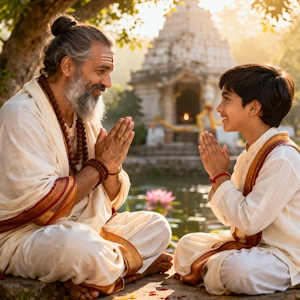
There is a moment that happens every day, in temples, in homes, in schools, in offices. Two people meet. One of them brings both palms together, fingers pointing upward, close to the chest. They lower their head slightly. And they say, Namaste.
It takes less than three seconds. Most people do it without thinking.
But something quiet and important lives inside that gesture. Something that took centuries to understand.
Let us go back to the beginning of it.
Long before there were offices or handshakes or visiting cards, people in this part of the world were asking a simple question. When two people meet, what exactly is meeting? The bodies? The names? The faces?
They did not think so.
Their answer was this. Every living being carries something inside them that is not the body. Not the name. Not the profession. It is a kind of light, a presence, a life-force that simply exists. They called it the atman. The self that cannot be created or destroyed. The part of you that was there before you were born and will remain after you are gone.
Now the question became interesting.
If every person carries this same inner presence, then when two people meet, it is not just two bodies greeting each other. It is one light recognizing another.
This is what Namaste means.
The word breaks into two parts. Namah means a bow, a surrendering of the ego. Te means to you. Put together, it says, I bow to you. But not to your face or your status or your name. I bow to the divine presence inside you.
The palms pressed together are not just a polite gesture. In the old understanding, the right side of the body carries active, outward energy. The left side carries receiving, inward energy. When you bring both palms together at the center of your chest, you are bringing these two forces into balance. You are becoming still. And from that stillness, you greet the other person.
There is an old story, simple and quiet, that captures this.
A young student once asked his teacher, why do we not shake hands like other people do? Why this pressing of palms?
The teacher did not answer immediately. He looked at a lamp burning in the corner. Then he said, when two flames meet, what happens?
The student thought. They merge, he said. Or at least, each makes the other brighter.
The teacher nodded. When you shake a hand, two bodies touch. When you do Namaste, two lights acknowledge each other.
The student sat with that for a while.
There is another layer that most people do not notice.
In Namaste, the head bows slightly. This is important. The ego bows. Whatever you think you are, your position, your pride, your opinions, all of it lowers, just for a moment. And in that moment, you are fully present to the other person. Not judging. Not comparing. Just acknowledging.
This is why Namaste was never meant only for temples or rituals. It was designed for everyday life. For the stranger on the road. For the elder in the house. For the child in the school. The gesture works the same in every direction because the inner light it honors is the same in every person.
When Namaste traveled to yoga studios and international stages, many people kept the gesture but lost the meaning. They saw it as a cultural sign or a polite hello. That is not wrong. But there is more available if you want it.
The full experience of Namaste asks something small but real from you. For one second, before you speak or judge or react, you pause. You press your palms. You lower your head. You say, quietly, in that gesture, the divine in me sees the divine in you.
And in that one second, something shifts.
You are no longer two strangers or two colleagues or two people in conflict. You are two expressions of the same life, meeting briefly, in this moment, on this earth.
That is what the gesture always carried. It was never about religion or ritual. It was about recognition. The simplest, deepest kind. The kind that asks nothing and gives everything.
TEN QUESTIONS FOR DEEP UNDERSTANDING
- Why did ancient Indians believe that something beyond the body exists in every person?
They observed that the body changes constantly. A child grows into an adult. The adult grows old. The body gets sick, heals, and eventually dies. But through all these changes, there is something that stays aware. The feeling of I am does not change even when everything else does. They called this unchanging witness the atman. It is not a belief. It is an observation. The body is a process. The atman is the one who notices the process.
- What is the connection between pressing palms together and inner stillness?
When your hands are open or moving, your energy is outward. You are doing something. When you bring both palms together at the center of your chest, the movement stops. The body signals to the mind that this is a moment of pause. Physiologically, pressing the palms together activates a centering response. The breath slows slightly. Attention moves inward for just a moment. That tiny moment of stillness is not accidental. It was deliberately built into the gesture so that every greeting begins from a calm, aware place rather than from noise or habit.
- Why is the chest the location for the Namaste gesture and not the forehead or the stomach?
The chest, in this tradition, is understood as the seat of the heart. Not the physical heart that pumps blood, but the center of feeling, of presence, of connection. When you place your palms there, you are saying that this greeting comes from your deepest self, not from your thinking mind or your performing self. The forehead is the place of thought. The stomach is the place of instinct. The chest is the place of being. Namaste comes from being.
- Is there a scientific parallel to the idea that all living beings share the same inner presence?
Yes, and it is striking. Modern physics tells us that at the subatomic level, all matter is made of the same fundamental particles and energy. The boundary between one object and another is far less solid than it appears. Biologically, all life on earth shares the same basic genetic code. The ancient thinkers arrived at a similar conclusion through observation and inner inquiry rather than laboratory instruments. They said all life shares the same source. Namaste is the social expression of that understanding.
- What is the significance of the head bowing in Namaste, and why is the ego specifically what must lower?
The ego is the part of the mind that constantly compares. It ranks people. It decides who is important and who is not. It protects the idea of I am better or I am more. When the head bows, the ego is interrupted. That interruption, even for one second, creates a space where the other person can be seen as they actually are, not as a category or a rank. The bow is not submission. It is clarity. It clears the filter of comparison so that genuine recognition becomes possible.
- Why does Namaste work equally toward a child, a stranger, and an elder, while other greetings do not?
Most greetings are adjusted based on the status of the other person. You shake hands differently with your boss than with a child. You speak differently to a stranger than to a friend. Namaste does not adjust because it is not addressed to the role or the rank. It is addressed to the inner presence. And the inner presence is the same in a child, a stranger, an elder, or a king. This is not idealism. It is a practical instruction to look past the label and see the person.
- What does it mean that two lights acknowledge each other, as the teacher explained?
A light does not need to touch another light to affect it. Two flames in a dark room already share the same darkness they are pushing back. When they come close, the room becomes brighter for both. No transaction happens. No exchange is made. Yet both benefit. The teacher was pointing out that genuine recognition between two people works the same way. You do not need to take anything from the other person. Simply seeing them clearly, honoring their presence, already makes both of you more alive in that moment.
- What is the hidden social teaching inside Namaste that rarely gets discussed?
Namaste quietly removes hierarchy from the moment of greeting. The gesture is identical regardless of who is greeting whom. The king does Namaste. The farmer does Namaste. The child does Namaste. The form does not change based on position. This is a radical social idea. It says that at the level of inner presence, no person is more valuable than another. This is not a political statement. It is a spiritual one. But its practical effect, if practiced sincerely, is that every person you meet receives the same quality of attention and respect.
- Why did Namaste survive for thousands of years while many other customs disappeared?
Namaste survived because it is not dependent on any specific belief system. You do not have to accept any philosophy to use it. The gesture itself does the work. Even if someone performs Namaste without knowing its meaning, the physical act still creates a pause, still brings the hands to the heart, still lowers the head. The form carries the function. Over centuries, as languages changed, as rulers changed, as religions came and went, Namaste remained because it asked nothing of the person using it except one moment of stillness.
- What is the secret that Namaste reveals about the nature of conflict between people?
Almost all conflict between people begins with the conviction that the other person is fundamentally different from you. Different enough to be wrong, to be an obstacle, to be an enemy. Namaste, practiced sincerely, makes that conviction difficult to sustain. When you bow to the inner presence of another person, you are acknowledging that they carry the same life that you carry. You may still disagree with them. You may still need to set limits with them. But you cannot fully dehumanize someone whose inner light you have just honored. This is why Namaste is not just a greeting. It is a quiet practice of peace.
OBJECTIONS AND THEIR REPLIES
Objection 1: This is just a cultural habit. People do it automatically without any awareness. It has no real meaning in practice.
Reply: The same is true of every meaningful human practice. People say thank you without thinking about gratitude. People hug without thinking about warmth. The automatic nature of a gesture does not erase its origin or its potential. What Namaste offers is a form that already has the right shape. A person who understands its meaning can fill that form with awareness at any moment. And even when it is done automatically, the physical act still creates a brief pause and a centering of attention. The meaning is available whenever the person is ready to receive it.
Objection 2: The idea that every person has an inner divine presence is a religious belief, not a universal truth. Not everyone accepts this.
Reply: The word divine here does not require a religious framework. Strip it down and the claim is simpler: every living being has an inner awareness that is not reducible to their social role or physical appearance. That awareness is what you are actually addressing when you speak to someone. You can call it consciousness, presence, or simply the person underneath the label. Namaste is a gesture that directs attention toward that deeper layer, whatever name you give it. The gesture works even without the theology.
Objection 3: If Namaste teaches equality, why has Indian society historically had such strong inequality and hierarchy?
Reply: A teaching and the failure to live up to it are two different things. Every culture has ideals it does not consistently practice. The existence of inequality does not disprove the teaching. It shows how difficult it is to sustain a principle under the weight of social habit, economic pressure, and human self-interest. The teaching of Namaste is not a description of how Indian society has always behaved. It is an instruction about how any human being can choose to behave, regardless of where they were born.
Objection 4: Pressing palms together is a physical action. Claiming it creates stillness or shifts energy sounds like superstition.
Reply: The connection between body posture and mental state is well documented in current behavioral research. When you change your posture, your mental state follows. Pressing the palms together at the chest, slowing the breath, and lowering the head are a cluster of physical signals that the nervous system responds to. The tradition did not use the language of neuroscience, but it arrived at the same practical truth. A physical gesture performed with intention changes the internal state of the person performing it. That is not superstition. That is the body and mind working together.
Objection 5: Namaste has become a fashionable gesture in the West, used in yoga classes and wellness culture with no real understanding. Does that not make it meaningless?
Reply: A tool used incorrectly does not become a bad tool. A hammer used to scratch your back is not fulfilling its purpose, but it has not lost its nature as a hammer. Namaste used as a fashionable closing to a yoga class carries none of its depth. But that does not affect what Namaste actually is or what it can do when understood and practiced properly. The misuse by one group does not take anything away from the sincere practitioner. It only shows that the surface of a thing can travel faster than its meaning.
Objection 6: Why should I bow to someone whose actions I find deeply wrong? Namaste seems to ask me to ignore real moral differences between people.
Reply: Namaste does not ask you to approve of another person's actions. It asks you to separate the person from their actions for one moment. Recognizing that a person carries an inner presence is not the same as endorsing everything they do. You can hold someone accountable for harmful behavior and still acknowledge that underneath those actions is a human being. In fact, this separation often makes difficult conversations more effective, because you are engaging with the person rather than simply attacking the category you have placed them in.
Objection 7: The concept of the atman, the inner self, is not scientifically proven. Why build a practice on something unverified?
Reply: Most of what shapes human life is not scientifically proven in the laboratory sense. Love, dignity, meaning, and purpose are not measurable objects, but their effects on human behavior and wellbeing are real. The atman is a name for something that anyone can observe in their own experience: there is an awareness behind your thoughts that is watching the thoughts happen. You can call it whatever you like or refuse to name it at all. The practice of Namaste points toward that observable reality regardless of what philosophical framework you use.
Objection 8: This is Hindu culture. People from other faiths or no faith should not have to adopt it or feel pressured to use it.
Reply: No one is required to use any gesture. Namaste belongs to a tradition, yes. But the idea it carries, that every person deserves to be seen at a deeper level than their role or appearance, is not exclusive to any religion. Many traditions, across the world and across history, have arrived at similar principles through different forms. If the gesture does not suit someone, the idea can be carried in other ways. The gesture is a vehicle. The destination is recognition. Each person can choose their own vehicle.
Objection 9: If Namaste is so powerful and peaceful, why is there so much conflict in places where it is practiced daily?
Reply: A practice reduces conflict in proportion to the sincerity and understanding with which it is used. Namaste done mechanically, without awareness, does not carry its full effect. Conflict in a society does not mean the society's best teachings are wrong. It means that the teachings have not been fully absorbed or consistently applied. The presence of violence in a place where peace is taught is not proof that peace is wrong. It is proof that teaching and living are two different challenges.
Objection 10: Modern life moves too fast for this kind of mindful greeting. It is not practical for daily use.
Reply: Namaste takes three seconds. That is the entire time investment. The question is not whether there is time. The question is whether there is awareness. The tradition knew that people are busy. That is precisely why the practice was compressed into a single gesture. You do not need to meditate for an hour to do it correctly. You only need one conscious second. Most greetings already take that long. Namaste simply asks that the second be used with intention rather than wasted on habit.





English
Practical Wisdom
Click on any topic to open
7
30
Astrology
Bhagavad Gita
Bhagavatam
Bharat Matha
Devi
Devi Mahatmyam
Ganapathy
Garuda Puranam
Glory of Venkatesha
Hanuman
Kathopanishad
Mahabharatam
Mantra Shastra
Mystique
Practical Wisdom
Purana Stories
Radhe Radhe
Ramayana
Rare Topics
Rigveda Explained
Rituals
Sages and Saints
Shiva
Spiritual books
Sri Suktam
Story of Sri Yantra
Temples
Vedas
Vishnu Sahasranama
Yoga Vasishta
26
17
10
0


