How Do Simple Acts Cleanse the Mind?
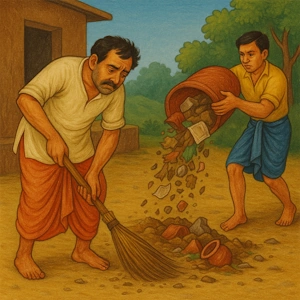
How do simple acts like puja, japa, pilgrimage, daana help in cleansing the mind of dirt that is piling up inside due to the continuous action of the mind under the influence of desires, anger, greed, ignorance, arrogance and competition?
Take pilgrimage for instance.
Why do we undertake a pilgrimage, say to Vaishnodevi, or Char Dham of Tirupati or Kashi? To get something. To get blessings. To get relief from results of bad karma, to get a job, to get married, to be successful in business, for health.
So, when we are doing we are looking up to an invisible power outside of us, beyond us, beyond our immediate neighbourhood, beyond our friends and relatives and contact to grant this wish to us.
So, this starts with the recognition of some power which is beyond all these, above all these and powerful that all these. Recognition of such power, of divinity, is the starting point, but the most important point.
This recognition grows, develops, evolves to encompass the scope of your complete worldly existence. As it grows, you will go on realising that your scope is defined by this divine power and your limits are set by this divine power.
So starting from a mere vague recognition and half hearted, suspicious, sceptical acceptance of such a divine power, you evolve to a stage when you realize that your scope and limitations are set by this power.
No amount of reading or listening will convince you about this, it has to happen. Incident after incident will make you develop this conviction, will force you to develop this conviction.
Stoppage of generation of dirt in the mind is equally important. If you go on producing dirt in full swing, even if you keep on removing it, it doesn’t help much because the rate of generation of dirt is thousand times higher than the speed at which you can remove, if at all you try.
So, with the recognition of this divine power, kama – desires – reduce. You start going to places of pilgrimage asking God for something – a job, a good husband, wife, health, money, house.
But as you go on recognizing the extent to which God has already planned your life, moment to moment – this is an experience, if I tell you this it will only sound like fiction, when you experience this, then the desires reduce. What is there to desire or ask for when God has already planned everything? Even if you are going to ask, he is not going to give you more than what is due to you or not give you because you didn’t ask for.
This realization comes and then you stop asking. This can’t happen initially. To know what happens in a court or a police station, you have to go there and see – you will not know that from outside.
So first, God will make you ask, and then tell you that – why are you asking, I am already giving you. Why are you asking for protection? I am already protecting you, you are under my protection.
This realisation comes. Sitting at home, reading spiritual books, listening to discourses, this will not happen. That would be yet another mental exercise. Acts like pilgrimage help. God will make you ask and then stop you from asking any more.
Kama reduces, impurity generated by kama reduces.
-
Simple acts like puja, japa, pilgrimage, and daana act as cleansing tools for the mind, reducing the weight of desires, anger, greed, ignorance, arrogance, and competition.
-
Pilgrimage begins with a practical motive, such as seeking blessings or relief, but evolves into recognition of a higher power that governs life.
-
Recognizing a power beyond family, society, and self is the first step towards spiritual maturity.
-
This recognition deepens with life experiences, shaping conviction that scope and limits of life are set by this divine order.
-
Mere study or hearing others will not create this conviction; it must be lived through incidents and personal transformation.
-
Cleansing alone is not enough; reducing the fresh generation of mental dirt is equally crucial for inner clarity.
-
Desire (kama) gradually weakens when one realizes that life events unfold according to a larger plan, not just through personal effort or prayers.
-
Pilgrimage serves as a training ground: at first one asks for gains, but through experience one learns that asking is unnecessary, as life is already provided for.
-
The deeper realization is that divine protection and provision are ongoing, independent of demands or rituals.
-
This shift from asking to trusting marks the reduction of desire and the cleansing of impurity from the mind.
What is the role of simple spiritual acts in cleansing the mind?
They function like washing away dust that constantly gathers. While desires, anger, and greed keep generating impurities, acts like puja, japa, or pilgrimage provide moments of clarity and surrender. Over time, these acts reduce the burden of accumulated mental toxins. The point is not ritual for its own sake but using it as a doorway to inner purification.
Why do small rituals have such impact on inner dirt?
Because they interrupt the cycle of endless thinking. Daily mind movements keep producing unrest, but ritualized acts force pauses, invoke humility, and direct attention beyond the ego. These pauses give the system time to reset. It is like clearing a blocked drain regularly before it overflows.
Isn’t ritual just an external act, how does it touch the mind?
Externally it looks mechanical, but internally it forces a shift in attention. By focusing beyond personal worries, even for a short time, the inner machinery slows down. Repeatedly done, this shapes habits of calmness and reverence. The effect is psychological, not magical.
Why do people start a pilgrimage with requests and desires?
Because the human mind initially sees divinity as a resource to solve problems. A person prays for health, wealth, or success. Pilgrimage becomes the channel to ask for these benefits. This is a natural first step in the journey.
Does asking for things during pilgrimage reduce its value?
Not at all. It is like children first going to parents only for food or toys. Over time they recognize love, guidance, and protection are deeper than those small requests. Similarly, pilgrimage gradually trains the mind to look beyond the surface.
Isn’t pilgrimage then just another form of bargaining?
It begins that way but does not end there. The act of traveling, praying, and reflecting exposes the seeker to deeper truths. As experience grows, one realizes that outcomes are not tied to demands but to a larger law. The bargain eventually dissolves into acceptance.
What is the significance of recognizing a power beyond oneself?
It marks the shift from ego-centered living to humility. At first, recognition may be faint or doubtful, but it plants the seed of trust. This seed expands until one sees that every boundary and possibility in life is set by that power. Such recognition is the cornerstone of inner transformation.
How does this recognition expand over time?
Through repeated life events that show personal control is limited. Successes, failures, and surprises force the mind to acknowledge that outcomes are not fully self-driven. This builds conviction that a higher order is always at work. Gradually, recognition grows into steady faith.
Isn’t this recognition just blind belief?
No, because it is not imposed from outside. It arises from direct confrontation with life’s unpredictability. The conviction builds as evidence accumulates: what cannot be explained by effort alone is seen as orchestrated by something larger. This is observation-based, not superstition.
Why is reducing new impurities as important as cleansing old ones?
Because constant production of dirt cancels the effect of cleaning. If anger, greed, and desires keep flooding in, purification rituals cannot keep up. It is like mopping a floor while a tap keeps leaking. Stopping the leak is more effective than endlessly cleaning.
How can one actually stop generating new dirt?
By shifting perspective. When you see life as already guided and provided for, the impulse to grasp, demand, or resent reduces. This lowers the creation of new agitation. Recognition of order brings calm, cutting dirt at its root.
Can rituals really stop new dirt, or do they only clean?
Initially they only clean, but with deeper recognition, they also reshape thinking patterns. The mind no longer rushes to demand and complain. In this way, rituals evolve from temporary cleaners into preventive disciplines.
Why does desire (kama) reduce with experience of divine order?
Because one realizes that nothing extra can be obtained by asking. Life unfolds according to a larger design. Desires lose their urgency when you know the essentials are already taken care of. This reduces the pressure of wanting.
What changes in the pilgrim when kama reduces?
They stop asking for trivial outcomes. Instead of running to God for jobs or money, they begin to rest in trust. Pilgrimage becomes less about demand and more about gratitude. This lightens the mental load.
Isn’t it natural to keep desiring more, even if one believes in divine order?
Yes, but constant experience teaches otherwise. Repeatedly, one sees that asking doesn’t alter the script. When this truth sinks in, desire naturally weakens. It is not suppression but a gradual recognition of reality.
Why can’t reading or listening replace lived experience in this?
Because second-hand knowledge lacks the conviction of direct encounter. Books can explain, but only incidents show the undeniable force of divine order. Conviction needs evidence personal to the seeker. Experience burns the lesson into the mind.
How does lived experience force conviction?
When events unfold despite careful planning or unexpected help arrives unasked, the mind notices patterns beyond effort. Over time, these repeat often enough to build trust. It becomes impossible to deny that a greater order operates.
Isn’t this just confirmation bias, seeing patterns where none exist?
No, because the evidence is not occasional coincidence but consistent alignment. Confirmation bias is selective, but lived experience forces recognition even against expectation. The conviction strengthens because it keeps proving itself over years of life.





English
Yoga Vasishta
Click on any topic to open
7
30
Astrology
Bhagavad Gita
Bhagavatam
Bharat Matha
Devi
Devi Mahatmyam
Ganapathy
Garuda Puranam
Glory of Venkatesha
Hanuman
Kathopanishad
Mahabharatam
Mantra Shastra
Mystique
Practical Wisdom
Purana Stories
Radhe Radhe
Ramayana
Rare Topics
Rigveda Explained
Rituals
Sages and Saints
Shiva
Spiritual books
Sri Suktam
Story of Sri Yantra
Temples
Vedas
Vishnu Sahasranama
Yoga Vasishta
26
17
10
0


