How Ayodhya Woke to a Festival and a Funeral
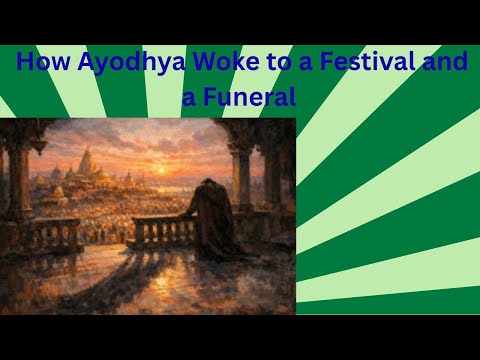
This is a comprehensive, verse-by-verse analysis of Ayodhya Kanda, Sarga 14. While Sarga 13 was the internal storm of Dasharatha, Sarga 14 is the collision between a private tragedy and the public world. It is the moment where Kaikeyi moves from emotional manipulation to legalistic entrapment, and the world outside prepares for a celebration that has alaready been cancelled in the heart of the King.
Part 1: The Weaponization of Dharma (Shlokas 1–10)
Shloka 1
पुत्रशोकार्दितं पापा विसंज्ञं पतितं भुवि।
विचेष्टमानमुत्प्रेक्ष्य ऐक्ष्वाकमिदमब्रवीत्॥
Seeing the King, a descendant of Ikshvaku, writhing on the ground, unconscious and tormented by grief for his son, that sinful woman (Kaikeyi) spoke these words.
Interpretation: The contrast here is between 'writhing' (vicheshtamanam) and 'spoke' (abravit). Dasharatha is in a state of primal, physical agony; Kaikeyi is in a state of cold, calculated speech. She is unmoved by his physical collapse.
Shloka 2
पापं कृत्वेव किमिदं मम संश्रुत्य संश्रवम्।
शेषे क्षितितले सन्नः स्थित्यां स्थातुं त्वमर्हसि॥
'Why do you lie there on the ground as if you have committed a sin, after having made a promise to me? You ought to stand firm in your commitment (Sthiti).'
Interpretation: This is psychological gaslighting. She frames his grief as a sign of guilt. She suggests that by being sad, he is behaving like a criminal, whereas by exiling his son, he would be behaving like a hero.
Shloka 3
आहुः सत्यं हि परमं धर्मं धर्मविदो जनाः।
सत्यमाश्रित्य च मया त्वं धर्मं प्रतिचोदितः॥
'Those who know Dharma say that Truth (Sathya) is the supreme virtue. It is by taking refuge in that very Truth that I am urging you toward your duty.'
Shlokas 4-5
संश्रुत्य शैब्यः श्येनाय स्वां तनुं जगतीपतिः।
प्रदाय पक्षिणे राजा जगाम गतिमुत्तमाम्॥
तथा ह्यलर्कस्तेजस्वी ब्राह्मणे वेदपारगे।
याचमाने स्वके नेत्रे उद्धृत्याविमना ददौ॥
'King Shaibya, having made a promise to a hawk, gave his own flesh and attained the highest state. Likewise, the radiant Alarka, when asked by a learned Brahmin, plucked out his own eyes and gave them without hesitation.'
Interpretation (Shlokas 3-5): Kaikeyi uses 'Dharma' as a cage. She cites extreme, almost violent examples of sacrifice. She is telling Dasharatha: 'If Alarka could pluck out his eyes, why can't you pluck out your son from your heart?' She strips Dharma of compassion, leaving only a cold, mechanical adherence to words.
Shloka 6-7
सरितां तु पतिः स्वल्पां मर्यादां सत्यमन्वितः।
सत्यानुरोधात् समये वेलां स्वां नातिवर्तते॥
सत्यमेकपदं ब्रह्म सत्ये धर्मः प्रतिष्ठितः।
सत्यमेवाक्षया वेदाः सत्येनावाप्यते परम्॥
'The Ocean, the lord of rivers, does not cross its shores because of Truth. Truth is the one-syllable Brahman; Dharma is established in Truth. Truth is the imperishable Vedas; through Truth, the Supreme is attained.'
Interpretation: She invokes the cosmic order. She is telling him that if he breaks his word to her, the very oceans might overflow, and the Vedas might perish. She makes his personal dilemma a matter of cosmic stability.
Shloka 8-9
सत्यं समनुवर्तस्व यदि धर्मे धृता मतिः।
स वरः सफलो मेऽस्तु वरदो ह्यसि सत्तम॥
धर्मस्यैवाभिकामार्थं मम चैवाभिचोदनात्।
प्रव्राजय सुतं रामं त्रिः खलु त्वां ब्रवीम्यहम्॥
'Follow Truth if your mind is set on Dharma. Let my boons be fruitful, for you are a granter of boons. For the sake of Dharma and at my urging, exile your son Rama. I say this to you thrice!'
Interpretation: The 'triple statement' (Trir-vachanam) is a binding legal concept in ancient India. By saying it three times, she is closing every exit. She isn't asking as a wife; she is demanding as a creditor collecting a debt.
Shloka 10
समयं च ममार्येमं यदि त्वं न करिष्यसि।
अग्रतस्ते परित्यक्ता परित्यक्ष्यामि जीवितम्॥
'O Noble One, if you do not fulfill this agreement of mine, I shall give up my life right before your eyes, having been rejected by you.'
Part 2: The King’s Breaking Point (Shlokas 11–18)
Shloka 11
एवं प्रचोदितो राजा कैकेय्या निर्विशङ्कया।
नाशकत् पाशमुन्मोक्तुं बलिरिन्द्रकृतं यथा॥
Thus urged by the fearless Kaikeyi, the King was unable to release himself from the bond, much like King Bali who was bound by the noose of Indra (Vishnu).
Interpretation: The word Nirvishankaya (fearless/shameless) is key. Kaikeyi has no doubt. Dasharatha is compared to Bali—a righteous king trapped by a technicality of a promise.
Shloka 12-13
उद्भ्रान्तहृदयश्चापि विवर्णवदनोऽभवत्।
स धुर्यो वै परिस्पन्दन् युगचक्रान्तरं यथा॥
विकलाभ्यां च नेत्राभ्यामपश्यन्निव भूमिपः।
कृच्छ्राद् धैर्येण संस्तभ्य कैकेयीमिदमब्रवीत्॥
His heart was wandering, his face lost its color. He was like an ox struggling under a heavy yoke. With distressed eyes, seeing nothing, the King gathered his courage with great difficulty and spoke to Kaikeyi.
Shloka 14
यस्ते मन्त्रकृतः पाणिरग्नौ पापे मया धृतः।
संत्यजामि स्वजं चैव तव पुत्रं सह त्वया॥
'O sinful woman! That hand of yours which I took in the presence of the sacred fire—I now renounce it. I renounce you and your son (Bharata) as well.'
Interpretation: This is the most 'eye-opening' moment of the Sarga. Dasharatha performs a spiritual divorce. By renouncing the hand taken at the wedding fire, he is saying their karmic union is over. By renouncing Bharata, he attempts to delegitimize the very kingship Kaikeyi is fighting for.
Shloka 15-16
प्रयाता रजनी देवि सूर्यस्योदयनं प्रति।
अभिषेकाय हि जनस्त्वरयिष्यति मां ध्रुवम्॥
रामाभिषेकसम्भारैस्तदर्थमुपकल्पितैः।
रामः कारयितव्यो मे मृतस्य सलिलक्रियाम्॥
'The night has passed, O Devi, and the sun is rising. The people will surely urge me to begin the coronation. Those materials gathered for Rama’s coronation—with those, Rama shall perform my funeral rites when I am dead.'
Interpretation: This is a terrifying prophecy. Dasharatha knows he won't survive this. He sees the 'Abhisheka' (coronation) water becoming 'Salila-kriya' (funeral) water.
Shloka 17-18
सपुत्रया त्वया नैव कर्तव्या सलिलक्रिया।
व्याहन्तास्यशुभाचारे यदि रामाभिषेचनम्॥
न शक्तोऽद्यास्म्यहं द्रष्टुं दृष्ट्वा पूर्वं तथामुखम्।
हतहर्षं तथानन्दं पुनर्जनमवाङ्मुखम्॥
'You and your son must not perform my funeral rites. O woman of evil conduct, you have destroyed Rama’s coronation. I cannot bear to see the people—who were once full of joy—now standing with downcast faces.'
Part 3: The Festive Morning and the Arrival of Vashistha (Shlokas 19–31)
Shloka 19-20
तां तथा ब्रुवतस्तस्य भूमिपस्य महात्मनः।
प्रभाता शर्वरी पुण्या चन्द्रनक्षत्रमालिनी॥
ततः पापसमाचारा कैकेयी पार्थिवं पुनः।
उवाच परुषं वाक्यं वाक्यज्ञा रोषमूर्च्छिता॥
While the high-souled King was speaking thus, the holy night, adorned with the moon and stars, turned into dawn. Then Kaikeyi, of sinful conduct, spoke harsh words again, overcome by anger.
Shloka 21-22
किमिदं भाषसे राजन् वाक्यं गररुजोपमम्।
आनाययितुमक्लिष्टं पुत्रं राममिहार्हसि॥
स्थाप्य राज्ये मम सुतं कृत्वा रामं वनेचरम्।
निःसपत्नां च मां कृत्वा कृतकृत्यो भविष्यसि॥
'Why do you speak these words that are like the pain of poison? You ought to summon your son Rama here. By placing my son on the throne and making Rama a forest-dweller, and by making me free of rivals, you will have fulfilled your duty.'
Interpretation: She calls his grief 'poison' (Gara). She is completely focused on the 'logistics' of her victory.
Shloka 23-24
स तुन्न इव तीक्ष्णेन प्रतोदेन हयोत्तमः।
राजा प्रचोदितोऽभीक्ष्णं कैकेय्या वाक्यमब्रवीत्॥
धर्मबन्धेन बद्धोऽस्मि नष्टा च मम चेतना।
ज्येष्ठं पुत्रं प्रियं रामं द्रष्टुमिच्छामि धार्मिकम्॥
Like a noble horse struck by a sharp whip, the King, repeatedly urged by Kaikeyi, said: 'I am bound by the ties of Dharma. My consciousness is lost. I only wish to see my eldest, dear, and righteous son, Rama.'
Shlokas 25-31 (The Scene Outside)
These verses describe the arrival of Sage Vashistha. The city is decorated with flags, the streets are swept and watered, and the air is thick with the scent of sandalwood and incense. The palace is surrounded by Brahmins, chariot-drivers, and wealthy citizens.
Interpretation: Valmiki is setting a stage for Tragic Dissonance. The 'Pure-hearted Vashistha' (Shloka 26) is entering a room that has become a den of 'Sinful-conduct' (Kaikeyi). The physical beauty of the city highlights the moral ugliness inside the chamber.
Part 4: Sumantra’s Innocent Praise (Shlokas 32–57)
Shloka 32-33
स त्वपश्यद् विनिष्क्रान्तं सुमन्त्रं नाम सारथिम्।
द्वारे मनुजसिंहस्य सचिवं प्रियदर्शनम्॥
तमुवाच महातेजाः सूतपुत्रं विशारदम्।
वसिष्ठः क्षिप्रमाचक्ष्व नृपतेर्मामिहागतम्॥
Vashistha saw the charioteer Sumantra at the door and said: 'O wise son of a Suta, quickly inform the King that I have arrived.'
Shlokas 34-42 (The Inventory of Joy)
Vashistha lists the materials brought: Ganga water, golden jars, the tiger-skin throne, the white bull, the four-toothed elephant, the chariot, the umbrella, the fans, the musicians, and the beautifully dressed women.
Interpretation: This is a list of things that will never be used for their intended purpose. Every item mentioned is a dagger in the heart of the reader who knows what is coming.
Shloka 43-46
Sumantra enters the inner chambers. The guards, knowing how much the King loves Sumantra, do not stop him. Sumantra, unaware of the tragedy, stands before the King with folded hands.
Shlokas 47-52 (The Stuti/Hymn)
Sumantra begins to praise the King: 'As the ocean rejoices at the rise of the sun, may you make us rejoice! As Matali praised Indra, as the Vedas praise Brahma, I wake you! Rise, O Great King, like the sun rising over Mount Meru!'
Interpretation: This is Cruel Irony. Sumantra tells the King to 'Rise like the Sun' when the King is at his lowest, darkest point. He compares Dasharatha to the 'Self-born Lord Brahma,' when Dasharatha feels like a helpless slave to a boon.
Shloka 53-56
Sumantra urges: 'The night has gone. All the preparations for Rama’s coronation are ready. The citizens and the merchants wait with folded hands. Without a King, a nation is like a herd without a bull, a night without a moon.'
Interpretation (Shloka 56): Sumantra’s metaphor is prophetic. Ayodhya is about to become that 'night without a moon.'
Part 5: The Collapse and the Summons (Shlokas 57–69)
Shloka 57-59
एवं तस्य वचः श्रुत्वा सान्त्वपूर्वमिवार्थवत्॥
अभ्यकीर्यत शोकेन भूय एव महीपतिः।
ततस्तु राजा तं सूतं सन्नहर्षः सुतं प्रति॥
शोकरक्तेक्षणः श्रीमानुद्वीक्ष्योवाच धार्मिकः।
वाक्यैस्तु खलु मर्माणि मम भूयो निकृन्तसि॥
Hearing those meaningful and soothing words, the King was overwhelmed with even greater grief. With eyes red from sorrow, he said: 'With these words, you are cutting into my very vitals (marmas) once again.'
Interpretation: Nikrintasi means to 'cut or shred.' Sumantra's 'soothing' words are physically painful to the King because they are based on a reality (the coronation) that no longer exists.
Shloka 60
सुमन्त्रः करुणं श्रुत्वा दृष्ट्वा दीनं च पार्थिवम्।
प्रगृहीताञ्जलिः किंचित् तस्माद् देशादपाक्रमत्॥
Hearing the piteous sound and seeing the King in such a miserable state, Sumantra folded his hands and stepped back in confusion.
Shloka 61-63 (Kaikeyi’s Deception)
यदा वक्तुं स्वयं दैन्यान्न शशाक महीपतिः।
तदा सुमन्त्रं मन्त्रज्ञा कैकेयी प्रत्युवाच ह॥
सुमन्त्र राजा रजनीं रामहर्षसमुत्सुकः।
प्रजागरपरिश्रान्तो निद्रावशमुपागतः॥
तद् गच्छ त्वरितं सूत राजपुत्रं यशस्विनम्।
राममानय भद्रं ते नात्र कार्या विचारणा॥
When the King could not speak due to his wretchedness, the 'clever' Kaikeyi said: 'Sumantra, the King stayed awake all night out of excitement for Rama’s joy. Now, exhausted by the vigil, he has fallen asleep. Go quickly and bring the illustrious Prince Rama here. Do not hesitate.'
Interpretation: This is a master-class in villainy. She re-labels the King’s catatonic grief as joyous exhaustion. She uses his silence as a tool to advance her agenda.
Shloka 64-65
अश्रुत्वा राजवचनं कथं गच्छामि भामिनि।
तच्छ्रुत्वा मन्त्रिणो वाक्यं राजा मन्त्रिणमब्रवीत्॥
सुमन्त्र रामं द्रक्ष्यामि शीघ्रमानय सुन्दरम्।
स मन्यमानः कल्याणं हृदयेन ननन्द च॥
Sumantra asks: 'How can I go without hearing the King’s own command?' The King then said: 'Sumantra, I wish to see the beautiful Rama. Bring him here quickly.' Sumantra, thinking this meant the coronation was proceeding, rejoiced in his heart.
Interpretation: Dasharatha’s command 'Bring Rama' comes from a place of wanting to see his son for perhaps the last time. Sumantra interprets it as 'Bring the King-to-be.' The same words mean two opposite things to the two men.
Shloka 66-69 (The Exit)
Sumantra leaves quickly, thinking of the auspicious events to come. He passes through the palace gates and sees the wealthy citizens and officials waiting in anticipation. The sarga ends with Sumantra moving through a crowd of immense joy, while he carries a summons that will end that joy forever.
Final Eye-Opening Insight:
Sarga 14 is the Sarga of the Mask.
- Kaikeyi wears the mask of Dharma (Sathya) to hide her cruelty.
- The King is forced to wear a mask of silence while his heart is shredded.
- Sumantra is masked by his own optimism and loyalty.
- Ayodhya is masked by decorations and perfumes.
Valmiki is showing us that catastrophe doesn't always look like a storm; sometimes it looks like a sunrise. The most painful part of this chapter is the 'Joy' of Sumantra and the citizens—a joy built on a foundation of lies and a father’s broken heart. This sarga teaches us that Truth (Sathya) without Compassion (Karuna) is not Dharma; it is simply a weapon.
1. Why does Kaikeyi use the stories of King Shaibya and King Alarka to taunt Dasharatha?
The Insight: Kaikeyi is performing a 'Dharma-hijack.' She isn't just asking for a favor; she is challenging Dasharatha’s identity. By citing Shaibya (who gave his flesh) and Alarka (who gave his eyes), she sets a 'mutilation standard' for righteousness. She is essentially saying, 'If they could physically mutilate themselves for a promise, why are you hesitating to emotionally mutilate yourself by exiling Rama?' She uses the highest ideals of his ancestors as a cage to make his fatherly love look like a spiritual failure.
2. What is the legal and spiritual significance of Dasharatha renouncing Kaikeyi and Bharata in Shloka 14?
The Insight: This is much more than a fit of rage; it is a formal ritual repudiation. In ancient Vedic tradition, the 'taking of the hand' (Panigrahana) at the marriage fire is an eternal bond. By saying, 'I renounce the hand I took in the fire,' Dasharatha is declaring the marriage spiritually dead because Kaikeyi has violated the fundamental duty of a wife—to be the King's Sahadharmacharini (partner in righteousness). Furthermore, by renouncing Bharata, he attempts to 'stain' the throne so that Bharata can never legally or morally sit on it. It is Dasharatha’s only available weapon: to strip the 'fruit' of Kaikeyi’s crime of its legitimacy.
3. Why does Valmiki spend so many verses (34–41) listing the coronation materials in such detail?
The Insight: This is a technique called 'Tragic Dissonance.' By listing the golden jars, the white bull, the honey, and the tiger skin, Valmiki makes the loss tangible. We don't just feel that Rama lost a 'kingdom'; we see the specific sacred items that were ready for him. It creates a 'sensory bridge' between the reader and the tragedy. It highlights the agonizing 'closeness' of the success—Rama was literally minutes away from the throne, and the physical presence of these items makes the sudden reversal feel like a physical blow.
4. Why does the King describe Sumantra’s hymns of praise as 'cutting into my vitals (marmas)'?
The Insight: It is the agony of the mask. Sumantra is treating Dasharatha like a God (comparing him to Brahma and Indra), but Dasharatha feels like a slave. Every word of praise reminds the King of the gap between who the world thinks he is (The Unconquerable King) and who he actually is in that moment (A broken man trapped by a woman’s whim). The 'marmas' are the sensitive points of the soul; Sumantra’s innocent joy is the most painful reminder of what is being destroyed.
5. How does Kaikeyi’s lie to Sumantra (Shloka 62) change the entire power dynamic of the palace?
The Insight: Kaikeyi becomes the Chief of Narrative. When she tells Sumantra that the King is 'exhausted from joy,' she is effectively gaslighting the entire kingdom. By controlling the information, she ensures that Rama enters the trap alone, without his supporters or his army, thinking he is going to see a happy father. This prevents a coup or a public rebellion. It shows that Kaikeyi isn't just greedy; she is a brilliant, cold-blooded strategist who knows that the 'truth' is whatever the person standing over the King says it is.
6. What is the symbolic meaning of the 'Sunrise' in this chapter?
The Insight: Usually, a sunrise in poetry symbolizes hope and new beginnings. Here, Valmiki flips the metaphor. The sunrise is a relentless deadline. Dasharatha literally begs the night not to end, because the dawn brings the public execution of his happiness. The sun rising over the festive city is 'blind'—it shines on the flags and the gold while the King sits in total darkness inside. It teaches us that nature is indifferent to human tragedy; the sun will rise on a coronation and a funeral with the same brilliance.
7. Does Dasharatha’s command 'Bring Rama' in Shloka 65 signify his surrender?
The Insight: It is a surrender to the inevitable, but a victory of the heart. Dasharatha realizes he can no longer stop the wheels of fate. However, his reason for summoning Rama is different from Kaikeyi's. She wants Rama there to dismiss him; Dasharatha wants Rama there because his 'consciousness is lost' and he needs to see his son's face one last time to survive the day. It is the tragic irony of two people giving the same order for two opposite reasons—one for a political execution, the other for a final, desperate look at love.





English
Ramayana
Click on any topic to open
7
30
Astrology
Bhagavad Gita
Bhagavatam
Bharat Matha
Devi
Devi Mahatmyam
Ganapathy
Garuda Puranam
Glory of Venkatesha
Hanuman
Kathopanishad
Mahabharatam
Mantra Shastra
Mystique
Practical Wisdom
Purana Stories
Radhe Radhe
Ramayana
Rare Topics
Rigveda Explained
Rituals
Sages and Saints
Shiva
Spiritual books
Sri Suktam
Story of Sri Yantra
Temples
Vedas
Vishnu Sahasranama
Yoga Vasishta
26
17
10
0


