The Most Dangerous Enemy is the One You Ignore
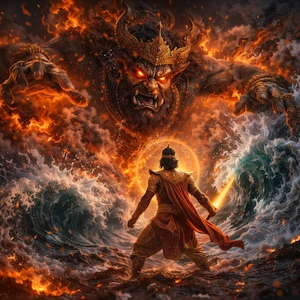
The story of Dhundhu Asura and King Kuvalashva shows how a ruler rises beyond personal life and becomes a protector of the world, even at great personal loss.
The Disturbance Beneath the Earth
In a vast desert region near the ashrama of Sage Uttanka, something terrifying lay hidden.
Not visible. Not moving. Yet never silent.
Beneath layers of sand, deep inside the earth, a mighty asura named Dhundhu slept. He was no ordinary being. Born of the lineage of Madhu, he possessed immense power. Even devas could not easily destroy him.
But his sleep was not peaceful.
Once every year, he would breathe.
That single breath was enough to shake the world.
The ground trembled. Mountains quivered. Forests swayed. Dust storms rose and covered the sky. Fire, smoke, and sparks burst out of the earth as if the world itself was cracking open.
For Sage Uttanka, living nearby, this was unbearable.
Tapas could not continue. Peace could not exist.
The rishi understood clearly — this was not just his problem. This was a threat to the entire world.
The Call to a King
At that time, King Brihadashva had just handed over his kingdom to his son Kuvalashva and was preparing to leave for the forest.
A common king would have walked away.
But dharma does not release responsibility so easily.
Sage Uttanka stopped him.
He said plainly — protecting the people is greater than personal renunciation. A king cannot choose tapas while danger still exists in his kingdom.
Brihadashva accepted this truth.
But instead of returning himself, he entrusted the task to his son.
Kuvalashva stepped forward.
No hesitation. No argument.
This is the moment where a prince becomes something more.
The March Toward the Unknown
Kuvalashva did not go alone.
He took his hundred sons along with him.
Warriors. Trained. Confident.
Together with Sage Uttanka, they moved toward the desert — toward something no one had clearly seen, only feared.
This was not a battle against a visible enemy.
This was a confrontation with a hidden force.
The Awakening of Power
As Kuvalashva advanced, something extraordinary happened.
By the will of Bhagavan Vishnu, divine energy entered him.
Not as a blessing from outside.
As a force within.
His strength increased. His presence changed. His purpose became absolute.
This is how dharma works.
When action is aligned with protection of the world, support comes — unseen but decisive.
Digging Into Darkness
The army reached the desert.
There was no enemy standing before them.
Only endless sand.
So they began to dig.
Deeper and deeper, breaking the surface layer of illusion, moving toward the hidden truth.
Finally, they found him.
Dhundhu.
Massive. Terrifying. Radiating destructive force.
The Devastation
The moment Dhundhu was disturbed, destruction began.
From his mouth came blazing fire.
Not ordinary fire.
A consuming force.
In moments, Kuvalashva’s sons began to fall.
One after another.
Burned. Destroyed. Reduced to nothing.
Out of a hundred, only a few survived.
This is the harsh face of dharma.
Even the righteous are not protected from loss.
The King Stands Alone
Now it was no longer a battle of numbers.
It was a battle of resolve.
Kuvalashva stood alone before Dhundhu.
Not as a grieving father.
Not as a helpless king.
But as a protector who had accepted the cost.
Dhundhu released water with unstoppable force, like an ocean breaking through the earth.
Fire and water together. Chaos in full form.
But Kuvalashva did something extraordinary.
Through yogic power, he absorbed the force.
He neutralized the elements.
He stood unmoved.
Then he struck.
With divine strength flowing through him, he destroyed Dhundhu.
The Title Earned
From that moment, Kuvalashva was no longer just a king.
He became Dhundhumara — the destroyer of Dhundhu.
A name earned, not given.
The Aftermath
Sage Uttanka was pleased.
He gave blessings:
Unending strength
Victory over enemies
Steadfastness in dharma
And what about the fallen sons?
They were not forgotten.
They attained higher lokas.
Their sacrifice was not loss. It was elevation.
The Inner Meaning
This story is not about a desert demon alone.
Dhundhu represents that hidden force within life which:
Stays buried
Disturbs peace suddenly
Creates chaos without warning
And Kuvalashva represents the one who:
Does not escape responsibility
Faces the unseen problem directly
Accepts loss but does not retreat
Protection of dharma is not clean or comfortable.
It demands clarity, courage, and the strength to stand even when everything is taken away.
Practical Life Lessons from Dhundhumara
1. Hidden problems are the most dangerous
What This Teaches
Dhundhu was buried deep under sand. No one saw him. Yet with a single breath, he shook the earth, raised storms, and disturbed everything around. Problems do not need visibility to create impact. What is ignored gathers force.
What Most People Miss
People react only when damage becomes visible. But life rarely breaks suddenly. It gives signals. Repeated stress, recurring conflict, small disturbances — these are early tremors. The real issue is already sitting underneath.
But Then a Question Comes
If everything hidden is dangerous, should one constantly dig into every issue
No. But patterns should never be ignored. If something keeps returning, it is not random.
2. Responsibility does not end when you step away
What This Teaches
Brihadashva was ready to leave for forest life. But Sage Uttanka stopped him. A king cannot abandon duty when danger still exists. Dharma is not a personal choice. It is a responsibility tied to your role.
What Most People Miss
Many think moving toward a spiritual path means leaving responsibilities behind. But unfinished duties create imbalance. True growth does not come from escape.
But Then a Question Comes
Does this mean one must remain bound to duties forever
No. It means you leave only when what depends on you is stable and protected.
3. Real leadership steps forward without delay
What This Teaches
Kuvalashva did not argue, question, or hesitate. He stepped forward immediately. Leadership is not about authority. It is about readiness when responsibility appears.
What Most People Miss
People wait for perfect clarity, full planning, and guaranteed outcomes. But many real situations demand action before comfort appears.
But Then a Question Comes
Is acting fast always correct
Not blindly. But delaying obvious duty weakens both the person and the situation.
4. Support comes when intention is right
What This Teaches
As Kuvalashva moved toward the task, divine energy entered him. Strength came after commitment. When action aligns with protection and dharma, unseen support begins to work.
What Most People Miss
People expect support before starting. But support follows movement. It does not lead it.
But Then a Question Comes
What if support never comes
Then the intention is not clear, or the effort lacks depth. Right action and right preparation together bring support.
5. Every battle has a cost
What This Teaches
Kuvalashva went with his hundred sons. Almost all were destroyed by Dhundhu’s fire. Even righteous action does not protect you from loss. Dharma demands a price.
What Most People Miss
People expect good actions to bring only good results. But real protection work is harsh. It tests what you are willing to lose.
But Then a Question Comes
Is it fair that even the righteous suffer loss
Fairness is not the measure here. Alignment with dharma is. Outcome is not always gentle.
6. Inner strength matters more than outer force
What This Teaches
In the end, Kuvalashva stood almost alone. He faced fire and water, chaos in full force. He did not collapse. He absorbed, controlled, and overcame. Victory came from inner steadiness.
What Most People Miss
External strength, numbers, and support can disappear at any moment. What remains is your internal stability.
But Then a Question Comes
Can such inner strength be developed today
Yes. Through discipline, clarity, and repeated exposure to challenge without running away.
Psychological Interpretation of Dhundhu
Now shift the view. Dhundhu is not just outside. He is inside.
1. Dhundhu is suppressed disturbance
What This Teaches
Dhundhu stays buried and silent. This is how the mind hides discomfort. Unresolved emotions, ignored fears, and uncorrected habits stay pushed down.
What Most People Miss
Silence inside does not mean peace. It often means avoidance. The longer something is buried, the stronger it becomes.
But Then a Question Comes
Is suppression always wrong
Short-term control helps. Long-term avoidance creates explosion.
2. The destructive breath is emotional overflow
What This Teaches
Once a year, Dhundhu breathes and chaos spreads. This mirrors emotional buildup. When pressure accumulates, release becomes violent.
What Most People Miss
People look at the outburst and judge it. They ignore the buildup behind it. The real problem started long before the reaction.
But Then a Question Comes
Can this buildup be prevented
Yes. By regular expression, correction, and awareness before pressure accumulates.
3. Digging the sand is self-inquiry
What This Teaches
Kuvalashva did not wait for Dhundhu to appear. He dug the sand and exposed him. This is self-inquiry — actively uncovering what is hidden.
What Most People Miss
Facing oneself is uncomfortable. Most prefer distraction over introspection. But without digging, nothing changes.
But Then a Question Comes
Why not just ignore and move forward
Because buried issues do not disappear. They return stronger.
4. The destruction of sons is loss of false identities
What This Teaches
Kuvalashva’s sons were destroyed in the process. Symbolically, these represent attachments — roles, identities, comfort layers.
What Most People Miss
Transformation is not addition. It is removal. What you cling to gets challenged first.
But Then a Question Comes
Why is growth painful
Because attachment resists change. Letting go feels like loss.
5. Final victory is mastery over inner chaos
What This Teaches
Kuvalashva absorbs fire and water. He controls both extremes. This is mastery over reactions, emotions, and impulses.
What Most People Miss
Victory is not destroying something outside. It is stabilizing what is inside.
But Then a Question Comes
Is complete control possible
Complete control is rare. But strong regulation and clarity are fully achievable.
Straight Understanding
Dhundhu is that force which:
stays hidden
builds pressure
erupts suddenly
Kuvalashva is that force within you which:
decides to face it
accepts the cost
finishes the work
-
Why is Dhundhu placed underground instead of openly attacking the world?
Because the most dangerous threats do not come openly. They grow in hidden layers. The underground setting reveals that destruction often begins silently, beneath awareness, and only later becomes visible. -
What does the desert setting around Dhundhu signify?
The desert represents dryness of awareness and absence of alertness. Where there is no vigilance, harmful forces can grow unchecked. It also shows a space where life seems calm on the surface but danger lies beneath. -
Why did Sage Uttanka not destroy Dhundhu himself despite knowing everything?
Knowledge alone is not action. The sage represents awareness, but the king represents execution. The story separates understanding from responsibility and shows that both must work together. -
What is the deeper secret behind Vishnu entering Kuvalashva only at the time of action?
Divine support is not automatic. It aligns with action taken for the larger good. The timing shows that grace follows commitment, not hesitation. -
Why were Kuvalashva’s sons involved in the battle instead of keeping them safe?
Dharma is not selective. It involves everyone connected to responsibility. The presence of the sons shows that the consequences of action extend beyond the individual to the entire circle around them. -
What is the hidden meaning of Dhundhu releasing both fire and water together?
It represents a mind in total imbalance. Opposing forces acting together indicate confusion, instability, and lack of control. This is deeper than anger or fear alone, it is complete disorder. -
Why did the battle require digging rather than direct confrontation?
Because the problem was not visible. It had to be uncovered layer by layer. This reveals that deep issues cannot be solved at the surface level. They demand effort to expose their root. -
What does the near-total loss of Kuvalashva’s sons reveal about unseen costs?
It shows that visible success often hides invisible sacrifices. The story quietly teaches that every major restoration of order comes with losses that are not always celebrated. -
Why is Kuvalashva’s victory described through control rather than aggression?
He absorbs and neutralizes forces before striking. This shows that mastery is not about attacking first, but about stabilizing the situation before acting. -
What is the deeper message behind Dhundhu’s periodic disturbance instead of constant attack?
It reflects how destructive patterns operate in cycles. They remain dormant, then reappear. This teaches the need for continuous awareness, not temporary solutions.
Objections and replies
-
Is this story just symbolic and not real?
Even if seen as symbolic, it describes real patterns of human behavior and social problems. Its value lies in insight, not in literal acceptance alone. -
Why would a powerful being remain hidden instead of ruling openly?
Because hidden control is often more effective. The story reflects how unseen forces influence life without direct visibility. -
Why depend on divine support instead of pure human effort?
The story does not replace effort. It shows that when effort aligns with a higher purpose, it gains additional strength. -
If dharma leads to suffering, why follow it?
Dharma leads to stability and long-term order. Avoiding it may reduce short-term difficulty but increases long-term damage. -
Why involve family members in dangerous responsibilities?
Because responsibility is shared. The story shows that roles and duties are not isolated to one person alone. -
Is the destruction of the sons justified?
The story does not justify loss, it presents it as a consequence. It teaches preparedness for the cost of action, not blind acceptance of harm. -
Why not relocate instead of fighting Dhundhu?
Avoidance does not remove the threat. It only shifts the problem elsewhere. The story promotes resolution, not escape. -
Does this story promote harsh action instead of compassion?
It promotes appropriate response. When destruction threatens the world, firm action becomes necessary to protect balance. -
Is complete control over such forces realistic?
Complete control is rare, but increasing control is always possible. The story sets a direction, not an easy endpoint. -
Why should modern people learn from ancient narratives like this?
Because the patterns of human behavior have not changed. The form may be ancient, but the principles remain directly applicable.





English
Purana Stories
Click on any topic to open
7
30
Astrology
Bhagavad Gita
Bhagavatam
Bharat Matha
Devi
Devi Mahatmyam
Ganapathy
Garuda Puranam
Glory of Venkatesha
Hanuman
Kathopanishad
Mahabharatam
Mantra Shastra
Mystique
Practical Wisdom
Purana Stories
Radhe Radhe
Ramayana
Rare Topics
Rigveda Explained
Rituals
Sages and Saints
Shiva
Spiritual books
Sri Suktam
Story of Sri Yantra
Temples
Vedas
Vishnu Sahasranama
Yoga Vasishta
26
17
10
0


