How Ancient Bharata Preserved the Vedas
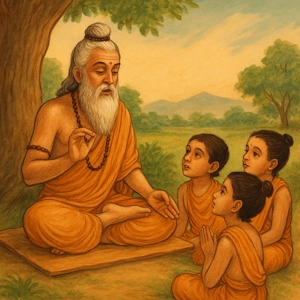
In the ancient world, where writing was not yet known, the spoken word held immense power. Teaching, learning, and the entire system of knowledge transmission depended on pronunciation and memorisation. This wasn’t just a preference — it was a necessity. And our ancestors took it very, very seriously.
The Oral Tradition: Teaching Without Textbooks
In those early days, education was entirely oral. The teacher, known as a Guru or Acharya, would recite knowledge aloud to the disciples. The students, in turn, would listen intently, repeat it several times, and commit it to memory. Since writing systems hadn’t yet evolved, memory was the only means of preserving knowledge.
To help with this, ancient scholars developed techniques to aid retention — such as repeating portions of text multiple times, reciting in rhythm, or using certain patterns. These memorisation strategies were collectively known as Samhita, Jatapatha, Ghanapatha, and more. Because the Vedas were preserved in this oral, repetitious style, they came to be known as Shruti — that which is heard.
Two Types of Memorisation
Memorisation was broadly classified into two types:
- With understanding — where the student knew the meaning of the words being memorised.
- Without understanding — mechanical or rote memorisation, without grasping the meaning.
Surprisingly, both forms were valued. Understanding was preferred, of course, as it allowed deeper learning and application. But even mechanical memorisation was considered important — especially when it came to the preservation of sacred texts. After all, a person who could accurately reproduce the verses in their correct order and with perfect pronunciation could still serve as a vital vessel of knowledge transmission, even if they didn’t know the full meaning.
Why Pronunciation Mattered So Much
Pronunciation wasn’t just a matter of aesthetics — it was critical. A single mispronounced syllable could change the entire meaning of a mantra or prayer. And in ancient rituals, that could spell disaster.
A famous story illustrates this point. Indra, the king of gods, once faced a powerful enemy — the asura Vritra. Tvashta (another god) wanted to avenge his son's (Trishiras) death at the hands of Indraby performing a yajna to create a being powerful enough to destroy Indra.
He intended to chant, Indrashatru vardhatam — meaning, 'may destroyer of Indra grow.' But due to a slight error in pronunciation, the stress was misplaced. Instead of creating someone who would destroy Indra, he ended up creating someone whom Indra would destroy. The outcome? A powerful being was born — only to be immediately slain by Indra.
The Legacy of Precision
This is why our ancestors treated the correct recitation of Vedic mantras as sacred duty. They didn’t rely on casual memory or guesswork. They followed the oral tradition with precision and reverence — and as a result, the Vedic literature has survived unchanged for thousands of years, passed down without losing even a syllable.
Today, when we chant these mantras or study these scriptures, we’re not just engaging with words — we’re witnessing the result of centuries of disciplined, heartfelt preservation.
Let us approach them with the same care and devotion.





English
Vedas
Click on any topic to open
7
30
Astrology
Bhagavad Gita
Bhagavatam
Bharat Matha
Devi
Devi Mahatmyam
Ganapathy
Garuda Puranam
Glory of Venkatesha
Hanuman
Kathopanishad
Mahabharatam
Mantra Shastra
Mystique
Practical Wisdom
Purana Stories
Radhe Radhe
Ramayana
Rare Topics
Rigveda Explained
Rituals
Sages and Saints
Shiva
Spiritual books
Sri Suktam
Story of Sri Yantra
Temples
Vedas
Vishnu Sahasranama
Yoga Vasishta
26
17
10
0


