Hiranyakashipu Used To Terrorize The World
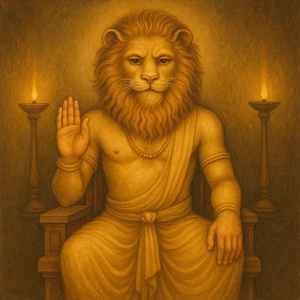
नारसिंहवपुः – नरस्य सिंहस्य चावयवा यस्मिन् लक्ष्यन्ते तद्वपुर्यस्य सः नारसिंहवपुः
One in whose body are organs of both man and lion.
नरवत् सिंहवद्रूपं यो बिभर्त्त्यभयप्रदम्
यथाकामं तु भक्तानां नारसिंहवपुश्च सः
Narasimha avatara reveals the protector abhaya prada aspect of Sri Hari.
Hiranyakashipu was son of Kashyapa Prajapati and Diti. Devas are sons of Kashyapa Prajapati and Aditi. That is why Devas are called Adityas and demons or Asuras are called Daityas. Same father different mothers. Devas and Asuras are stepbrothers.
This propaganda that Asuras are Dravidas and the original inhabitants of Bharata Varsha and the Aryas headed by their Devas were invaders who came from Mesopotamia is absolutely farce. Starting from Vedas every scripture speaks about the relationship between Devas and Asuras. They were stepbrothers. The only difference, Devas were righteous, and Asuras were evil minded, wicked. People who are taking ahead this propaganda don’t understand what kind of character assassination they are doing on themselves, and the so-called Indologists are taking advantage of their ignorance with ulterior motives. Brothers, some were good, some were bad. It has got nothing to do with the caste system or races.
Hiranyakashipu was very powerful. His brother Hiranyaksha was the one who took Earth away and hid her under the ocean. He was killed by Varaha avatara and Bhagavan retrieved Bhumi Devi and made her his own consort. After the death of his brother, Hiranyakashipu became all the more vengeful towards Devas and after defeating Indra, he started ruling the three worlds – Bhumi, Swarga and Patala. Functions of all the Devas Vayu, Agni, Surya came all under his control. They all acted at his will and command.
He himself became Yama. He himself became Kubera, the Lord of wealth. He deprived the Devas of their Yajna Bhaga. Yajna Bhaga means oblations offered in the Yajna. Whenever an oblation like cooked rice or ghee is offered in Yajna, it is specified to which Devata it is meant. For example, after giving an ahuti of ghee it is said Idam Agnaye – this is for Agni, Idam Indraya – this is for Indra. This Yajna Bhaga is rightfully due to them as ordained by creator Brahma.
सहयज्ञाः प्रजाः सृष्ट्वा पुरोवाच प्रजापतिः । अनेन प्रसविष्यध्वमेष वोऽस्त्विष्टकामधुक् ।
देवान् भावयतानेन ते देवा भावयन्तु वः । परस्परं भावयन्तः श्रेयः परमवाप्स्यथ ।
Prajapati Brahma created Devas, men and Yajna together. Yajna is the means of give and take between Devas and Manushyas. Men offer to Devas by means of Yajna and Devas bless men in return. In this manner they nourish each other. This is a system laid down by creator Brahma.
Now, whatever is offered in Yajna and meant for Devas, Hiranyakashipu would take away. Devas began to starve. They were so scared of Hiranyakashipu that they started roaming around the earth disguised as humans. He was fond of drinking. Many of the celestial beings became subservient to him. Gandharvas sang his praises. Apsaras danced for him. Siddhas and Nagas became his upasakas.
-
Why would Bhagavan choose a form that is part man and part lion?
Because form follows purpose. The human part speaks to our reason and closeness, the lion part embodies unstoppable strength. Together they signal: protection with intelligence, power without compromise. -
If the wicked sometimes rule, does that mean dharma is weak?
No. It means dharma is patient. Power can seize control quickly; justice restores order steadily. Temporary dominance is not final victory. -
Are Devas and Asuras races or moral types?
They are moral types. Devas stand for order, light, and responsibility. Asuras stand for ego, domination, and excess. These forces also live inside us. -
What does it mean when one ruler grabs the roles of many gods like wealth, death, wind, and fire?
It symbolizes dangerous centralization. When one ego tries to control every function of life, balance breaks and suffering grows. -
Why is taking offerings from sacred rituals considered so serious?
It is theft from the social and cosmic commons. Ritual giving trains gratitude and reciprocity. Stealing that weakens the bond between humans, nature, and the divine. -
Do Devas need our offerings?
Not for survival. Offerings reform us. Giving aligns the mind, disciplines desire, and keeps society cooperative. The benefit returns to the giver and the community. -
How is yajna relevant if I do not do fire rituals?
Live yajna as a daily principle: earn ethically, share a portion, serve without fuss, and dedicate results to a higher goal. Work becomes worship, and society stays nourished. -
Why do talented people sometimes sing praises of the unjust?
Fear, comfort, and ambition make people serve power. It is a warning to anchor talent in values; skill without character feeds tyranny. -
What is the meaning of ‘abhaya’ or fearlessness here?
It is the inner certainty that justice is real and protection is near. Fearlessness does not ignore danger; it trusts truth and acts with courage. -
If the universe is governed by laws, how can a divine intervention occur?
Law itself includes the clause of correction. When disorder crosses a line, the same law manifests a restoring force. Intervention is justice, not a break in order. -
Why does evil often attack rituals first?
Because rituals shape hearts. If gratitude, restraint, and sharing are weakened, people become easier to control. -
What lesson do ‘stepbrothers’ teach beyond a family story?
Good and harmful tendencies share a house inside us. Which one rules depends on daily choices: what we practice, praise, and permit. -
Is devotion passive or active in such a world?
Devotion is highly active. It trains courage, steadies the mind, and pushes us to protect the vulnerable while staying anchored in truth. -
How do I know if my power is turning asuric?
Watch for these signals: contempt for limits, joy in others’ fear, anger at fair criticism, and a habit of taking more than giving. Reverse course fast. -
What personal practice counters the rise of tyranny?
Daily gratitude (yajna mindset), fair sharing of resources, truth-telling without cruelty, and steady remembrance of the higher purpose behind your work. -
What is the core takeaway about protection?
Protection arises when courage, ethics, and surrender meet. Do your duty without bending to fear, and hold your heart in Bhagavan’s care.





English
Vishnu Sahasranama
Click on any topic to open
7
30
Astrology
Bhagavad Gita
Bhagavatam
Bharat Matha
Devi
Devi Mahatmyam
Ganapathy
Garuda Puranam
Glory of Venkatesha
Hanuman
Kathopanishad
Mahabharatam
Mantra Shastra
Mystique
Practical Wisdom
Purana Stories
Radhe Radhe
Ramayana
Rare Topics
Rigveda Explained
Rituals
Sages and Saints
Shiva
Spiritual books
Sri Suktam
Story of Sri Yantra
Temples
Vedas
Vishnu Sahasranama
Yoga Vasishta
26
17
10
0


