Hanumanji Prevented From Serving Sri Ramji
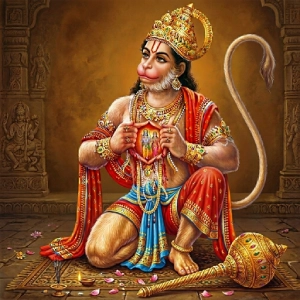
Some people grew jealous seeing Hanumanji's closeness to the Lord. One day, as he was walking into the court, Hanumanji was told, you may not go in there. Service to the Lord has been divided between many people. Each task is delegated to someone, only he can do it. A list has been prepared and the Lord has approved it.
Hanuman ji was shocked. They're trying to keep me away from the Lord. He said I want to see the list, I want to know what my duty is.
The list was read out loudly in front of the Lord. Hanumanji's name was not there. Every single task was given to someone else. Hanumanji said, can I do something if it is not there in this list? Everyone said yes. Everything was included in the list. You know when you yawn,
You snap your fingers a few times. This is a tradition. By the way, do you know why yawning is considered as a bad omen? In the fight between Devas and Vritrasura, Agni and Soma got trapped inside Vritrasura's body. They could come out only when Indra made Vritrasura to yawn. But when he yawned, Vritrasura's vital energies, prana and apana also left his body. He was then defeated by Indra. You snap your fingers to ward off such
Feat
Hanumanji said, I will take up the duty of snapping fingers whenever the Lord yawns. But for this, he has to be always with the Lord. That too looking at his face throughout, which is what he wanted. Nobody could say anything. Hanumanji got what he wanted. At night, the Lord and Sita Mata were retiring into their privacy. Hanumanji also wanted to go inside. Sita Mata stopped him, you are our son, but this is not done. But what if the Lord yawns in the night? How will he know?
climbed onto the roof of the palace and kept on snapping his fingers. How else can he make sure that fingers snapped whenever the Lord yawns, if at all he yawns?
After some time he could see a lot of commotion from below. The Lord's brothers had all come, even Rajaguru Vasishta had come down. It was midnight. Hanumanji could hear Vasishta calling out his name.
When he walked into the palace, he could see the Lord sitting with his mouth wide open. Hanumanji was still snapping his fingers. Now that the Lord was in front of him, Hanumanji stopped the snapping. The Lord's mouth closed. He started speaking, oh what a relief. You know what had happened?
Yawning and snapping of fingers have to go together. As soon as Hanumanji started snapping his fingers, the Lord gave out his first yawn. But then Hanumanji did not stop. He kept on snapping his fingers. The Lord could not close his mouth. He had to give out a series of yawns till the time Hanumanji stopped. Everyone panicked. The Lord is sitting with his mouth wide open. He is not speaking. See the closeness between the Lord and Hanumanji. As the Lord himself had said once, we are one and the same.
- What underlying human flaw drove the courtiers to create the list of duties, and how does it contrast with Hanumanji's core nature?
The courtiers were driven by jealousy and a desire to control access to the Lord, representing worldly ego, insecurity, and the desire for exclusivity. In contrast, Hanumanji's nature is rooted in pure, selfless devotion. He did not seek power, status, or public recognition; his only desire was the constant presence and service of his Lord. This contrasts the transactional nature of the courtiers with the unconditional love of a true devotee. - How does Hanumanji's response to being excluded from the list demonstrate his unique combination of intellect and devotion?
Instead of getting angry, arguing about the unfairness, or feeling defeated, Hanumanji calmly looked for a loophole. By asking if he could perform a task not present on the exhaustive list, he outsmarted the jealous courtiers. His sharp intellect served his devotion, allowing him to claim the seemingly insignificant task of snapping fingers during a yawn. This brilliantly required him to look at the Lord's face at all times, achieving his ultimate goal of uninterrupted closeness.
- What is the hidden mythological significance of snapping fingers when someone yawns, and how does it elevate the stakes of Hanumanji's chosen task?
The tradition originates from the cosmic battle between Devas and Vritrasura. Agni and Soma were trapped inside the demon, and they escaped when Indra forced him to yawn. However, Vritrasura's vital energies, prana and apana, also left his body during the yawn, leading to his defeat. Snapping fingers became a vital gesture to ward off the bad omen of losing life energy. By taking on this task, Hanumanji positioned himself as the ultimate protector of the Lord's vital energies, turning a simple gesture into an act of supreme spiritual guardianship.
- What does the midnight incident reveal about the physical and spiritual connection between Lord Rama and Hanumanji?
The incident reveals a profound, inseparable symbiosis. Because the action of yawning and the reaction of snapping fingers are intrinsically linked in this context, Hanumanji's continuous snapping on the roof forced the Lord into a continuous state of yawning. It illustrates the mystical principle that the Divine is bound by the pure love of the devotee, to the extent that their physical states reflect their absolute spiritual unity.
- How does this story serve as a critique of the formalization and bureaucracy of spiritual or religious duties?
The courtiers tried to formalize service through a rigid, approved list, treating devotion like a set of administrative chores to be divided and conquered. The story critiques this worldly approach by showing that genuine devotion cannot be contained, restricted, or delegated by human-made lists. True spiritual connection is spontaneous, continuous, and personal, effortlessly bypassing all artificial boundaries and hierarchies.
- Why did Sita Mata stop Hanumanji from entering the inner chambers at night, and what deeper boundary does this highlight?
Sita Mata stopped him out of adherence to worldly protocols of privacy, decorum, and marital boundaries, even while affectionately acknowledging him as a son. This highlights the inherent tension between societal norms and the boundless, all-encompassing nature of a true devotee's love. For Hanumanji, there is no separation between day and night, or public and private; his service and devotion recognize no earthly barriers.
- What does Hanumanji's action of sitting on the roof and continuously snapping his fingers reveal about the nature of absolute surrender?
It reveals his absolute single-mindedness, innocence, and unwavering commitment. Without the visual cue of the Lord yawning, he chose to continuously perform the task rather than risk missing a single moment of service. It highlights a state of extreme devotion where the devotee completely surrenders their own comfort, sleep, and logic for the sake of the deity, acting purely on faithful anticipation.
- Why was Lord Rama unable to close his mouth, and what greater truth did this forced physical state reveal to the courtiers?
Lord Rama was unable to close his mouth because the cosmic rule binding the yawn to the snap was activated and sustained by his greatest devotee's continuous action. This physical manifestation forced the entire court, including the wise Rajaguru Vasishta, to witness the unparalleled bond between the two. It humbled the jealous courtiers, proving to them that human schemes could never separate Hanumanji from the Lord.
- The story concludes with the statement that the Lord and Hanumanji are one and the same. How does the narrative practically demonstrate this complex philosophical concept of non-duality?
Non-duality is demonstrated through immediate cause and effect. The devotee's distant action directly controlled the deity's physical state, blurring the line between the master and the servant. Neither could function independently in this specific dynamic; the Lord's comfort and normalcy were entirely dependent on Hanumanji stopping his action. They operated as a single, synchronized spiritual entity.
- What is the hidden lesson for individuals today regarding how they offer their service, skills, or love, based on Hanumanji's approach to the list?
The hidden lesson is that true value lies in the purity of intent and the dedication applied to a task, not in the prestige of the title. While others fought over grand, visible duties to feed their egos, Hanumanji took an overlooked, seemingly insignificant task and turned it into the most powerful and intimate role of all. It teaches that supreme dedication to even the smallest duty brings one closer to the ultimate truth than merely holding a high position for the sake of status.





English
Hanuman
Click on any topic to open
7
30
Astrology
Bhagavad Gita
Bhagavatam
Bharat Matha
Devi
Devi Mahatmyam
Ganapathy
Garuda Puranam
Glory of Venkatesha
Hanuman
Kathopanishad
Mahabharatam
Mantra Shastra
Mystique
Practical Wisdom
Purana Stories
Radhe Radhe
Ramayana
Rare Topics
Rigveda Explained
Rituals
Sages and Saints
Shiva
Spiritual books
Sri Suktam
Story of Sri Yantra
Temples
Vedas
Vishnu Sahasranama
Yoga Vasishta
26
17
10
0


