Hanuman: The Strongest, Yet the Humblest
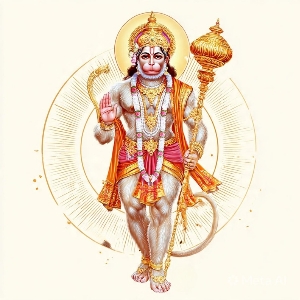
अतुलितबलधामं हेमशैलाभदेहं
दनुजवनकृशानुं ज्ञानिनामग्रगण्यम्।
सकलगुणनिधानं वानराणामधीशं
रघुपतिप्रियभक्तं वातजातं नमामि।।
I bow to the son of the wind, who is the home of matchless strength, whose body shines like a golden mountain, who is like a fire to the forest of demons, who stands foremost among the wise, who is the treasure of all virtues, who is the lord of the monkeys, and who is the most beloved devotee of Lord Rama.
1. Atulitabaladhaama — The Home of Unmatched Strength
The word atulita means without comparison. Bala means strength. Dhaama means a place where something lives or resides.
So this phrase does not just say Hanuman is strong. It says he is the living home of strength. Strength lives inside him the way light lives inside the sun.
This is important because it sets the tone for the entire verse. Hanuman is not just powerful among others. He is the very source and residence of power.
2. Hemashailaabhadeha — A Body That Shines Like a Golden Mountain
Hema means gold. Shaila means mountain. Abha means radiance or glow. Deha means body.
His body is compared to a golden mountain, not just for color, but for what a mountain represents. A mountain is stable, unshakeable, enormous, and full of presence. Gold adds the idea of purity and divine quality.
Hanuman's physical form is not ordinary. It carries the weight, the glow, and the steadiness of a sacred mountain made of gold.
3. Danujavanakrishaanu — Fire to the Forest of Demons
Danuja means demon. Vana means forest. Krishaanu means fire.
A fire entering a forest destroys it completely. There is no negotiation. No delay. No partial burning.
This describes how Hanuman deals with destructive forces. When he enters the space of demons, he does not slow down or compromise. He removes them the way fire removes a forest. Completely and without doubt.
This line refers both to the burning of Lanka and to the larger idea that Hanuman is the destroyer of evil forces wherever they exist.
4. Jnaaninamagraganya — Foremost Among the Wise
Many people think of Hanuman only as a warrior. But this line corrects that view. Jnaani means a person of deep knowledge and wisdom. Agraganya means the first to be counted or the one who stands at the front.
Hanuman is not just physically powerful. He is placed at the very front of all wise beings. His wisdom is as complete as his strength.
This combination of power and wisdom is rare. Most powerful beings lack subtlety. Most wise beings lack force. Hanuman holds both fully.
5. Sakalagunanidhana — The Treasure of All Virtues
Sakala means complete. Guna means virtues. Nidhana means a treasury or storehouse.
This phrase says that every good quality that exists is stored inside Hanuman. Courage, loyalty, humility, love, discipline, intelligence, selfless service — all of it lives in him together.
He is not great in just one area. He is the complete model of a perfect devotee and a perfect being.
6. Vaanaraanamadhiisha — The Lord of the Monkeys
Adhiisha means the highest lord or ruler. Hanuman is the leader of the vaanar sena, the monkey army of Kishkindha.
But at a deeper level, this also means that he leads all those who are humble in form but great in dedication. The monkey is not the most glamorous creature. Yet under Hanuman's leadership, that army crossed oceans, fought armies, and helped restore justice. Leadership is not about form. It is about devotion and purpose.
7. Raghupatipriyabhakta & Vaatajaata — I Bow to the Dearest Devotee of Rama, Born of the Wind
Raghupati is Lord Rama, the king of the Raghu dynasty. Priya means most beloved or dearest. Bhakta means devotee. Vaatajaata means born of Vayu, the wind god.
Namaami means I bow or I offer my salutation.
All the qualities described before this moment — strength, divine body, destroyer of evil, wisdom, virtue, leadership — reach their highest point in this one fact: Hanuman is the most beloved devotee of Rama.
That is his true identity. Not his power. Not his glow. Not even his wisdom. His deepest nature is love and surrender to his Lord.
The Takeaway
This verse is a complete portrait of an ideal being in just four lines. It moves from outer qualities to inner ones. From physical greatness to wisdom. From leadership to devotion.
The final bow is not just to Hanuman's strength or appearance. It is to the fact that all of his greatness flows from one source — his complete love and surrender to Rama.
This is the verse's deepest teaching. True greatness is not power alone. It is power placed entirely in the service of love and righteousness.





English
Hanuman
Click on any topic to open
7
30
Astrology
Bhagavad Gita
Bhagavatam
Bharat Matha
Devi
Devi Mahatmyam
Ganapathy
Garuda Puranam
Glory of Venkatesha
Hanuman
Kathopanishad
Mahabharatam
Mantra Shastra
Mystique
Practical Wisdom
Purana Stories
Radhe Radhe
Ramayana
Rare Topics
Rigveda Explained
Rituals
Sages and Saints
Shiva
Spiritual books
Sri Suktam
Story of Sri Yantra
Temples
Vedas
Vishnu Sahasranama
Yoga Vasishta
26
17
10
0


