Guru Dakshina
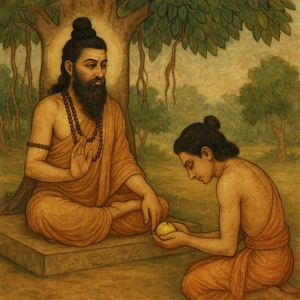
Guru dakshina refers to the traditional offering or fee given by a student to a guru in gratitude for the knowledge received. This practice dates back to the Vedic age. In the earliest Vedic context, dakshina simply meant a gift or honorarium offered to learned purohitas or teachers, often after a ritual or teaching. In Vedic yajnas, the patron was expected to reward the purohta with a dakshina – originally often a cow as payment for services
The very word dakshina is even personified as a goddess in the Rig Veda, underscoring how integral the concept of giving an offering was in those early times
As the guru–shishya (teacher–disciple) tradition developed, especially in the Gurukula system of education, the idea of guru dakshina took on a more personal and educational role. In ancient Bharata, students (shishyas) would live with their guru during the brahmacharya phase and receive education in the guru’s home or ashrama. Formal education typically lasted for many years, during which all students, regardless of background, lived as equals under the guru’s care
At the completion of one’s studies, it was customary (and often required) for the student to offer the guru a dakshina as a sign of respect, gratitude, and repayment for the teacher’s guidance
This offering was not seen as a commercial tuition fee, but rather a sacred duty and gesture of thanks. Importantly, guru dakshina was not always monetary – it could be a gift of goods, help with a specific task, or anything that the teacher desired or that the student could afford
Each student was expected to offer according to their means and the guru’s wishes, so the dakshina might range from symbolic tokens (like a simple fruit or cloth) to substantial gifts (land, gold, cattle) in the case of wealthy students
Over time, this tradition evolved but remained a cornerstone of the guru–shishya relationship. Through the epics and classical era, we see guru dakshina being paid in various forms – sometimes with profound sacrifices or significant deeds. The underlying principle, however, stayed consistent: knowledge in Sanatana tradition was considered so precious that one must honor it by giving back to the teacher in some form. This ensured a cycle of gratitude and respect, distinguishing the guru–shishya bond as more than a transactional exchange. It was a dharma (duty) for disciples to acknowledge the guru’s contribution in shaping their life
In the following sections, we will see how this concept is reflected in various scriptures and stories, and how its spirit continues in modern times.
Scriptural References in Sacred Texts
The practice of guru dakshina is mentioned or illustrated throughout the sacred texts of Sanatana Dharma, from the Vedas and Upanishads to the great epics and Puranas. These scriptures provide both direct references to the custom and narrative examples of how guru dakshina was given and what it symbolized.
Vedas and Upanishads
The Upanishads, which are philosophical texts stemming from the Vedic tradition, explicitly advise students to offer dakshina to their teachers. A famous injunction from the Taittiriya Upanishad (Shikshavalli) is recited to students upon the completion of their education, instructing them on their duties. In this passage, the guru exhorts the graduating disciple: 'Speak the truth; practice virtue… Give unto the teacher what is pleasing to him.'
This effectively means the student should approach the teacher with an offering that the guru would appreciate – a direct endorsement of the guru dakshina tradition in scriptural lore. Another portion of the same Upanishad elaborates on the spirit in which gifts should be given: 'Whatever is to be given should be given with faith, not without faith – according to one’s plenty, with modesty, and with reverence.’
In other words, offerings to the guru should come from a place of sincere faith and humility, never grudgingly or arrogantly. This shows that the act of giving guru dakshina was not meant to be a mere formality, but a heartfelt contribution made in the right spirit. There are also narrative examples in the Upanishads illustrating the concept. The story of Satyakāma Jābāla in the Chandogya Upanishad is often cited. Satyakāma, a poor but earnest student, was accepted by sage Gautama for education. Before imparting the highest knowledge, the guru gave Satyakāma the task of tending a herd of weak, lean cows as a form of service. Satyakāma took this duty to heart – he vowed not to return until the 400 weak cows had multiplied to a thousand
For years he lived in the forest serving the cattle, determined to increase the wealth of the ashram so he could offer it as guru dakshina. His dedication was so pure that it is said the gods and nature themselves revealed spiritual truths to him during his task
When Satyakāma finally returned with 1000 healthy cattle – far more than he was given – his guru was overjoyed and recognized that Satyakāma had attained enlightenment along the way. This tale highlights that guru dakshina in the Upanishadic context was not always a one-time gift; it could be seva (service) and unwavering commitment that ultimately made the student worthy of the knowledge. The 'wealth' Satyakāma brought back symbolized both a material guru dakshina and the spiritual growth he had achieved through service
Beyond these, the very notion of dakshina (offerings) recurs throughout Vedic literature as a virtue. In later Vedic texts (Brahmanas and others), we also find that students would often give cows, gold, or garments to their teachers on completing education. Thus, both prescriptive texts (like Upanishadic instructions) and stories reinforce guru dakshina as an established norm by the end of Vedic period.
Epics – Ramayana and Mahabharata
The two great Sanskrit epics, the Ramayana and the Mahabharata, contain numerous examples that echo the guru dakshina tradition. In the Ramayana, although there isn’t a single dramatic episode explicitly labeled as guru dakshina, the concept is implicit throughout. The princes of Ayodhya (Rama and his brothers) studied under Guru Vasishtha, and later Rama and Lakshmana acquired advanced skills from Sage Vishvamitra
These gurus were highly revered, and the princes served them with obedience and devotion. In one instance, when Vishvamitra took Rama for the protection of his yaga, it can be seen as the prince rendering service as a form of guru dakshina – effectively repaying his mentor by fulfilling a task for him beforehand itself. Some retellings suggest that Lord Rama’s greatest guru dakshina to his teachers was his promise and effort to live by the righteous principles (dharma) they taught him. This implies that in the ethos of the Ramayana, truly living the guru’s teachings was itself viewed as the ultimate offering back to the guru. Even if the epic doesn’t describe a physical gift exchanged, the spirit of guru dakshina is present in the profound respect and lifelong loyalty the students (like Rama) show to their gurus. The Mahabharata, on the other hand, provides very clear episodes of guru dakshina – some inspiring and others rather dramatic. The most famous is the story of Ekalavya, a tribal youth who wished to study archery under Guru Dronacharya. Drona had refused to teach Ekalavya, so Ekalavya practiced on his own, fashioning a clay image of Drona to serve as his symbolic guru. Through relentless practice and devotion to this imagined guru, Ekalavya became an extraordinarily skilled archer. When Dronacharya later discovered Ekalavya’s prowess, he felt threatened on behalf of his royal pupil Arjuna (to whom he had promised to make the greatest archer). Drona then demanded a cruel but symbolic guru dakshina from Ekalavya: the right thumb – essential for an archer. Without hesitation, and holding his guru in absolute reverence, Ekalavya cut off his thumb and offered it to Drona as his guru dakshina
This tragic tale underscores the guru dakshina concept in a rather extreme form: the disciple’s willingness to sacrifice even a part of his own body out of obedience and gratitude. While Ekalavya’s story is often debated for its ethical implications, it is repeatedly cited in tradition to illustrate the ideal of a disciple’s unwavering devotion – he was ready to give everything he had to his guru, literally. Another instructive episode from the Mahabharata involves Guru Dronacharya and his royal students (the Kauravas and Pandavas) at the end of their military training. When their education was complete, Drona asked for a very specific guru dakshina: he wanted his students to capture King Drupada of Panchala and bring him captive. This request was rooted in Drona’s own past rivalry with Drupada, but for the students it became a test of their loyalty and skill. The Kaurava princes attempted and failed to subdue Drupada, but the Pandava prince Arjuna – Drona’s most accomplished student – succeeded in defeating and seizing King Drupada, presenting him to Drona as the demanded guru dakshina
Drona, having thus been 'paid,' took half of Drupada’s kingdom and released him, settling an old score. This story highlights that a guru’s dakshina could be an extraordinary task – in this case, effectively helping the guru in a personal mission. It reinforces that guru dakshina was about duty and obedience: the teacher could ask for anything he desired, and a loyal student was honor-bound to fulfill it if possible. These epic narratives cement the idea that guru dakshina was an expected part of completing one’s education. The form it took could vary widely – from moral dedication to dramatic sacrifices or tasks – but the underlying principle was the same: a student must not leave the guru’s tutelage without offering something in return. It was both an economic support to the guru (who often had no other income) and a moral acknowledgement of the guru’s role.
Puranas and Other Texts
The Puranas give perhaps the most miraculous account. The Bhagavata Purana and the Harivamsha describe how Krishna repaid his guru Sandipani Maharshi. As a youth, Krishna, along with his brother Balarama, went to study under Sage Sandipani. After completing their training in literally all arts and sciences in a very short time, Krishna asked his guru to name a suitable dakshina. Sandipani knew he had divine students and made a bold request: his own son. Sandipani’s young son had gone missing and was presumed dead; they should bring him back.
For the guru dakshina, Krishna and Balarama set out to recover the boy. The Bhagavata recounts that they found that a demon (variously named Shankhasura or Panchajana) had taken the child. Krishna slew the demon, retrieved the boy’s soul from the realm of Yama (god of death), revived the guru’s son, and brought him back to life as an offering to their astonished teacher
In addition, Krishna presented Sandipani with the demon’s conch (which later became Krishna’s famous Panchajanya conch) and other riches as extra gifts
This tale is a beautiful example of a disciple literally giving the guru what he asked for – even if it meant doing the impossible. It emphasizes the devotion and superhuman lengths a student like Krishna was willing to go to in order to show gratitude to his guru. Another well-known Purana story is that of Guru Vishvamitra and King Harishchandra (told in the Markandeya Purana and elsewhere). Vishvamitra performs a grand yaga for which King Harishchandra promises to give dakshina. The sage, in order to test the king’s integrity, demands an extremely costly dakshina – essentially pushing the king into poverty and hardship as he tries to fulfill it. Harishchandra’s steadfast effort to pay his guru dakshina (even selling himself and his family) became a legendary example of truthfulness and duty. Although this story is more about a king and a rishi in a ritual context (not a student in an educational context), it still underlines how seriously the idea of promised dakshina was taken in dharmic lore. From the above, we see that the practice of guru dakshina is woven into scripture and legend. Whether it’s a formal guideline in the Upanishads, or dramatic stories in epics and Puranas, the message is consistent: a student should give back to the guru after receiving knowledge. The nature of the gift might be material (cows, gold, wealth), service-oriented (completing a task or mission), or even symbolic/spiritual (a vow to uphold the guru’s teachings or, in extreme cases, a personal sacrifice). In all cases, guru dakshina is portrayed as a sacred obligation – one that completes the cycle of learning by infusing it with gratitude and reciprocity.
Symbolic and Spiritual Significance of Guru Dakshina
Beyond the literal act of giving gifts or services, guru dakshina carries deep symbolic and spiritual significance in the guru–shishya tradition. It is not merely a payment; it is considered a gesture laden with cultural and spiritual meaning. At its core, offering guru dakshina symbolizes the student’s gratitude and humility. It is an acknowledgment that knowledge is priceless and cannot be taken for free – the guru’s teachings have transformed the student, and thus the student feels compelled to give back in whatever way possible. This prevents a sense of entitlement in the student and reinforces humility. The act of giving also helps reduce the student’s ego, reminding them that what they have gained is by the guru’s grace, not solely by their own merit. Interestingly, traditional explanations of the term dakshina itself reflect a spiritual meaning. An etymological breakdown of the Sanskrit word describes da as 'gift or offering,' kshi as 'to dwell or abide,' and na as 'knowledge.' Thus dakshina can be understood as 'an offering that enables knowledge to dwell (in one’s being)'
In other words, the very act of giving to the guru helps the knowledge one has received to settle firmly in the self. By making a material or energetic offering, the student in turn becomes more established in wisdom
This interpretation highlights a subtle truth in the tradition: learning is not complete until one has given back – the giving consummates the learning process, making it part of the student’s life and character. The spiritual psychology behind guru dakshina also involves the idea of energy exchange. The guru imparts wisdom (considered a form of subtle or spiritual energy) to the disciple; the disciple returns some form of energy to the guru through the dakshina – be it money, service, or devotion. This reciprocal flow creates a balance. Many spiritual traditions in India believe that when knowledge is given freely by the teacher, an imbalance occurs if the student does not reciprocate – offering dakshina balances that and prevents any karmic debt. It also cultivates shraddha (faith and reverence) in the student. As the Taittiriya Upanishad guidance showed, giving should be done 'with faith... with modesty ... with reverential awe'
The emphasis on faith, respect, and sincerity means the value of guru dakshina lies as much in the bhāva (attitude) of the giver as in the item given
A simple offering given with genuine devotion is worth more than an extravagant gift given with pride or reluctance. Within the guru–shishya paramparā (lineage tradition), guru dakshina also symbolizes the continuation of the lineage. In the convocation address quoted earlier, the Upanishad after instructing the student to present gifts to the teacher, immediately adds 'take care that the thread of your lineage does not break'
This implies that the true dakshina includes carrying forward what one has learned – to live by those teachings and eventually perhaps teach others. The student’s success and right living are in fact the extended guru dakshina that a teacher ultimately desires. In this sense, the highest guru dakshina is the disciple’s own life as a reflection of the guru’s guidance. A traditional saying is that the glory of a guru is seen in the conduct of his disciple. A scripture by Adi Shankaracharya, Guru Ashtakam, even questions the worth of any scholarly accomplishment if the student’s mind is not devoted to the guru’s principles
Many gurus themselves have expressed that the greatest 'gift' they seek is the earnest practice of their teachings. The most pleasing gift a guru receives from his disciple is when the student practices the teachings... with sincerity and earnestness – the student becomes the living embodiment of the guru.
In other words, if a disciple exemplifies the values and knowledge imparted by the teacher, that is a guru’s ultimate reward. This highlights a beautiful spiritual principle: guru dakshina is not measured by its material value but by the spirit of dedication and growth it represents. It transforms from an external exchange into an internal one – the disciple 'pays' the guru by attaining wisdom and upholding righteousness, which in turn brings honor to the guru. In summary, guru dakshina carries multifold significance: it is a token of gratitude, a lesson in generosity and humility, a means of energetic balance, and a commitment to preserve and live the teachings. It reinforces that education in the Sanatana Dharma context is not a commercial contract but a sacred bond. The guru gives jnana and the shishya gives seva or dakshina and through this mutual exchange, both are enriched. This spiritualizes the act of giving – making guru dakshina an extension of one’s learning and devotion rather than a mere formality.
In essence, guru dakshina is not just about offering a gift—it’s about offering oneself. It completes the learning process by blending humility, gratitude, and action. Whether given as service, sacrifice, or sincere remembrance, dakshina reflects the disciple’s inner transformation. It reminds us: true knowledge asks not for money, but for reverence.





English
Rare Topics
Click on any topic to open
7
30
Astrology
Bhagavad Gita
Bhagavatam
Bharat Matha
Devi
Devi Mahatmyam
Ganapathy
Garuda Puranam
Glory of Venkatesha
Hanuman
Kathopanishad
Mahabharatam
Mantra Shastra
Mystique
Practical Wisdom
Purana Stories
Radhe Radhe
Ramayana
Rare Topics
Rigveda Explained
Rituals
Sages and Saints
Shiva
Spiritual books
Sri Suktam
Story of Sri Yantra
Temples
Vedas
Vishnu Sahasranama
Yoga Vasishta
26
17
10
0


