From Prison to Gokula
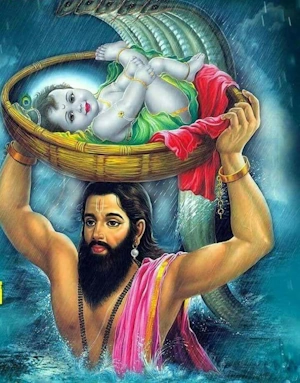
Bhagavatam Skandha 10, Adhyaya 3 begins with an eerie stillness. Midnight arrives. The stars align. The prison glows faintly. Then—Bhagavan Krishna is born. Vasudeva moves through locked doors, across a roaring Yamuna, to Gokula. A silent exchange. The leela has begun.
The moment had arrived —
a time wrapped in beauty,
bearing all auspicious signs.
The stars stood quiet in their places.
Planets cast no agitation.
The skies looked on
like sages in deep meditation.
Rohini ruled the heavens.
The directions glowed.
The sky spread wide and pure.
Stars rose like garlands for the Lord.
Villages, forests, cities, and cowsheds
all bloomed with a subtle joy.
The earth became a temple
awaiting her deity.
Rivers ran crystal clear.
Lakes gleamed with blooming lotuses.
The air hummed
with the murmur of birds
nestled in flower-laden trees.
Nature stood in prayer,
its offerings soft and fragrant.
The wind moved gently,
cool to the skin,
carrying a sacred sweetness.
Every homa flame
burned steady and clean.
The rites of the brahmanas
rose upward
as if drawn by an unseen magnet.
The minds of the noble turned serene.
Those burdened by darkness
felt peace, sudden and deep.
As Janardana prepared to arrive,
celestial drums sounded above —
no hands played them.
It was the joy of the unseen.
Kinnaras sang with golden voices.
Gandharvas filled the sky with hymns.
Charanas and Siddhas offered praise.
Heaven’s dancers moved in rhythm.
Every realm rejoiced,
carried by one silent truth—
He was coming.
The sages and devas
showered garlands of divine flowers.
The clouds, heavy with delight,
rumbled slowly across the sky.
Even the sea murmured,
as if whispering the name
it had long remembered.
At midnight,
when darkness was full,
Bhagavan Vishnu revealed Himself.
He appeared from Devaki’s womb—
she, radiant as a goddess.
He came forth
like the moon rising in the east—
gentle, whole,
filling all space with light.
There He was —
the divine child, glowing like a mystery unwrapped.
Eyes like lotus petals,
four arms extended gracefully,
holding shankha, chakra, gada, and padma.
His chest bore the mark of Shrivatsa,
a radiant Kaustubha gem gleamed at His throat,
and golden silk wrapped His dark, rain-cloud skin.
His crown shone with priceless vaidurya gems.
Earrings flared beside curls like coiled lightning.
A thousand locks flowed over His shoulders.
Girdle, anklets, armlets —
each ornament glowed as if alive.
Vasudeva gazed at Him,
eyes wide with wonder,
as if seeing the sun
within the stillness of night.
Tears filled Vasudeva’s eyes.
He beheld his son —
yet he knew it was Hari Himself.
A rush of joy flooded him.
In that divine ecstasy,
he resolved to gift ten thousand cows to brahmanas.
The birth of Krishna
was not just a moment,
it was the end of centuries of waiting.
Realizing it was the Supreme Purusha before him,
Vasudeva bowed low,
his heart steady, hands folded.
The prison shone,
lit by the radiance of that child.
All fear left him.
In that chamber of pain,
Bhagavan’s light
turned iron into shrine.
Vasudeva said -
O Bhagavan,
You are well known —
the eternal Purusha, untouched by prakriti.
Your nature is pure bliss and awareness,
self-born, self-shining,
seer of all minds,
yet bound by none.
It is You
who brings forth this world through Your own maya,
woven with the three gunas.
Though appearing to enter creation,
You remain ever beyond it.
You stand inside time,
without ever being caught in it.
Just as the changeless elements
stand distinct from their transformations,
You remain unchanged
even while giving rise
to countless energies and forms.
Your will alone
creates the cosmic symmetry.
These forms seem to come together,
to act, to dissolve—
but they are only rearrangements
of what always existed.
There is no real birth or death here.
Only the appearance
of movement in stillness.
O Lord of all,
You are known only by refined intellect,
never by the senses.
Even when You seem covered in qualities,
You remain untouched.
Inner or outer has no meaning to You—
for You are all that is.
Fools imagine that You are present
only in visible traits,
separate from the self.
But whatever they reject,
and whatever they cling to—
both belong to You.
Nothing lies outside Your scope.
O Master,
Scriptures speak of Your acts
of creation, maintenance, and dissolution.
Yet they say You act without desire,
without change.
Though the gunas touch creation,
they do not touch You.
You remain their witness.
To sustain the worlds,
You take on a white form—
serene, pure, sattvic.
For creation,
You wear the red hue of rajas.
And when time ends,
Your dark form, tinged by tamas,
draws all things back into silence.
O Lord of all,
You have now appeared in our home—
to protect this world.
Armies of kings and demons
will rise against dharma.
But You shall move through them
like fire through dry grass,
untouched and unyielding.
This wicked king,
he already heard of Your descent.
He killed Your elder brothers
before they could cry.
Even now,
he races here with sword in hand,
longing to destroy
what fate has sent to destroy him.
Shuka said—
Devaki looked upon her son.
This was no ordinary child —
He bore the marks of the Mahapurusha.
Her heart, already pierced by Kamsa’s cruelty,
rushed with fear.
Yet her smile stayed gentle,
as she stepped toward Him.
Devaki said—
'O Lord, the form I see now—
the sages speak of it as formless,
the first cause, the eternal flame.
Pure, changeless, beyond all names.
You are that brilliance.
You are Vishnu Himself,
the flame that lights the soul from within.'
'When all creation dissolves,
when aeons end
and the great elements return to their source,
You alone remain—
silent, whole,
known by the name Shesha,
but beyond even that.'
'Time —
its breath, its swing, its surge —
moves by Your will.
From blink to year,
from instant to kalpa,
it dances in Your grasp.
To that unseen Master of Time,
my soul bows for refuge.'
'Mortal beings run,
haunted by death’s shadow.
They flee across worlds,
but find no peace.
But one glance at Your lotus feet—
even by chance—
and the storm breaks.
Death turns back.
The heart becomes still.'
'You who lift fear
from the hearts of servants—
protect us now
from Kamsa, son of Ugrasena.
Let this divine form,
so majestic and full of power,
remain hidden from worldly eyes.
Let only the meditative
see You as You are.'
'O Madhusudana,
let not this birth become known.
Let that sinner, Kamsa,
never discover You.
For Your sake,
I have endured terror.
Let me not break now,
when You have come.'
'O Soul of the universe,
withdraw this form —
shankha, chakra, gada, padma —
this four-armed radiance,
adorned with majesty.
Return to the form of a child,
so that none may suspect
what Devaki had held in her womb.'
'You, the Supreme Purusha,
who holds this universe within Himself,
now appear as my son.
You who wear the cosmos
as a garment,
lie in my arms.
What a play this is —
that mortals will see You
as just another newborn.'
Bhagavan said—
'O Devaki,
You were Prishni in the first creation,
when Manu was born of Brahma.
Your husband then was Sutapa,
a pure and steadfast mind—
a Prajapati entrusted with the task of creation.'
'At that time,
you both were instructed by Brahma
to engage in deep tapas.
You withdrew your senses,
turned inward,
and embraced an austerity
so intense
even the heavens held their breath.'
'You endured storms,
sun, snow, and fire.
Breath held,
desires shed,
you stood like stillness itself.
No sorrow touched your minds.
Even hunger,
even time,
bowed to your vow.'
'You lived on fallen leaves and wind,
your hearts tranquil,
fixed only on Me.
With minds emptied of worldliness,
you desired only one thing —
to see Me,
to hold Me.
That desire became your worship,
and that worship,
became My promise.'
'You both stood in that blazing tapas,
unmoving, unbroken,
for twelve thousand divine years.
Austerity that crushed the senses,
yet flowed with longing—
for Me,
and Me alone.'
'I was pleased, O sinless one.
Not just by the tapas,
but by your unwavering faith,
your steady bhakti,
and the way you held Me
as the only truth in your heart.
That devotion called Me forth—
in that very form
you now behold.'
'I appeared before you
as the giver of boons,
and said—
"Ask, what do you desire?"
You both asked for a son
just like Me.
But there is none like Me…
so I Myself became your son.'
'You were untouched by worldly pleasure,
childless and pure.
But enchanted by My own maya,
you did not ask for liberation.
You did not seek moksha.
You asked only for Me
in your home.'
'When I disappeared after that birth,
you rejoiced in worldly joys,
feeling you had attained all that you desired.
With Me as your child,
you tasted simple happiness—
and in that joy,
your hearts stayed fulfilled.'
'O Devaki, O Vasudeva,
in all the worlds,
no other couple equaled your virtue or generosity.
So I became your son
in that first birth—
as Prishni-garbha,
born from your vow,
born from your fire.'
'In your next birth,
you were Aditi and Kasyapa.
I was born again to you—
as Vamana,
called Upendra by the gods,
small in form,
yet carrying the weight
of all the three worlds.'
'Now, for the third time,
I have come again—
in the same divine form,
and to the same two souls.
This is My vow fulfilled.
This is the truth
I gave you long ago.'
'I have shown you this form
so that your memory
may awaken to past births.
Only by this recognition
can true knowledge arise—
for mortal minds,
bound in flesh,
forget the divine
even when it lies in their arms.'
'You have loved Me as your child,
and you have remembered Me as Brahman.
You have bound Me
with affection and meditation.
And because of that,
you shall reach
My supreme abode—
where union is eternal,
and all longing ends.'
Shuka said—
After speaking these words,
Bhagavan Hari fell silent.
Before the very eyes of His parents,
He, who shines beyond the gunas,
became a newborn child—
helpless in form,
yet holding the whole cosmos in His breath.
Then Vasudeva, moved by the will of Bhagavan,
took the child in his arms.
It was still night.
As he prepared to leave the prison,
in Nanda’s house,
Yogamaya—
the divine illusion—
was born from Yashoda.
The guards at the gates fell asleep,
their minds blank, their senses numbed.
The heavy doors of the prison,
locked with massive iron bars and chains,
swung open on their own,
like hearts surrendering to grace.
As Vasudeva stepped out carrying Krishna,
the doors quietly closed behind him.
The clouds above rumbled gently.
Rain fell, soft and slow.
Shesha followed,
his hoods spread wide,
shielding the divine child
from every drop of the night.
The Yamuna, swollen and fierce,
roared through the dark.
Waves rose like serpents,
frothing with urgency.
Whirlpools circled like guardians at war.
But as Bhagavan approached,
the river bowed,
offering a clear path—
as if Lakshmi herself parted the water.
Vasudeva reached Nanda’s Gokula.
The night held its breath.
The cowherds slept deeply,
unaware that the axis of the world
was passing through their door.
He entered Yashoda’s home,
placed Krishna beside her,
and gently lifted the newborn girl
from her side.
He returned to the prison silently.
No locks creaked, no chains clanked.
He laid the girl beside Devaki,
locked the iron shackles around his feet again,
and sat as before—
as though nothing had changed,
though everything had.
Yashoda, mother of Gokula,
awoke at dawn.
She felt joy,
but knew nothing of what had happened.
Exhausted from labor,
her memory faded like mist.
She did not notice
the divine had taken her son’s form—
and the leela had begun.
- The entire cosmos becomes auspicious at midnight under Rohini Nakshatra — rivers, winds, stars, and hearts reflect divine joy.
- Bhagavan Krishna takes birth in His four-armed form in Devaki’s prison chamber, shining like a thousand suns.
- Vasudeva and Devaki offer stutis, recognizing Him as the Supreme Purusha and recalling their past births as Prishni–Sutapa and Aditi–Kashyapa.
- Bhagavan reassures them and withdraws His divine form, assuming the form of an ordinary infant.
- Yogamaya is simultaneously born to Yashoda in Gokula.
- Vasudeva carries infant Krishna across the Yamuna — the river parts, Shesha shelters, doors unlock — all by divine will.
- Krishna is exchanged with Yogamaya, and Vasudeva returns to prison unnoticed, reshackling himself.
- Yashoda, unaware of the switch, believes the divine child beside her is her own.
Thus ends the third chapter—where silence, night, and divine will conspired to shift the course of the world. Bhagavan Krishna, the very soul of the cosmos, was born in a prison cell, yet the earth blossomed as if heaven had touched it. No trumpet announced Him. No army protected Him. Yet the Yamuna parted, the locks surrendered, and even time held its breath. Vasudeva fulfilled the task given by fate, and Gokula unknowingly became the cradle of creation. The child lay smiling beside Yashoda, the storm passed, and the leela had begun—wrapped in secrecy, destined for eternity.





English
Bhagavatam
Click on any topic to open
7
30
Astrology
Bhagavad Gita
Bhagavatam
Bharat Matha
Devi
Devi Mahatmyam
Ganapathy
Garuda Puranam
Glory of Venkatesha
Hanuman
Kathopanishad
Mahabharatam
Mantra Shastra
Mystique
Practical Wisdom
Purana Stories
Radhe Radhe
Ramayana
Rare Topics
Rigveda Explained
Rituals
Sages and Saints
Shiva
Spiritual books
Sri Suktam
Story of Sri Yantra
Temples
Vedas
Vishnu Sahasranama
Yoga Vasishta
26
17
10
0


