Every Mantra Has Got Two Rishis
So far, we have seen the meaning of the first eight mantras of the first sukta of Rigveda, Mandala 1.
There is one richa remaining in this sukta.
The total number of mantras in the sukta starting with agnimeele purohitam is 9.
अग्ने सूपायनो भव
नः स्वस्तये सचस्व
'O Agni, be here. Upayana means gift.
Gift to us all the goodness, welfare, swasti — like how a father would bring presents for his child — piteva soonave.'
In the same way, grant us all our wishes.
The relation between Agni and yajamana is that of father and son.
And Agni would give, fulfil all the wishes of the yajamana like how a father would fulfil the wishes of his son.
The second sukta — vaayavaa yaahi — also has nine mantras.
The devata of the first three richas is Vayu.
The next three richas — Indra and Vayu together.
The last three richas — Mitra and Varuna together.
This is a call to Vayu — an invitation.
Please come and partake your portion of the Soma.
The Soma is ready. All the samskaras have been performed for Soma.
They are pure and fit for your consumption.
Please come and have your portion.
Aharvidaha — these ritwiks and yajamana are well-versed in the procedure of yajnas.
They have kept the Soma ready.
And they are addressing you with praises.
They are praising your virtues — ukthebhihi jarante.
A couple of things I want to point out here:
Mantras have got Rishi, Mantra, Devata, and Viniyoga.
In Rishi also, there are two kinds of Rishis.
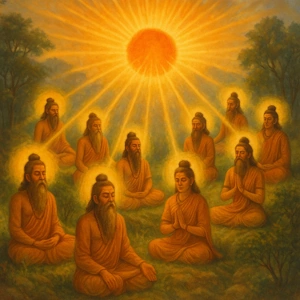
We know that every ray of the Sun is a mantra.
So this Parama Purusha, Paramatma, whom we can call Surya Narayana or Hiranyagarbha —
he is the Rishi for all the mantras.
Then, out of these crores and crores of mantras, some are revealed to specific Rishis such as Vasishta, Atharva — even female Rishis like Apala, Vishwavara.
So we can say every mantra has got two Rishis.
Now, to whom is the mantra addressed? To a particular devata.
So, the Rishi is the vakta and the Devata is the shrota.
What is the role of the chanter of the mantra?
He is the medium through which this mantra is going.
The vakta of the mantra is the Rishi, and the shrota is the Devata.
The chhandas is the meter in which the mantra is composed or exists.
Then, the viniyoga is there — the purpose or the context in which the mantra is employed.
Mantra exists for a reason.
The same mantra can be employed in different contexts also.
But one general rule is that a mantra should be used only in the worship of the particular Devata of the mantra.
You should not use Devi Sukta for the worship of Vishnu or Indra,
or a mantra pertaining to Indra for the worship of Yama.
Another point —
There are a lot of mantras common in Rigveda and Samaveda.
The mantra found in richa form itself is sung in Samaveda.
Here also, if the viniyoga says it should be chanted — it should be chanted.
If the viniyoga says it should be sung — it should be sung.
You should not change it the way you want.
When you say a mantra of one Devata should not be used to worship another Devata, it needs a clarification.
Take the case of Vedic marriage.
In the Vedic marriage, the groom is considered to be Maha Vishnu, and he is worshipped.
The bride’s father washes his feet.
Does it mean that the acharyas, elders, are not respected? No.
That means the restriction is when something is offered.
When an ahuti is offered — an offering is made — then the mantra of that particular Devata is used.
But another Devata can also be praised with the mantras of that Devata during that time.
Keep this point in mind:
The category of mantras called shastras or stotras — they are also Veda.
Mantras — not the stotras that we regularly chant.
These mantras can be chanted even in a yajna where that particular Devata does not get an ahuti.
Vayu is fond of Soma.
He has given his word to the yajamana that once Soma is properly prepared,
he will come and consume it.
He is sure to come.
He will honour his word.





English
Vedas
Click on any topic to open
7
30
Astrology
Bhagavad Gita
Bhagavatam
Bharat Matha
Devi
Devi Mahatmyam
Ganapathy
Garuda Puranam
Glory of Venkatesha
Hanuman
Kathopanishad
Mahabharatam
Mantra Shastra
Mystique
Practical Wisdom
Purana Stories
Radhe Radhe
Ramayana
Rare Topics
Rigveda Explained
Rituals
Sages and Saints
Shiva
Spiritual books
Sri Suktam
Story of Sri Yantra
Temples
Vedas
Vishnu Sahasranama
Yoga Vasishta
26
17
10
0


