Even Shiva Bowed to Him First
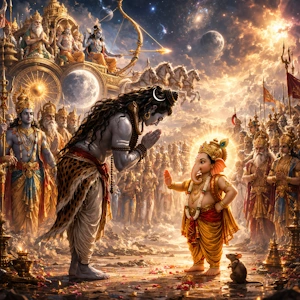
Shiva assembled the most powerful army ever gathered. Every god, every celestial weapon, every cosmic force was ready. The chariot was built from the elements of the universe itself.
Yet the whole procession froze.
Not because of an enemy. Not because of fear. It stopped because one small figure stood in the path. A child with an elephant head, completely relaxed, completely unmoved.
This was Ganesha. Son of Shiva. Lord of beginnings. Lord of obstacles.
He made one simple announcement. No god, no demon, no human finds success without honouring him first. The army had forgotten this. So he stood there as living proof of their mistake.
The Context You Need to Understand
First understand the context.
The three floating cities in this story are called the Tripura. They belonged to powerful demons who had grown invincible through years of intense penance. The cities floated in the sky and could only be destroyed at one precise moment when all three aligned in a straight line. That moment was rare. Everything had to be perfect.
Shiva's chariot was not ordinary. The earth itself was the base. The sun and moon were the wheels. Mount Meru was the bow. Brahma drove it. Vishnu became the arrow.
This was not a small war preparation. This was a cosmic event.
And yet, in all this grand preparation, one simple act was skipped. Nobody stopped to honour Ganesha. Nobody sought his blessing at the beginning.
This is why he appeared. Not out of ego. Out of cosmic law.
What This Means at a Deeper Level
Now look at the deeper point.
Ganesha is not simply a god who likes sweets and gets upset when ignored. He represents something very specific in Sanatana Dharma.
He is the principle of proper beginnings.
In any action, the first moment carries the seed of everything that follows. If the seed is planted without care, the whole tree grows crooked. Honouring Ganesha at the start is the act of bringing full awareness and humility to that first moment.
The word Vighna means obstacle. Ganesha is called Vighnaharta, the remover of obstacles. But here he appears as the obstacle itself. This seems contradictory. It is not.
He becomes the obstacle only when the proper beginning is skipped. Once honoured, he clears every obstacle ahead. The same energy that blocks you can open the path for you. The difference is only whether you approached the beginning with awareness or with arrogance.
What Shiva's Gesture Teaches
There is another important detail. The most important moment in this story is not Ganesha stopping the army. It is what Shiva did after.
Shiva did not order his son aside. Shiva did not use his supreme authority to override the moment. Instead, Shiva walked up to Ganesha with flowers. He offered them with full respect. Then he embraced his son and affectionately smelled the top of his head.
This is a very specific gesture in Indian culture. It is the gesture of a parent expressing deep love and pride toward a child. Shiva, the lord of destruction, the one who holds the universe in his matted hair, performed this gesture toward the young Ganesha in front of the entire cosmic army.
Here is what this means.
Shiva was not just honouring his son out of affection. He was demonstrating to every god watching that even the highest power must bow to right order. Dharma does not bend for status. It does not bend even for the lord of the universe. Shiva understood this. And by honouring it openly, he showed the others how to stand before something greater than their own power.
The Practical Meaning for Daily Life
What is essential:
Before beginning any important work, pause. Even one quiet moment of acknowledgement is enough. This can be a prayer, a moment of stillness, a simple mental offering to Ganesha, or just the act of saying to yourself that you are beginning with humility and not with pride.
This is not superstition. It is an internal act. It brings your awareness fully to the present moment. It removes the unconscious arrogance that rushes into action without thinking. That arrogance is itself the first obstacle.
What is optional:
Elaborate rituals, specific mantras, detailed puja procedures. These are beautiful if you know them. But the core act is internal. A sincere pause done simply is more powerful than an elaborate ritual done with distraction.
The Scriptural Connection
This story comes from the Shiva Purana and is also referenced in the Linga Purana. The tradition of worshipping Ganesha at the start of every auspicious act, every ceremony, every journey, every new venture, comes directly from this cosmic principle.
The Rigveda contains a hymn to Ganapati, the lord of the ganas, the lord of all groups and assemblies. The idea that this force must be invoked first is ancient. It runs through the entire tradition of Sanatana Dharma.
Even today, in any Hindu ceremony, Ganesha puja comes first. Not second. Not after the main deity. First. This sequence is not habit. It is a reminder encoded in practice.
Straight Understanding
Skipping his worship is the most common reason great efforts fail.
Honouring Ganesha is the act of meeting the start of your work with full awareness instead of rushing past it. When even Shiva stopped his greatest mission to do this, the message is clear. Size and power do not exempt you from right order.
Ganesha does not ask for much. He asks only that you do not treat your beginning as unimportant.
The entire universe waited while Shiva offered flowers to his son. That pause was not a delay. That pause was the reason everything that followed could succeed.
- Why did the entire cosmic army freeze because of one small child?
The army did not freeze out of fear. It froze because a cosmic law was being violated. Ganesha is not simply a deity with feelings who wanted attention. He represents the principle that every beginning must be entered with awareness and humility. When that principle is ignored, nothing can move forward correctly. The universe itself enforces this. Size of the army, power of the weapons, importance of the mission — none of these matter. The law applies equally to all.
- Why does Ganesha become the obstacle when he is supposed to remove obstacles?
This is the most misunderstood aspect of Ganesha. He is not two different things depending on his mood. He is one consistent principle. That principle is this: a beginning approached with arrogance creates its own blockage. A beginning approached with awareness opens the path. Ganesha does not punish you by becoming an obstacle. He simply reflects back the quality of your beginning. If your beginning is careless, the path resists. If your beginning is humble and aware, the path clears. He is a mirror, not a gatekeeper with personal preferences.
- Why was Shiva's gesture of smelling Ganesha's head more important than the actual battle?
In Indian tradition, a parent smelling the top of a child's head is not a casual gesture. It is one of the most intimate expressions of love, pride, and recognition. Shiva performed this in front of every god, every cosmic force assembled. He was not just showing affection. He was making a public declaration that right order stands above even his own supreme authority. The battle was temporary. This demonstration of dharma was eternal. Every being watching learned something that no scripture lecture could have taught as powerfully.
- What does it tell us that Brahma drove the chariot and Vishnu became the arrow?
This detail reveals how serious the Tripura mission was. Brahma is the creator. Vishnu is the preserver. Both were serving Shiva in specific roles in this mission. The entire creative and sustaining force of the universe was organized for this single act. And yet even this complete mobilization of cosmic power could not bypass the principle of the right beginning. When even the greatest possible effort is subject to this law, the message is clear. No amount of power or preparation substitutes for the awareness with which you begin.
- Why are the three cities described as floating and only destroyable at one aligned moment?
The Tripura represent forces that have made themselves invincible through discipline. Penance and tapas gave the demons their power. This is an important detail. The tradition does not say the demons were weak or foolish. They had earned their strength. The only way to defeat them was through perfect cosmic alignment and perfect preparation. This is why skipping Ganesha's worship was such a significant error. When the task requires absolute precision, the beginning requires absolute care. The greater the mission, the more important the quality of the start.
- Is there a connection between Ganesha's elephant head and the principle he represents?
Yes. The elephant in Indian tradition represents memory, patience, the ability to clear paths through dense forest, and the quality of moving deliberately without rushing. The elephant does not panic. It does not act impulsively. It assesses, then acts with full force when needed. These qualities are exactly what a proper beginning requires. You assess before you act. You bring your full awareness before you move. The elephant head on a child's body also represents a mature mind on a young form, meaning wisdom does not depend on age or size. It depends on the quality of awareness.
- Why does this story say the ganas, Shiva's own attendants, forgot to honour Ganesha?
This is a teaching about familiarity and assumption. The ganas were close to Shiva. They served him constantly. They were part of the inner circle. And because of that closeness, they assumed they understood the full picture. Assumption is one of the most dangerous forms of arrogance. It does not feel like arrogance from the inside. It feels like confidence. The ganas were not malicious. They were simply moving too fast, too sure of themselves. This is the most common reason people skip proper beginnings. Not contempt, but assumption.
- Why does the Rigveda mention Ganapati if Ganesha is thought of as a later deity?
This is an important distinction. The form of Ganesha with the elephant head developed its iconography over time. But the principle of Ganapati, the lord of all groups and assembled forces, is ancient. The Rigveda addresses this force as the one who must be invoked for all gatherings and beginnings. The later stories gave this principle a vivid form so that people could relate to it personally. The principle came first. The personal form came later to make the principle accessible. The deeper teaching was always there. The stories made it easier to remember and carry.
- What is the real meaning of doing Ganesha puja before every ceremony?
Most people treat it as a starting ritual, like the opening line of a program. But the actual meaning is much more direct. Before you begin anything significant, you are being asked to stop completely. In that stop, you are asked to acknowledge that you do not control outcomes. You are asked to recognize that your effort depends on forces larger than your own will. That recognition, done sincerely, removes the first and most powerful obstacle: the belief that your plan alone is sufficient. The puja is an externalized version of an internal shift. That shift is what actually changes the quality of what follows.
- What is the secret that most people miss about why Shiva succeeded in destroying the Tripura after honouring Ganesha?
The secret is this. Shiva did not succeed because Ganesha rewarded him. Shiva succeeded because the act of honouring Ganesha changed the quality of Shiva's own state. When you pause, acknowledge, and approach your beginning with humility, your mind becomes still. A still mind sees clearly. A clear mind times its action perfectly. The three cities had to be destroyed at one precise moment of alignment. That kind of precision requires a completely undistracted, fully present awareness. Shiva's bow was drawn from that state of presence. The pause was not a ritual delay. The pause was the preparation that made perfect timing possible.
Objection 1: This is just a myth. A child with an elephant head stopping an army is obviously not real history.
Reply: The story is not presented as historical journalism. It is presented as symbolic teaching. Every culture uses stories to carry deep principles. The Greeks used myths. The Hebrews used parables. The Indians used Puranas. The question is not whether an elephant-headed child literally stood on a road. The question is whether the principle inside the story is true. That principle, which says that a beginning entered with arrogance is its own obstacle, can be tested in your own life today. The form of the story carries the teaching. The teaching stands on its own merits.
Objection 2: Why would an all-powerful God need to ask permission from his own son?
Reply: This objection assumes that power means exemption from order. The story is making the opposite point. Real power understands and respects the laws that govern all things. A physicist who knows the laws of nature does not ignore them out of pride. He works with them. Shiva's greatness is demonstrated precisely by the fact that he did not override the principle. He honoured it. A god who ignores cosmic law out of pride is not greater than the law. He is simply arrogant. Shiva's action shows the difference between true authority and mere force.
Objection 3: This looks like a religion that requires constant rituals and payments to gods before anything gets done. That is superstition.
Reply: The story itself separates this clearly. The core act is internal. It is a pause. It is the act of entering a beginning with humility instead of assumption. The rituals are external forms that help people remember to do this internally. If you do the ritual with full sincerity and internal awareness, it works. If you do it mechanically while thinking about something else, it is just procedure. The tradition is pointing at the internal act. The external ritual is a tool, not the destination. You can do the internal act completely without any ritual at all.
Objection 4: If Ganesha removes obstacles, why do good and sincere people still fail?
Reply: The principle does not promise that sincerity guarantees the result you want. It says that a proper beginning gives your action the best possible foundation. Outcomes depend on many factors: effort, skill, timing, the actions of others, circumstances outside your control. What Ganesha represents is the removal of the obstacles that come from within you, specifically from arrogance, distraction, and rushing. External obstacles remain. But the internal ones, which are often the ones that cause people to give up, lose focus, or make careless errors, are reduced when you begin correctly.
Objection 5: This is just a brahmanical tradition invented to keep people performing rituals and paying priests.
Reply: The story of Ganesha stopping Shiva's army requires no priest and no payment. It requires a pause and an internal acknowledgement. The principle is available to anyone. Whether the tradition was sometimes misused by institutions for control is a separate historical question worth examining. But the principle inside the story does not belong to any institution. It belongs to the person who understands it. The teaching and the misuse of the teaching are two different things. Judge the principle on its own terms.
Objection 6: This seems to say that if you just pray to Ganesha, success is guaranteed. That is wishful thinking.
Reply: The story does not say this. Shiva still had to build the chariot, assemble the army, draw the bow, and time the shot perfectly. Ganesha's blessing did not replace any of that effort. What it did was remove the internal obstacle that comes from arrogance and carelessness. The blessing is the beginning of effort, not a substitute for it. Anyone who treats worship as a replacement for work has misread the story entirely.
Objection 7: In modern science we understand causality. Praying to a deity does not change physical outcomes. This is pre-scientific thinking.
Reply: Science explains how things happen at the material level. It does not explain the quality of attention and intention that a person brings to their work. A surgeon who begins an operation in a distracted, rushed, arrogant state and a surgeon who begins in a calm, fully present, humble state may both have identical technical knowledge. Their outcomes will differ. The internal state of the person acting is a real variable. It affects real results. Ganesha as a principle is pointing at exactly this variable. You do not need to believe in a deity to recognize that the quality of your beginning affects the quality of your result.
Objection 8: Why is Ganesha worshipped first even before other more powerful gods? This seems arbitrary.
Reply: It is not arbitrary. Every other deity represents a specific domain. Shiva governs transformation. Vishnu governs preservation. Lakshmi governs abundance. Ganesha governs the beginning itself, the doorway through which everything else enters. Before you can receive any of what the other deities represent, you must pass through the beginning correctly. He governs the threshold. This is why he comes first. Not because he outranks the others in a hierarchy. But because his domain is the entry point to all other domains.
Objection 9: How can one story from an ancient text be relevant to modern life and work?
Reply: The principle in this story is not time-sensitive. In 2026 as much as in any ancient era, people rush into important work without adequate awareness. They assume their plan is complete. They skip the pause that would reveal the flaws. The result is that the first obstacle they meet tends to be larger than it needed to be because they did not approach the beginning with care. The teaching addresses a pattern of human behavior that has not changed. Ancient delivery, permanent relevance.
Objection 10: This is cultural mythology specific to India. Why should people from other cultures find meaning in it?
Reply: The principle of a proper beginning is not Indian. It is universal. Every serious tradition in the world addresses this. Before a Japanese tea ceremony, there is a ritual entry and purification. Before a major legal proceeding, there is an oath. Before surgery, there is a checklist. Before military operations, there are full briefings. The act of pausing, acknowledging the seriousness of what you are about to do, and bringing full awareness to the start is a universal human recognition. Ganesha is the Indian symbolic form of this universal principle. You can receive the principle without adopting the form. The form is the carrier. The principle belongs to everyone.





English
Ganapathy
Click on any topic to open
7
30
Astrology
Bhagavad Gita
Bhagavatam
Bharat Matha
Devi
Devi Mahatmyam
Ganapathy
Garuda Puranam
Glory of Venkatesha
Hanuman
Kathopanishad
Mahabharatam
Mantra Shastra
Mystique
Practical Wisdom
Purana Stories
Radhe Radhe
Ramayana
Rare Topics
Rigveda Explained
Rituals
Sages and Saints
Shiva
Spiritual books
Sri Suktam
Story of Sri Yantra
Temples
Vedas
Vishnu Sahasranama
Yoga Vasishta
26
17
10
0


