This is What Ganesha Actually Removes
Summary
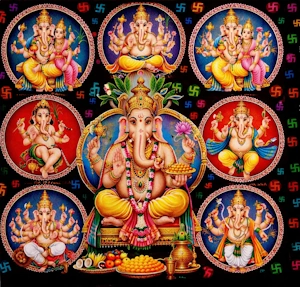
The eight avatars of Bhagavan Ganesha are divine responses to specific inner disturbances, showing how each can be corrected and brought into balance.
Scriptural Context
- This teaching comes from the Mudgala Purana.
- Each avatar appears to restore order when a particular imbalance grows.
- The focus is not on the demon alone, but on the method of correction.
The Eight Avatars — What They Address
Vakratunda — correcting jealousy
- Subdues Matsarasura
- Shows how comparison disturbs the mind
- Teaching: stay within one’s dharma with clarity
Ekadanta — correcting arrogance
- Subdues Madasura
- Reveals the danger of pride and excess
- Teaching: strength lies in restraint
Mahodara — correcting delusion
- Subdues Mohasura
- Addresses confusion and wrong understanding
- Teaching: develop the capacity to reflect calmly
Gajavaktra — correcting greed
- Subdues Lobhasura
- Shows how fear-driven desire expands endlessly
- Teaching: cultivate contentment
Lambodara — correcting anger
- Subdues Krodhasura
- Demonstrates control over intense reaction
- Teaching: hold and regulate, not react blindly
Vikata — correcting restless desire
- Subdues Kamasura
- Reveals the instability of unchecked wanting
- Teaching: establish inner steadiness
Vighnaraja — correcting attachment
- Subdues Mamasura
- Addresses possessiveness and ‘mine’-ness
- Teaching: engage without clinging
Dhumravarna — correcting ego
- Subdues Ahamkarasura
- Exposes ego as unstable and dependent
- Teaching: observe the sense of ‘I’ carefully
The Deeper View
- These disturbances are interconnected
- If one is not handled, it strengthens others
- The avatars show different ways of restoring balance
Ganesha’s form supports this understanding:
- The large belly represents the ability to contain and transform
- The calm expression shows steadiness under all conditions
Role of Puja and Worship
Puja is a continuous practice in Sanatana Dharma, not limited to one occasion.
It includes:
- Daily worship at home or temple
- Chanting, stotra, and remembrance
- Observances such as Ganesh Chaturthi
Its role:
- It steadies the mind
- It builds a living connection with Bhagavan
- It prepares the mind to receive and apply these teachings
Inner Discipline — Applying the Teaching
Along with worship:
- One observes how these disturbances arise in daily life
- One brings awareness before reaction
- One gradually reduces their influence
This is how the guidance of the avatars becomes practical.
How They Work Together
- Puja builds focus and devotion
- Inner discipline brings transformation
Both are necessary:
- Without puja, effort becomes dry
- Without inner work, understanding remains incomplete
Straight understanding
The avatars show how the mind can be brought back to balance.
Reflective thoughts
- In my daily life, where do I need correction the most right now?
- Can I connect one form of Ganesha with one change I want to make?
-
Question: Why does Bhagavan Ganesha take different forms instead of remaining in one form
Answer: Each form addresses a different kind of inner disturbance. The mind is not disturbed in one way alone. It shifts between jealousy, anger, pride, and confusion. A single approach does not correct all of them. The different forms show that correction must match the nature of the problem. This reflects a precise understanding of human psychology in the shastra. -
Question: Are these demons external beings or inner realities
Answer: Traditionally they are described as beings. But their deeper meaning is internal. They represent forces active within the mind. The teaching works at both levels. It preserves the narrative while guiding the seeker inward. This layered approach is a key strength of Sanatana Dharma. -
Question: Why are these disturbances shown as powerful asuras
Answer: Because they are powerful. These tendencies are not small habits. They can dominate thought, decision, and action. By presenting them as asuras, the shastra communicates their seriousness. It prevents the seeker from underestimating them. -
Question: What is the significance of Ganesha subduing rather than always destroying
Answer: Not all tendencies are to be eliminated completely. Some must be regulated and transformed. Anger can become strength. Desire can become motivation. The teaching is not suppression. It is mastery. This is why many asuras surrender instead of being destroyed. -
Question: Why is Ganesha’s form itself full of symbolism
Answer: Every part of his form teaches something. The large belly shows the ability to contain. The calm face shows steadiness. The broken tusk shows sacrifice. The form itself is a visual teaching. It allows even a simple devotee to absorb deep principles without study. -
Question: What is the hidden connection between all eight disturbances
Answer: They are interconnected. One feeds another. Jealousy leads to greed. Greed leads to anger. Anger strengthens ego. This chain is subtle and continuous. The avatars show that correction must be applied at multiple points, not just one. -
Question: Why is puja important in understanding these teachings
Answer: Puja prepares the mind. It creates focus, humility, and receptivity. Without this preparation, knowledge remains intellectual. Puja makes the mind steady enough to observe itself. It is not separate from understanding. It supports it. -
Question: What is the deeper meaning of creating and immersing the murti
Answer: The form is created to help the mind focus on Bhagavan. Through worship, the mind becomes refined. When the murti is immersed, the teaching is that the external support can be released once the inner connection is established. The process reflects internalization, not rejection. -
Question: Why is ego considered the final disturbance
Answer: Ego supports all others. Without ego, jealousy cannot arise. Without ego, pride cannot sustain. Ego creates the sense of separation. When it weakens, other disturbances lose their base. This is why Dhumravarna’s teaching is placed last. -
Question: What is the deeper greatness of this teaching
Answer: It integrates devotion, psychology, and discipline into one system. It does not separate spiritual life from daily life. Every reaction, every thought becomes part of sadhana. This completeness is what makes the teaching powerful and enduring.
-
Objection: These are just myths with no practical value
Reply: The narratives may appear symbolic, but the tendencies they describe are real. Jealousy, anger, greed, and ego are experienced daily. The teaching gives a structured way to understand and correct them. That is practical value. -
Objection: There is no proof that these avatars existed
Reply: The purpose of the teaching is not historical proof alone. It is transformation. Even if one sees the forms symbolically, the guidance remains valid. The effectiveness of the teaching can be tested through practice. -
Objection: Why use stories instead of direct instruction
Reply: Stories communicate at multiple levels. They reach both intellect and emotion. They remain memorable. Direct instruction may be forgotten. Stories stay and guide over time. -
Objection: This is just psychological interpretation added later
Reply: The inner meaning is built into the original structure. Each asura clearly represents a specific disturbance. The connection is not forced. It is intentional and consistent across the teaching. -
Objection: Rituals like puja are unnecessary
Reply: Rituals train the mind. They build discipline, focus, and humility. Without these, the mind remains scattered. Inner work becomes difficult. Ritual and reflection are meant to support each other. -
Objection: Why not simply follow ethical rules instead of such teachings
Reply: Rules tell what to do. They do not explain why the mind fails to follow them. This teaching addresses the root causes. It works at the level where behavior actually begins. -
Objection: These ideas belong to the past and are not relevant today
Reply: Human tendencies have not changed. Jealousy, anger, and ego are still present. The context may change, but the mind remains the same. The teaching stays relevant because it addresses the mind. -
Objection: This promotes suppression of natural emotions
Reply: The teaching does not promote suppression. It promotes understanding and control. Emotions are observed, regulated, and directed properly. This leads to clarity, not repression. -
Objection: There are too many concepts and forms, making it confusing
Reply: The diversity allows precision. Different disturbances require different approaches. The system provides clarity when studied patiently. It is not random complexity. -
Objection: Why depend on Bhagavan instead of self-effort
Reply: Both are required. Self-effort applies the teaching. Devotion to Bhagavan gives strength and steadiness. Together they make the process complete and sustainable.





English
Ganapathy
Click on any topic to open
7
30
Astrology
Bhagavad Gita
Bhagavatam
Bharat Matha
Devi
Devi Mahatmyam
Ganapathy
Garuda Puranam
Glory of Venkatesha
Hanuman
Kathopanishad
Mahabharatam
Mantra Shastra
Mystique
Practical Wisdom
Purana Stories
Radhe Radhe
Ramayana
Rare Topics
Rigveda Explained
Rituals
Sages and Saints
Shiva
Spiritual books
Sri Suktam
Story of Sri Yantra
Temples
Vedas
Vishnu Sahasranama
Yoga Vasishta
26
17
10
0


