Does Pinda Daan Really Reach the Departed?
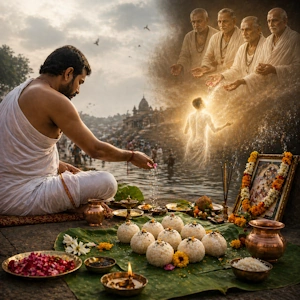
People perform Shraddha and Pinda Daan.
But most do not clearly understand what is actually happening.
They think it is symbolic.
They think it is tradition.
They think it is just respect for ancestors.
That is incomplete.
This is functional.
This is part of the post-death system.
When a person leaves the body and goes by the Pitruyana path, the journey is not smooth.
There is hunger.
There is thirst.
There is exhaustion.
Here is the important part.
The being does not carry a full physical body anymore.
It exists in a subtle state.
It no longer has a body made of flesh and bone.
It operates through a finer layer of existence.
It still has needs.
But it cannot meet them like a physical body can.
So how does it sustain?
This is where Shraddha and Pinda Daan come in.
The offerings made by the living directly support the departed.
Not emotionally.
Not symbolically.
Functionally.
The texts are very clear on this.
The rice-balls offered, the water given, the daan performed do not remain here.
They reach.
But not in the same gross form.
What reaches is the subtle essence.
Just like food becomes energy in your body, the offering becomes usable essence for the departed being.
That is why it is called nourishment.
Now understand something deeper.
This is not optional decoration.
This is part of the system that assists the being during the early stages after death.
Especially the first ten days.
During this period, something critical is happening.
The subtle body is stabilizing.
The texts describe that the Pinda offerings help in forming a new experiential body.
This happens day by day.
The first day supports formation of the head.
The second day supports the neck and shoulders.
Then the heart forms.
Then the back forms.
Then the navel forms.
Then the lower parts form.
Then the limbs form.
This is not anatomy in the physical sense.
This is a way of explaining gradual formation of a subtle vehicle through which the being continues its journey.
Each day of offering supports one stage of stabilization.
Without the full sequence, the vehicle remains incomplete.
Without this support, the being remains unstable.
It remains hungry.
It remains restless.
It remains unsettled.
Now comes a hard truth.
If Shraddha and Pinda Daan are not done properly or not done at all, the being does not receive proper nourishment.
It continues in a state of lack.
The texts say clearly that such beings wander.
They do not wander peacefully.
They remain in discomfort.
They remain in incompleteness.
Now understand something important.
This is not superstition.
This is system logic.
If a being is in transition and requires support, and that support is not provided, the condition remains unresolved.
Now another question comes.
If food is offered here, how does it reach there?
The answer is simple.
Do not think in gross terms.
You are not sending cooked rice through space.
What reaches is the subtle component.
The intention reaches.
The mantra reaches.
The ritual process reaches.
These act as a conversion mechanism.
They transform physical offering into subtle nourishment.
This is why method matters.
This is why correctness matters.
This is why casual performance does not give full effect.
Now one more detail.
The offering is not used entirely by the departed.
The texts say it is divided.
One part sustains the elements of the subtle body.
One part goes to the assisting forces in the journey.
One part supports the being directly.
This shows something precise.
The journey is not isolated.
There are roles.
There are mechanisms.
There is distribution.
This is a complete system with structure and participants.
Every part has a function.
Nothing is arbitrary.
Now understand the real value of this knowledge.
Shraddha is not about fear.
It is about responsibility.
The relationship with parents and ancestors does not end at death.
It continues in a different form.
During life, they supported you physically.
After death, you support them through ritual.
This is balance.
This is Dharma.
Now bring this to modern thinking.
Many people say what is the need.
They say we remember them in our heart.
They say that is enough.
Emotion is good.
But it is not the same as process.
Remembering someone is an internal feeling.
Performing Shraddha is an external action.
It produces a result in a specific system.
One does not replace the other.
If a system exists, it must be engaged properly.
Otherwise, results do not follow.
Now understand the core point.
Shraddha and Pinda Daan are not about pleasing the departed.
They are about sustaining them during a specific phase of transition.
Once that phase is complete, the nature of the relationship changes.
But during that phase, this support matters.
That is why the texts insist on it.
Not as blind ritual.
As structured assistance.
So the real question is not should it be done.
The real question is do you understand what you are doing when you do it.
When done with clarity, this is not ceremony.
It is intervention.
You are actively supporting a being through one of the most demanding phases of its journey.
Because when done with clarity, this is one of the most practical parts of Dharma.
Simple.
Direct.
Essential.
1
Question: What exactly is being transferred during Shraddha if the physical food does not travel
Answer: What moves is not the food but its subtle essence. The ritual, mantra, and intention act as a conversion system. Just as digestion turns food into energy, the offering is converted into a usable form for the departed.
2
Question: Why is the ten-day sequence treated as non-negotiable
Answer: Because the transition happens in stages. Each day supports one layer of stabilization. If the sequence is broken, the process remains incomplete. This is structured progression, not random repetition.
3
Question: If there is no physical body, why is there still hunger and thirst
Answer: These are not physical sensations. They reflect incompleteness in the subtle condition. Until the new form stabilizes, there is a continuous sense of lack. The offerings directly address that gap.
4
Question: Why is correct method emphasized more than emotional sincerity
Answer: Because this is a working system. Emotion creates connection but does not ensure transfer. Method ensures the process happens properly. Without correctness, the intended result weakens.
5
Question: What does the sharing of the offering between different forces indicate
Answer: It shows the journey is supported by a structured system. The departed is not isolated. There are assisting roles, and the offering is distributed accordingly. This reflects coordination, not belief.
1
Objection: This is only a cultural practice without real effect
Reply: Cultural practices do not need precision. This system defines timing, sequence, and outcome. That level of detail exists only when a process is expected to produce results.
2
Objection: There is no way food can reach someone who has died
Reply: It does not travel as food. It is transformed into subtle essence. Even in daily life, what is eaten becomes something else. The same principle is extended here through ritual.
3
Objection: Remembering ancestors with respect should be sufficient
Reply: Memory is internal. This process is external. Internal respect does not perform the function of supplying support. Both exist, but they are not interchangeable.
4
Objection: There is no scientific validation for this
Reply: Science measures what instruments can detect. Many aspects of human experience are not directly measurable but still real. This operates in a domain beyond physical instruments.
5
Objection: Many people ignore this and nothing seems to happen
Reply: Not all effects are visible or immediate. Some outcomes are subtle and unfold over time. Lack of visible disturbance does not mean absence of impact.





English
Garuda Puranam
Click on any topic to open
7
30
Astrology
Bhagavad Gita
Bhagavatam
Bharat Matha
Devi
Devi Mahatmyam
Ganapathy
Garuda Puranam
Glory of Venkatesha
Hanuman
Kathopanishad
Mahabharatam
Mantra Shastra
Mystique
Practical Wisdom
Purana Stories
Radhe Radhe
Ramayana
Rare Topics
Rigveda Explained
Rituals
Sages and Saints
Shiva
Spiritual books
Sri Suktam
Story of Sri Yantra
Temples
Vedas
Vishnu Sahasranama
Yoga Vasishta
26
17
10
0


