Lord Rama Undertook a Pilgrimage Once
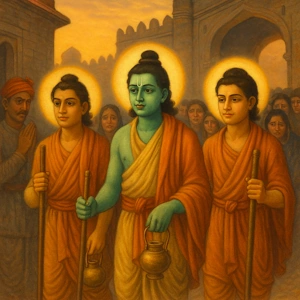
Lord Rama returned from Gurukula.
He started spending time at the palace.
People were happy under King Dasharatha.
The governance was well organized. People were healthy.
After some time, the Lord developed a desire to go on a pilgrimage. He wanted to visit holy teerthas and shrines all over Bharata Varsha.
He went to seek permission from King Dasharatha.
'I am eager to see holy places by the side of divine rivers, ashrams in sacred forests, temples. Please grant me permission.'
This was the first time ever the Lord asked for something from his father.
Dasharatha discussed with Kulaguru Vasishta and said ok.
For something as simple and routine as going on a pilgrimage, the king seeks advice. He doesn’t act like it is a matter between father and son or like 'I am the know all'.
A discussion takes place, whether it is appropriate to send Lord Rama or not, and with the Kula guru’s consent, the permission is given.
Why is this mention of pilgrimage? Only the less intellectual people roam around at places of pilgrimage looking out for something or the other — relief from papa, blessings.
Why should someone in search of knowledge do such things? He should turn inward, not outwards, he should look inside — that is what the shastra says.
The Lord clears this confusion by embarking upon a pilgrimage himself.
What are these for — pilgrimage, puja, yajna — they are all done for chitta shuddhi.
For cleansing of the mind. When done in the proper manner, in an ordained way, they give chitta shuddhi.
Removal of clutter from the mind.
In a mind which is a clutter, there cannot be jnanodaya.
The Lord is showing this to us.
Everyone has to go through these preparatory phases.
You can’t just drop from the sky in a parachute, pick up Brahma Sutra or Viveka Chudamani and try to understand what they say.
For that, chitta shuddhi is needed. And chitta shuddhi is attained by following the simple methodology of dharma — chant shlokas and stotras, go to temples, do puja, go on a pilgrimage, help someone, feed someone.
These are acts that help attain chitta shuddhi.
In fact, these are the only acts worth doing if you are in the jnana marga.
In fact, these are acts that you should essentially do if you want to be in the jnana marga.
These are prerequisites for being in the jnana marga.
This is what the Lord is showing us here. The whole line of topmost philosophers and scholars and sages are available — none other than Vasishta is sitting there, right in front of him, available 24 x 7.
The Lord has completed Gurukula education. But he is not sitting through scholarly sadas. He is not putting up tricky questions to them and seeking answers.
He says, 'I want to go on a pilgrimage. I want to visit temples, do puja, take bath in holy rivers.'
Not calling scholars for debates and discussions.
Isn’t it obvious?
यन्मायावशवर्त्ति विश्वमखिलं ब्रह्मादि देवासुरा
यत्सत्त्वादमृषेव भाति सकलं रज्जौ यथाऽहेर्भ्रमः ।
यत्पादप्लव एक एव हि भवाम्भोधेस्तितीर्षावतां
वन्देऽहं तमशेषकारणपरं रामाख्यमीशं हरिम् ॥
This maya which is his own creation — everybody is under its influence, even Brahma, devas, asuras, everyone.
यन्मायावशवर्त्ति विश्वमखिलं ब्रह्मादि देवासुरा
He also knows that.
His lotus feet alone can give release from that maya.
यत्पादप्लव एक एव हि भवाम्भोधेस्तितीर्षावतां
He also knows that.
Still, he goes on a pilgrimage.
This is what Yoga Vasishta does.
The Lord shows us by his own example how to live life.
How to live life in its multifaceted, many many different aspects.
He did the pilgrimage, went far and wide.
There was a seeing-off when he went, there was a royal welcome when he came back.
Lakshmana and Shatrughna went with him.
Bharata was at his maternal grandfather’s place.
-
Rama, though fully trained and surrounded by scholars, chose to begin his journey with a pilgrimage — proving inner purification comes before intellectual exploration.
-
He asked for permission from his father and guru, showing that even spiritual acts must follow the path of humility and dharma.
-
Pilgrimage, puja, and yajna are not for the weak-minded; they are intentional methods to cleanse the mind.
-
Chitta shuddhi (mental purity) is the foundation for real jnana (knowledge); without it, the mind remains unfit to receive truth.
-
Rama's choice teaches that no one is exempt from the basics — discipline, humility, and preparatory practice are essential for true spiritual growth.
-
Simple acts like chanting, visiting temples, helping others, and doing puja train the mind to drop ego and emotional clutter.
-
A mind full of inner noise cannot support jnanodaya — the awakening of higher wisdom.
-
Even highly evolved beings demonstrate rituals and pilgrimage to guide humanity by example, not to fulfill personal need.
Why did Rama choose pilgrimage over scholarly discussion?
Because self-purification comes before scriptural study. A clean and calm mind is the first qualification for absorbing spiritual truth.
Isn't it more efficient to go straight to scriptural learning after Gurukula?
Not really. Without purifying distractions, even great teachings won’t land. Stillness prepares the mind to grasp subtle truths.
Isn’t this just delaying learning in the name of 'readiness'?
No. It’s like tuning an instrument before a concert. Jumping in without preparation leads to misunderstanding and ego traps.
Why did Rama seek permission from his father and guru?
Because spiritual maturity includes humility. Even personal vows must pass through the lens of dharma and respect.
Can’t a grown, capable seeker act independently in spiritual matters?
Dharma is not just about results — it's about process. Seeking counsel shows accountability and shrinks the ego.
Is this overdoing formality for a personal spiritual choice?
Not at all. This guards against impulsiveness. Even noble intentions need the grounding of tradition.
How does pilgrimage help the mind?
It shifts the mind from self-centeredness to sacredness. The physical effort, symbolic acts, and exposure to holy spaces soften the inner being.
Can rituals and travel really affect the inner world?
Yes. Actions shape impressions. Repeated sacred experiences wear down the inner clutter gently and steadily.
Isn’t this blind belief — thinking travel and rituals fix the mind?
No. It’s subtle conditioning. Done with awareness, they rewire the mind to drop selfish patterns.
Why is chitta shuddhi essential before gaining knowledge?
Because a cluttered mind distorts even true knowledge. Purity allows clear perception and deeper insight.
What if someone is naturally sharp and intelligent?
Sharpness isn’t enough. Without purity, intelligence becomes pride, and pride blocks understanding.
Isn’t this undervaluing intellect?
Not at all. It respects intellect enough to protect it — by ensuring the mind that holds it is stable and humble.
Why are simple dharmic acts like puja and seva part of the path to jnana?
Because they make the ego bend. These acts make the heart lighter and the mind quieter.
Aren’t these things too basic for a seeker of truth?
They’re basic, yes — like breathing. But they are essential. Without them, one stays trapped in selfishness.
Isn’t it better to meditate than to chant or visit temples?
Meditation without preparation becomes frustration. These acts are the soil in which meditation can grow.
What blocks the awakening of wisdom?
Inner clutter — emotions, pride, attachments, impulses. If these remain, even good ideas can’t settle in.
Can’t strong focus or concentration overcome that?
No. That only suppresses noise. True clarity comes by slowly removing the cause of that noise.
Isn’t purification a long, indirect path?
It’s direct in its own way. Real purity transforms how we perceive, not just what we know.
Why did Rama perform acts like pilgrimage despite being spiritually advanced?
To demonstrate the correct sequence and mindset. Even great souls don’t bypass the basics.
Doesn’t he already know everything?
Yes — but he teaches by living it. His path is instruction through example, not just words.
Shouldn’t evolved souls meditate instead of doing rituals?
That’s pride talking. Real evolution embraces all dharmic acts with reverence, not arrogance.





English
Yoga Vasishta
Click on any topic to open
7
30
Astrology
Bhagavad Gita
Bhagavatam
Bharat Matha
Devi
Devi Mahatmyam
Ganapathy
Garuda Puranam
Glory of Venkatesha
Hanuman
Kathopanishad
Mahabharatam
Mantra Shastra
Mystique
Practical Wisdom
Purana Stories
Radhe Radhe
Ramayana
Rare Topics
Rigveda Explained
Rituals
Sages and Saints
Shiva
Spiritual books
Sri Suktam
Story of Sri Yantra
Temples
Vedas
Vishnu Sahasranama
Yoga Vasishta
26
17
10
0


