Importance of Salagrama
माधवः – मायाः धवः – MAA means Lakshmi, her dhavaha, her husband.
मधिविद्यावबोध्यत्वात् माधवः – Madhuvidya is a scheme of upasana in Vedanta which is kept very secretive and imparted to the most deserving. That knowledge is Sri Hari. Hence he is Madhava connected to Madhu.
मौनाद्ध्यानाच्च योगाच्च विद्धि भारत माधवम्
Through silence and meditation that is yoga, know him.
Maunam ma
Dyanam dha
Viddhi va
Ma dha va
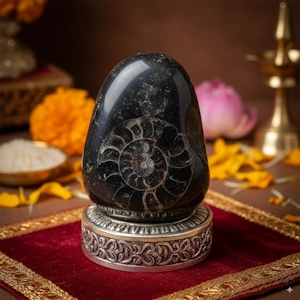
Do you know about the greatness of Salagrama or Shalagrama? Salagramas are stones found in Gandaki river in Nepal with markings of chakra, the Sudarshana chakra carved into it. Not just chakra, there could be other markings also, like gada, lotus, hoof of cow. They have living presence of Sri Hari in them. And they are one of the most auspicious items in Vaishnava worship.
गण्डक्युद्भववज्रकीटकृतचक्रयुक्तशिला द्वारकोद्भव- तादृशशिला च ।
Not just from Gandaki, Salagramas are also found in Dwaraka at the mouth of Gomti river. They are particularly called Dwaravati shilas. Primarily, Salagramas are from Gandaki in Nepal. Elsewhere it is mentioned that this Gomti is a branch of Gandaki itself.
You must know about the past births of Tulasi Devi. She was a gopika in Goloka. Her name was Viraja. Due to her intimacy with Krishna, too much of intimacy, Radha Rani sent her down to earth, to take birth on earth. There was a gopa in Goloka called Sudama. He had developed a liking for Tulasi. So Radha Devi sent him also down as an asura called Shankhachuda. Down on earth they both married.
Both Sudama and Tulasi are called amshas of Sri Hari himself. They are not different from him. This concept should go into your mind. Nothing is apart from him, different from him. When we say, devas, asuras, manushyas, they are all amshas of him. Nothing can be other than him because he himself is the universe.
So, when devas and asuras fight each other, we become judgemental and say that devas are good people and asuras are bad people. It is, in fact, different amshas of Sri Hari himself playing out there. So do not become very hard and harsh. Who is good and who is bad, it does not have more relevance than what happens in a movie script. The hero and the villain on the screen. Are they for real? No.
So, here Shankhachuda and Tulasi who took birth on earth are both amshas of Sri Hari only. Shankhachuda started troubling the devas and he defeated them. They started roaming around like beggars. They went to Brahma, Brahma took them to Mahadeva, and they all together went to Vaikuntha. They told Sri Hari what has happened.
Sri Hari told them two things. Shankhachuda can be destroyed only by Lord Shiva. But he is protected by a kavacha of Sri Hari and also the power of pativratya of his wife. He can be killed only if these two go.
Lord Shiva went down and initially made a diplomatic effort to convince Shankhachuda to return Swarga to devas. He did not listen for his own reasons. It was not arrogance. In fact, the conversation between Lord Shiva and Shankhachuda is very interesting. Shankhachuda was a parama bhakta of Sri Hari and had great respect for Lord Shiva. Still, the battle started.
Sri Hari came disguised as an old man and asked for the kavacha, which Shankhachuda gave to him. This is another thing. Those days when someone comes and asks for something, especially a noble person, you do not refuse. See what happened to Bali, what happened to Karna. They all gave away their most valuable possessions just because someone came and asked for it, just because somebody asked for it. It was so natural to them. He asked for it. How can I refuse? Refusal was not in their book.
So, Shankhachuda’s protective armour was gone. And while Shankhachuda was still in the battlefield fighting, Sri Hari disguised himself as Shankhachuda and approached Tulasi Devi. Tulasi Devi herself was a parama bhakta of Sri Hari, in fact his own amsha. Tulasi was happy to see her husband back. They spent intimate time together. She lost her pativratya thus. And there Lord Shiva killed Shankhachuda.
But sadhwi Tulasi Devi soon realized that there was something wrong. This is not my husband. She was about to curse. Sri Hari showed her his real form. But still she cursed. She cursed Sri Hari. How can you be so callous, so stone-hearted. You become a stone.
Sri Hari explained to her. You both, you and your husband, have done enough tapasya. Now this is sufficient. It is time for you to leave this body behind. Your body will become a river, called Gandaki. Your hair will become plants called by your own name, Tulasi plants. You will be the most auspicious among all flowers used in puja. Wherever you, in the form of Tulasi plants, are found, in all the worlds, they will be the most sacred and auspicious places. And in your form as Gandaki nadi, you will be the adhisthatru devi of all punya nadis.
And my own amsha Lavana Samudra. Lavana Samudra means the regular sea that we see. There are other kinds of samudras also, like the milky ocean, samudra made up of sugar cane juice. Gandaki nadi will be the wife of Lavana Samudra. But at the same time you will be with me ever in Vaikuntha as my wife, always.
And here on earth, I will always be with you in Gandaki nadi as stones, in the form of stones, and there a kind of worms with teeth as sharp as diamonds will go on engraving the sign of my chakra on these stones, thus marking them as sacred stones with my living presence in them. These stones will be of different kinds, some with many chakras, some with other kinds of markings with which it can be made out which form of mine is present in that particular stone.
Wherever a Shalagrama is there, my presence along with Lakshmi will be there. Any noble act performed in the presence of Shalagrama, such as vrata, snana, pratishta, puja, will be considered as the most auspicious and will yield manifold results. If you do abhisheka of Salagrama every day with water, it is like you have acquired the punya of all kinds of danas. If you drink this abhisheka teertha every day, all the punya nadis will want to come and touch you; you will be so pure. All kinds of troubles, they will run away from such a person.
Do you know who is the most favourite devotee of Sri Hari? Someone who would keep Salagrama, shankha, and Tulasi together. Do you see the connection?
-
How do I bring the presence of the Lord into a small city home without elaborate rituals?
Keep a clean shelf with a small image or stone symbol, light a lamp, and chant 12 names from Vishnu Sahasranama daily. Consistency beats grandeur. The room’s mood shifts within a week when the sound is steady. -
What if I struggle to focus while chanting?
Use breath-coupled japa: inhale ‘Om’, exhale one name like ‘Narayana’. Do this for 12 breaths, then continue normally. The breath becomes your metronome; mind slips into rhythm. -
Can chanting genuinely reduce anxiety and overthinking?
Yes. Fix a count — 54 or 108 — and a time — same slot daily. Predictable repetition lowers cognitive noise. By week two, you notice fewer mental loops and faster recovery from stress spikes. -
How do I connect chanting to real-world decisions?
Before a major call or meeting, chant 8 names clearly, then write one line: ‘What is the right next step?’ The name softens ego-noise, the line anchors action. Do, review, refine. -
I feel unworthy. Will my chanting still work?
It will. Names are power sources, not rewards. Show up with whatever you have — tired, doubtful, imperfect — and keep the count. Grace follows perseverance, not self-image. -
Can we make family time around chanting without making it heavy?
Yes. Pick a 7-minute window after dinner. Sit in a circle, one person leads 10 names, others repeat. End with silent thanks. Families that chant together argue less and reconcile faster. -
What is a compact routine for busy days?
Morning: 3 minutes of Sahasranama — choose 12 names.
Commute: silent japa, one name per 4 steps.
Night: 1 mala of ‘Om Namo Narayanaya’ in bed. -
How do I use chanting to steady sleep?
Keep a small counter or mala by the pillow. Slow nasal breathing, 54 repetitions of one chosen name. The brain learns to associate that sound with ‘power down’. -
I read about various divine forms — how do I benefit without studying everything?
Set a simple intent: ‘You who are beyond, within, and before me — guide my mind and work today.’ Then chant your set. Intention focuses the current; names carry it. -
What if my mind wanders and guilt kicks in?
Don’t wrestle the mind. Note the drift, return to the next bead and next name. Put a tiny dot in a notebook for each completed round. Tracking turns guilt into momentum. -
Can nama japa support physical health respectfully?
Pair a 15-minute walk with soft japa. Steps become beads. Sunlight, motion, and gentle sound lower tension, improve mood, and regulate breath. No phones. Let the name lead the pace. -
How do I bring the practice into a high-pressure office day?
Micro-pauses: on every hour, one deep breath and one name — ‘Vasudeva’. It resets posture, breath, and tone before the next task. Ten such resets change the feel of an entire day. -
We have friction at home. Can chanting help before tough talks?
Agree on one shared mala in the same room, then speak. The shared rhythm softens voices and turns debate into problem-solving. Add a rule: no conclusions until the mala is done. -
I want to feel devotion, not just do a drill. How?
Offer each round to someone specific — an elder, spouse, child, colleague. ‘May this name bring them clarity and strength.’ Personal offering warms the heart. -
Is there a weekly plan that actually builds depth?
Week plan:
Mon–Wed: learn 12 new names, chant each 3 times.
Thu–Fri: review earlier names, slow and clear.
Sat: 3 malas of one favorite name.
Sun: sit 5 minutes after chanting, eyes closed, let the echo settle. -
How do I use chanting during pain or medical procedures?
Choose one name beforehand — ‘Narayana’. Exhale the name slowly through the mouth while the procedure happens. Hold a bead in the palm to anchor attention. Pain feels less sharp when the breath-name loop is steady. -
What should I measure to know it is working?
Track four things weekly: minutes chanted, names learned, days continuous, one behavior shift (fewer snaps, better sleep onset, calmer meetings). Small, visible gains keep the engine running. -
I keep forgetting to chant. Any simple cue?
Doorway rule: every time you enter or leave a room, repeat one name once. These tiny repetitions seed the day with remembrance. -
How do I close a session with respect?
End with: ‘Let this merit support clarity, compassion, and right action for all.’ Bow the head, rest the beads on the forehead, take three quiet breaths. Then carry the steadiness into the next task.





English
Vishnu Sahasranama
Click on any topic to open
19


